The hauntingly beautiful common loon, horned grebe and another diver, red-breasted merganser, have been spotted lately on Blackwell Forest Preserve’s Silver Lake, based on photos shared on eBird.
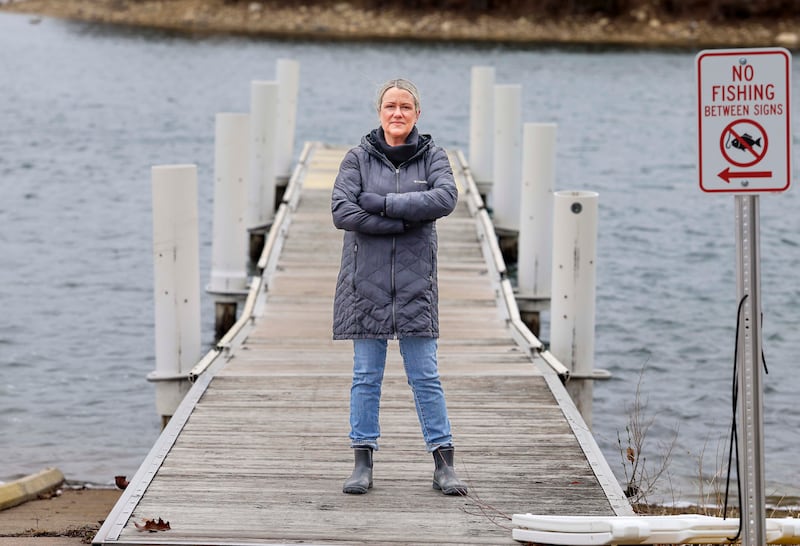
Amy Tavolino can often be found there, as well, making her way around the shore. A volunteer for the Chicago Bird Collision Monitors, the Wheaton resident takes it upon herself to pick up fishing litter, and she’s dedicated herself to that cause for more than a decade.
“Respect the preserves. You’re a visitor. There’s a lot of animals that call this place their home. And please clean up even if it’s not yours. Please just clean up anything you see laying around, if it’s in branches or trees, because you will save a life,” Tavolino said. “You will, and any bit helps.”
Her message is especially timely: The Illinois spring trout fishing season opened Saturday at some 60 ponds, lakes and streams throughout the state. In DuPage County, anglers descended on a freshly stocked Silver Lake, Pickerel Lake in Pratt’s Wayne Woods and Grove Lake in Wood Dale Grove.
:quality(70)/cloudfront-us-east-1.images.arcpublishing.com/shawmedia/RJZXNT4HBJGS7OBNNOWDHGMVXU.jpg)
“It connects people to nature, and it’s a great thing. It is — if it’s done responsibly,” Tavolino said.
She doesn’t shy away from the gruesome injuries caused by fishing gear. Tavolino always has a crate in her car and, her husband, Jerry, does too, so they can rescue animals and bring them to the district’s wildlife hospital in Glen Ellyn.
“It takes hundreds of years for monofilament line to break down, and it is very strong, not breaking in cases of entanglement,” she said via email. “It can get tangled up in vegetation, wrapped around wildlife, and pollutes natural areas. Hooks and lures may be swallowed or attach to wildlife in a way that causes injury or death.”
Some of the most significant injuries to wildlife can occur when a line wraps tightly around a body part, Touzalin said.
“With time, this can cut off circulation, cause extreme swelling, deep lacerations, and even amputation. Hooks that are swallowed must be surgically removed, and hooks or lures attached to the body can cause severe wounds and infection,” she said.
:quality(70)/cloudfront-us-east-1.images.arcpublishing.com/shawmedia/D6NAADQMJVHCNNEPICHIJM6USU.jpg)
The Lake County Forest Preserve District has monofilament recycling stations at heavily trafficked access points, such as boat launches and fishing piers, Nick Huber, a restoration ecologist, said.
“Fishing line, hooks, lures, and sinkers are non-biodegradable materials that will persist in the environment indefinitely,” he noted via email.
The Kane County Forest Preserve District provides receptacles where fishing line can be discarded at many of its preserves where fishing is popular, Wildlife Biologist William Graser said. Oftentimes, it’s Canada geese that get fishing line wrapped around their legs.
“When the animals can be captured, they are taken for treatment, but capturing them is often difficult,” Graser said in an email. “That’s why it is important that we work on the prevention side of things.”
The DuPage forest preserve district has shared Facebook posts about proper disposal and regularly incorporates that message into communications about fishing events, including the trout season opener, Community Engagement Director Anamari Dorgan noted.
The district also created a humorous video in which a man gets a second chance after littering. The video, posted with the hashtag #DontBeThatGuy, has received more than 9,000 views on YouTube. It advises anglers to cut line into 6-inch segments before throwing it away because animals can still get into the trash or a dumpster.
Anglers can also put their line in recycling tubes in some DuPage preserves. The district has removed or plans to remove other containers, but only certain ones located where trash cans are also present.
:quality(70)/cloudfront-us-east-1.images.arcpublishing.com/shawmedia/LSRLOY52EVHFTGKRBQQMAXNCKA.jpg)
“What we found was that some people were using the receptacles for general trash disposal, which caused the fishing line to become tangled with other waste and prevented it from being recycled,” Dorgan explained via email.
From what he sees, most people who enjoy fishing do so in a responsible manner. Line can end up in the environment accidentally when hooks and lures become snagged on rocks and tree branches.
“If you see fishing line, or other trash that can harm wildlife, pick it up for proper disposal, even if someone else left it there,” he said.
‘Litter hurts’
Tavolino spends at least an hour each day in the summer cleaning up fishing line and hooks, focusing on Herrick Lake and Blackwell. She tries to get to Pratt’s Wayne Woods once a week.
She and her husband filled a plastic bin with clumps of line, along with hooks and bobbers, from the three preserves last summer.
Tavolino said she’s been picking up after anglers for about 14 years.
“I belong around nature and wildlife. It’s so important to me,” said Tavolino, whose mother was a volunteer at what was then called the Willowbrook Wildlife Center.
There’s a “Litter hurts” sign posted near Silver Lake’s boat launch. Tavolino wants to see more signage.
:quality(70)/cloudfront-us-east-1.images.arcpublishing.com/shawmedia/W2P5JYVYLBDKBE4ERPCH3OTYQA.jpg)
“I’ve talked to people fishing before, ‘Can you please clean up?’ And there’s a lot of good people out there that say, ‘Yeah, I do all the time,’” she said. “And there are those that, they don’t care. So it’s hard to reach people, sometimes, but got to keep doing it.”
“The pain that they endure from these injuries is just terrible,” she said.
Injury or death
The DuPage Wildlife Conservation Center addresses the issue in a new exhibit hall. There’s a display about the hazards posed to wildlife, and with an X-ray box, you can view images of past patients. Fishing line or other equipment that is improperly discarded is dangerous to many species, said Stephanie Touzalin, wildlife education supervisor.
https://www.dailyherald.com/20260405/news/please-clean-up-volunteer-warns-of-harm-done-by-fishing-litter/