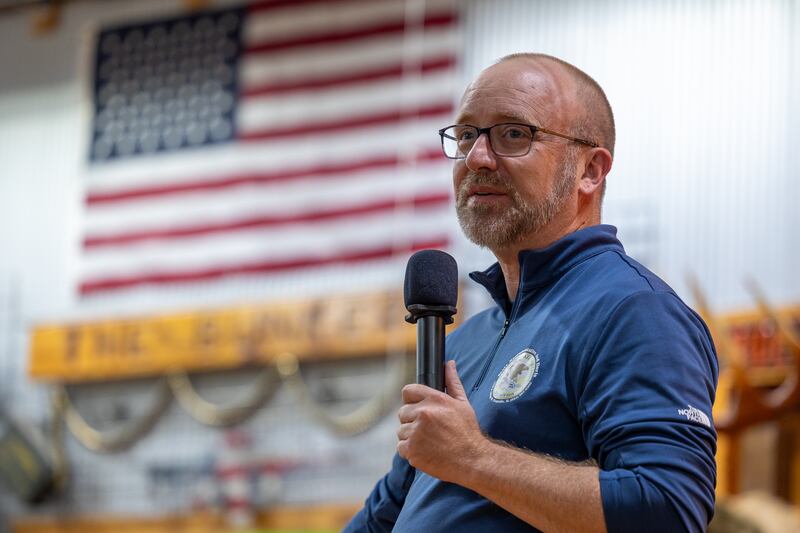
With all the noise being generated by data centers lately, one state representative is trying to ensure the most crucial voice is not being drowned out – the local residents.
State Rep. Jed Davis, R- Yorkville, introduced legislation that has not advanced in Springfield, but he said his proposal of public referendums before city data center approval must enter the statewide conversation.
Davis’ proposal, House Bill 5755, has been part of the General Assembly’s recent focus on data center regulation. That focus also includes the larger House Bill 5513, the POWER Act, which will likely be the main data center bill for future floor debates. The POWER Act currently only has Democratic sponsors.
The POWER Act, which is currently stalled but has sizable support, would establish comprehensive environmental, water and energy regulations for hyper-scale data centers. The bill requires cumulative impact assessments on residential and small business utility bills, and prohibits nondisclosure agreements between developers and municipalities.
It also mandates periodical water usage reporting and requires compliance with stringent energy codes.
The bill would also create a compensation fund for local residents and small businesses negatively impacted by an incoming data center.
Davis said while it’s nice the bill requires public notice, it does not go far enough to ensure residents and local communities have the ultimate say regarding data centers.
Davis was also skeptical that state regulatory mandates would achieve the transparency, environmental and health goals that residents at city meetings across the region have demanded.
He said one thing is for certain, the vast majority of residents he was elected to represent are opposed to local data center construction. Their opposition has been in the face of the city of Yorkville green-lighting three large data center campuses, including the 1,034-acre Project Cardinal, the 540-acre Project Steel, and the 228-acre CyrusOne data center campus.
All together, 39 data center warehouses would be constructed in Yorkville across the three projects at full build-out over the next 10-20 years of construction.
:quality(70)/cloudfront-us-east-1.images.arcpublishing.com/shawmedia/4XYH7GBL3NGRZOG6QBKX7FLPNU.png)
Residents have filed lawsuits to halt Project Cardinal and separately against Project Steel.
The approval for each project in Yorkville came after hours and hours of public comments during City Council meetings with residents denouncing the data centers and accusing the city of “selling out” its residents for revenue promised for the city and schools.
Residents expressed concerns of possible sound, light and environmental pollution, diminished quality of life and property values.
Davis said a poll he conducted with residents within Yorkville School District 115 came back with almost 90% of residents opposing data centers in town, regardless of the significant tax revenues they could generate.
Davis said that “eye-opening” result led him to draw-up a bill proposing a public referendum enabling residents to get the final say on data center construction if 15% or more of recent voters sign a petition.
“I’ve always been a huge proponent of local control,” Davis said. “We really want them to have the final say because they have a better pulse on the community. The people I represent kind of felt like they didn’t have a voice anymore. They’ve been very vocal on the data center issue, strongly opposed in several ways. I am trying to return the power back to their hands.”
Davis said he hopes other legislators can look to his bill when considering how to formulate the larger data center bill that will eventually be passed. In a similar light, Davis said he earlier filed legislation to compensate people and small businesses “who are going to lose property value due to data centers moving in.”
Davis said if the larger bills contains unfunded state mandates, it will likely lose Republican support. He said including the voice of local communities is a great way to create bipartisan momentum.
While his bill is not designed to stop development, Davis said some communities may ultimately welcome a data center, the proposed process provides greater transparency and builds greater trust between residents and their local elected officials.
“For something with this level of impact, on infrastructure and quality of life, residents deserve more than a meeting – they deserve a vote,” Davis said.
:quality(70)/s3.amazonaws.com/arc-authors/shawmedia/0cef0bf9-a04e-4bb4-aea0-03d8ced01c00.jpg)