Do you have old peonies? My peonies have been passed down through five generations: great-grandmother to grandmother, to mother, to me, to my daughter. They are called legacy or heritage peonies: plants that have a family history, possibly moved from family farms to homes, preserving a legacy.
Your peonies and mine may also be what are called Heirloom Peonies. Mine is “Lady Anna” (word of mouth, no DNA), introduced by the French in 1856. Two other popular Heirloom varieties are “Sarah Bernhardt” and “Duchesse de Nemours.”
These are cultivars that can live for more than 100 years! They are fragrant, reliable and tough.
Before my great-grandmother procured her long-lived peonies, they had already logged an impressive history.
Peonies get their start
Sometime before the 11th century, Chinese breeders domesticated wild peonies, including tree peonies, and bred herbaceous peonies, those we now know as garden peonies. The breeding was not so much for their beauty and fragrance, but for the medicinal properties of their roots. Various medicines have been made from peony roots for more than 2000 years to treat inflammation, high blood pressure and epilepsy.
Then, herbaceous peonies, which we recognize as common garden peonies, gained popularity in China, for their beauty and fragrance. Tree peonies were popular in the arts, and became a symbol of status and nobility. Chinese breeders created unique peonies, and by the 16th century, there were more than 30 named cultivars.
On the road and over the seas
Herbaceous peonies were imported to Europe in the early 1800s. The French were the most interested, seeing their value as ornamentals. Interest spread throughout Europe, northeastern America, then on to the prairie states and Canada by 1850.
By 1950 there were over 90 registered peony breeders in North America! Now, in North America, you can find herbaceous peonies, tree peonies and hybrids of the two. The common garden herbaceous peony, Paeonia lactiflora, is available in a number of flower forms and colors.
These days DNA testing is available to verify your cultivar.
And one myth I’d like to bust.
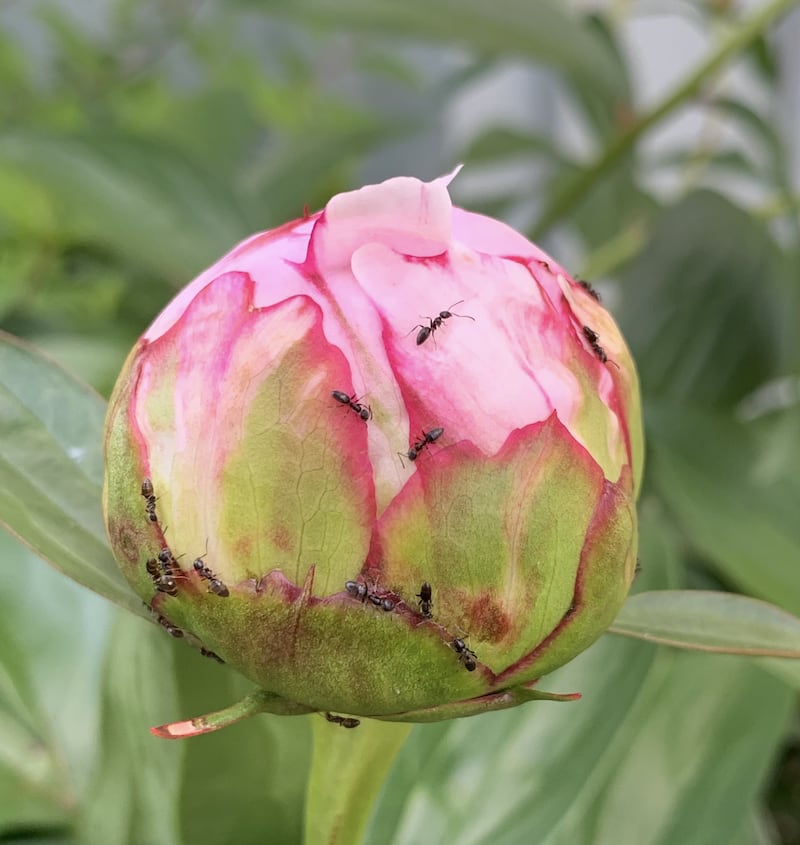
When your peony buds are good sized, look a little closer. You will most likely see ants crawling on them. Have you ever heard that “Ants help the buds open.” While this isn’t quite true, it is an example of mutualism, a relationship between a plant and insect where both enjoy benefits.
The buds have a sticky, sweet substance on them, which the ants eat. The presence of the ants discourages pests, like aphids, that might harm the peony. So, everybody wins!
For more about peonies, visit any of these sources:
- About Peonies. The American Peony Society. https://americanpeonysociety,org o
- The Beloved Peony. https://extension.psu.edu/the-beloved-peony
- It’s Peony Time! https://extension.illinois.edu/blogs/good-growing/2019-04-30-its-peony-time o Peony History. https://mbgna.umich.edu/peony-history
• Kay Truemper is a certified master gardener and master naturalist volunteer with University of Illinois Extension serving DuPage, Kane and Kendall counties.