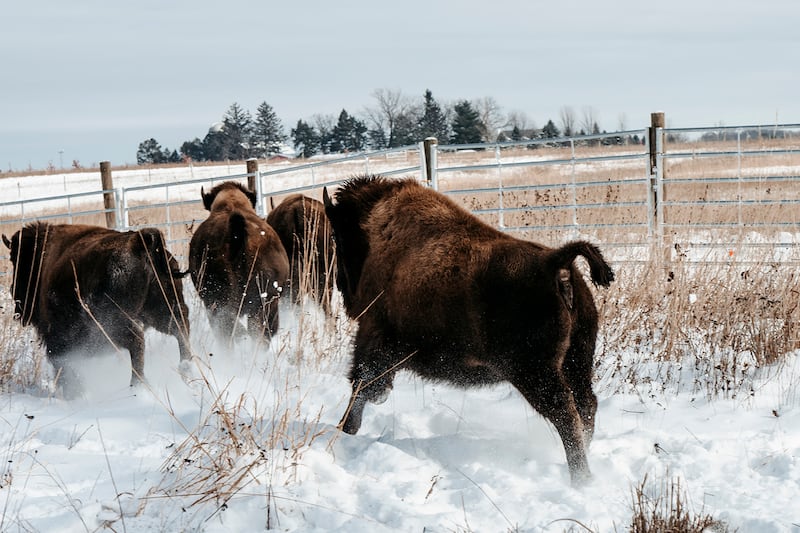
After returning bison to a Kane County native prairie for the first time in more than 200 years, the forest preserve is offering a sneak-peek for viewers to get up-close – just not too close.
Much like the bison which can thunder across the prairie at 40 mph, tickets to sneak-peek events went fast, really fast.
While you can still join a waitlist, you may have to wait until April, when the gates at Burlington Prairie Forest Preserve near Sycamore are reopening to the public.
The extra months give the herd of bison time to acclimate to their new environment.
For some lucky few, the Forest Preserve District of Kane County is hosting “Bison: Early Admission,” a series of naturalist-guided programs in March. The programs are open to those 18-and-above. Dates for the one-hour programs, at select times, are on March 15, 17, 24, 29, 31.
Though events are full, you can join the waitlist at kaneforest.com/register.
:quality(70)/cloudfront-us-east-1.images.arcpublishing.com/shawmedia/RGDMO4EY35EPNJ7M4VAF2JONCU.jpg)
The programs provide an “up-close look at bison, prairie ecology, and the ongoing restoration efforts at Burlington Prairie Forest Preserve.”
After the initial events sold out fast, forest preserve district officials said they are also offering naturalist-guided bison programming in the summer.
The forest preserve called the reintroduction of bison to their native tallgrass prairie ecosystem in the county a momentous occasion worth celebrating. Bison first explored their new home on Dec. 5.
Before the bison made claim to their new prairie habitat, the American Indian Center of Chicago, which owns the herd, held a ceremonial blessing of the land.
Herds of bison were eradicated from the Prairie State by human destruction of the tallgrass prairie and overhunting. The last recorded native bison in Illinois was humbled by a hunter’s gun in 1837.
The tall grasses nearly followed the bison’s fate, with less than one-tenth of 1% of the ecosystem surviving the conversion of the prairie to farmland and developments.
The uprooting of the prairie, beginning during the industrial revolution, eroded the unique soil microbiome that took thousands of years to form beneath the bison’s hooves. Countless plant and animal species intertwined with the ecosystem vanished with the bison.
With the help of conservation agencies, often seeding by hand, flowers like white wild indigo, blazing stars and pale purple coneflowers are once again blooming from the protected prairie soil.
The AIC is further partnering with the forest preserve district to create educational programming so the public to learn from the bison and the ecosystem they help sustain. A program is being launched this spring where community scientists can help monitor prairie health, track changes over time and help take care of the vital ecosystem.
:quality(70)/s3.amazonaws.com/arc-authors/shawmedia/0cef0bf9-a04e-4bb4-aea0-03d8ced01c00.jpg)