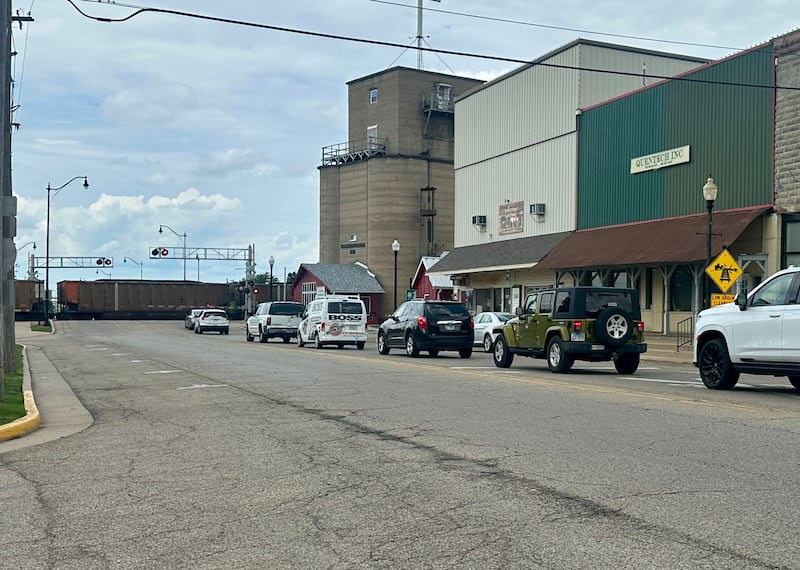
A nationwide issue touched down in the Illinois Valley last month when a stopped freight train stood still in Mendota for close to four hours, halting traffic, disrupting travel and tying up law enforcement.
The stopped train belonged to the Burlington Northern Santa Fe Railway Company, one of the most prevalent freight companies in the country and a fixture in northern Illinois.
The May 28 stoppage is the most recent and local instance of freight trains wreaking havoc on motorists, but it is far from an isolated occasion.
“BNSF trains operate 24 hours a day, seven days a week. We do our best to limit the amount of time any crossing is blocked,” BNSF spokesperson Kendall Sloan said in response to the Mendota incident.
“Our business and our customers depend on BNSF to keep our trains moving,” Sloan said. “When our trains experience a situation that forces them to stop, BNSF works to correct or resolve the situation as quickly as possible to resume the safe movement of trains.”
Even with the commitment to improving responses to stoppages and delays, local emergency response groups have experienced problems working effectively around them.
Mendota Fire Chief Dennis Rutishauser said that whenever trains are stopped, all downtown crossings are blocked “for a considerable amount of time”, and the closest alternative route through the Fourth Avenue viaduct is inaccessible for the department’s larger trucks.
Rutishauser also said that alerting dispatch can only help so much with stopped trains, given the regulations in place.
“Even though the State of Illinois states maximum time for blocking crossings is 10 minutes, the railroad operates under federal regulations, which do not give time limits,” he said.
Other area municipalities’ fire and police departments’ concerns are similar: blocked crossings delay response times when every second matters.
Ottawa Fire Chief Brian Bressner said his department has noticed freight traffic has become more disruptive as trains have grown longer in recent years.
:quality(70)/cloudfront-us-east-1.images.arcpublishing.com/shawmedia/PWEY7QPBXVDGTITNMVSBF75NTI.jpg)
“As train lengths have increased in recent years, the challenges associated with blocked crossings have become more noticeable and can have a direct impact on emergency response operations,” Bressner said.
So, have freight trains gotten longer? According to a U.S. Government Accountability Office report, the average freight train lengths at two major railroads increased by about 25% between 2008 and 2017, and all seven Class 1 railroads reported longer than average trains – some stretching nearly 3 miles.
Despite having contingency routes in place, each department agrees that even small detours can be critical in emergencies.
“Seconds matter when responding to violent crimes in progress or car accidents with injuries,” Ottawa Deputy Chief Kyle Booras said.
“Fire can sometimes quadruple in size every minute,” Princeton Fire Chief Scott Etheridge said, noting that EMS response delays can significantly reduce survivability in cardiac arrest cases. He also said rerouting around crossings can add miles and minutes during calls.
In Streator, Police Chief Robert Wood preached a similar sentiment, explaining freight trains “definitely impact response times,” although the city’s viaduct and underpasses provide some alternate routes.
“It can still cause delays in service depending on where the call is,” Wood said. “When tracks are blocked for a longer period of time, officers are made aware of this through dispatch, which allows for better planning for response to calls, as we know which crossings are affected.”
There is hope for a solution in the Illinois Valley soon.
Sloan said that BNSF “stands ready to work with the local community if they bring forward a workable solution.” However, Sloan notes that the workable solution would have to be brought forward by local municipalities, something BNSF frequently encounters.
“Every day, the railroad works with multiple governments throughout the region to advance similar projects,” he said.