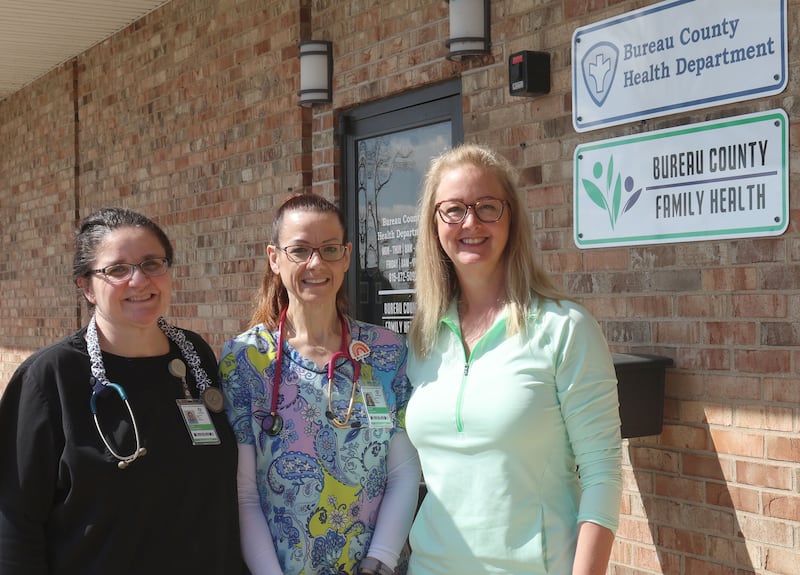
As rural areas across the country continue to lose access to obstetric and women’s health services, leaders at the Bureau County Health Department say their newly established family health clinic is proving local health departments can help fill the gap and potentially serve as a model for communities across the state.
The Bureau County Family Health Clinic, which opened in April last year, was created specifically to address growing concerns surrounding women’s health access in Bureau, Putnam and Marshall counties after years of hospital service reductions and provider shortages.
“We felt that the health department needed to step up and take responsibility for local health,” Bureau County Board of Health chair Pat Schou said. “If you look at this area 10 years ago, we had three hospitals providing OB services. All of a sudden, it fell apart. And it’s not just happening here.”
According to a 2025 study from the University of Minnesota School of Public Health, access to obstetric care in rural areas is declining significantly across the country. Between 2010 and 2022, seven states had at least a quarter of their hospitals stop providing obstetric services. By 2022, there were eight states where more than two-thirds of rural hospitals were without obstetric services.
Schou, who has chaired the Bureau County Board of Health for about 30 years, said the clinic was born out of a community needs assessment and conversations with longtime women’s health providers about how rural communities could respond to declining care access.
“We can’t always expect a large health system to fix everything,” Schou said. “We also have to know what our local needs are, and we have to be responsible locally.”
The clinic now provides women’s healthcare, family planning, prenatal and postpartum care, gynecological services, primary care, immunizations and behavioral health support through a partnership with Arukah Institute of Healing.
Angie Reidner, who has worked in women’s healthcare for four decades and as a midwife for 35 years, said the clinic was designed around “low barrier care” tailored to the realities of rural communities.
:quality(70)/cloudfront-us-east-1.images.arcpublishing.com/shawmedia/DSRXGPTCXFGDJP3VYTENMFDXCE.jpg)
“When you can include the family and the women’s healthcare together in one setting, you’re really providing comprehensive low barrier care,” Reidner said. “For rural women, that’s important because sometimes you’re traveling an hour, an hour and a half to get the care that you need.”
Reidner said the clinic has focused heavily on prenatal and postpartum care, areas she believes have become increasingly vulnerable as rural hospitals have scaled back obstetrics programs.
She added that postpartum care is often overlooked despite rising concerns nationwide surrounding maternal mental health and safety.
“Unfortunately, one of the leading causes of mortality during the postpartum period is maternal suicide and violence,” Reidner said. “We really need to make sure that we are available and that we are seeing women after they have their babies easily, quickly and regularly.”
According to Schou, the clinic started entirely from scratch – a challenge both she and Reidner acknowledged is one reason similar models have not become more common among local health departments.
“This coming together was certainly not easy,” Schou said. “You have to set up a clinic, build consensus, get community support and have your board beside you.”
Rather than relying on major grants, Schou said the health department used reserve funds and secured a $150,000 line of credit through county government to launch the clinic.
“That just shows you how supportive the community was,” Schou said.
The clinic has quickly grown since opening, with officials saying patient demand exceeded typical expectations for a startup rural practice.
“We are full most days,” Reidner said. “From day one, we’ve seen a minimum of 14 to 16 patients a day. Usually, when you start a practice, you see two, maybe three patients a day if you’re lucky.”
Schou said patients now come from roughly 50 ZIP codes throughout the region.
Repeatable success
The clinic’s leadership believes the model could eventually help shape rural health strategies elsewhere in Illinois and beyond. Schou said he has already presented on the clinic at a national conference and discussed the concept with state maternal health officials.
“I hope they do look to model this,” Reidner said of other health departments. “We have to realize that our communities have to take care of our communities.”
Looking ahead, Reidner said the clinic hopes to continue expanding community education, increase access to walk-in care for sexually transmitted infections and urgent women’s health concerns and reduce stigma surrounding issues such as substance use, violence and mental health.
“We need to be very intent on meeting their needs for low-barrier care and non-stigmatizing care,” Reidner said.
Schou said the long-term goal extends beyond their community and ties directly to the future healthcare of rural communities.
“If we’re going to keep our rural communities viable, we have to have young families and we have to support and provide things they need,” Schou said. “People in rural areas deserve quality care.”