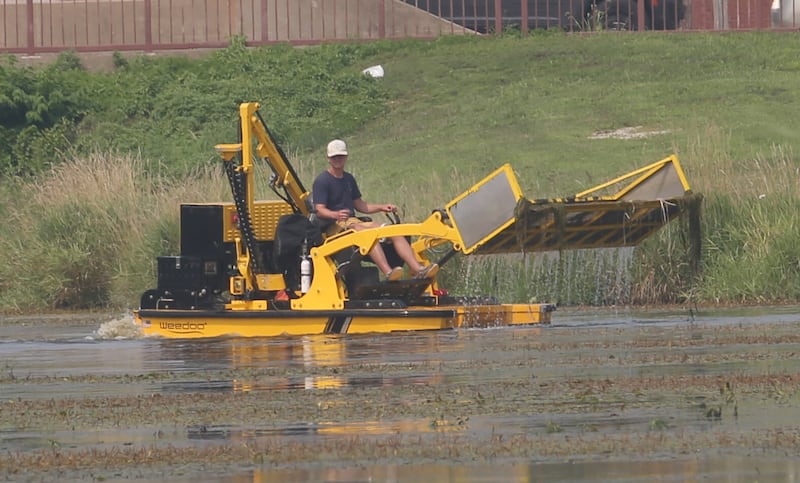
The Ottawa City Council is looking at how to move forward with its support of the I&M Canal after some commissioners noted that the current process is leaving the canal to resemble a swamp.
At Tuesday’s Ottawa City Council meeting, Commissioner of Public Improvements Marla Pearson pointed out the need for a further plan, as the current one wasn’t getting the job done.
“We need a better plan going in for what we’re going to do with the canal to make it aesthetic for the community so that people don’t walk by, look down and say, ‘Where’s Shrek at,’” Pearson said.
Prompted by an email from Arnie Bandstra, President of the Ottawa Canal Association, the Council discussed the problems with the canal project and what to do moving forward.
“I gave them a letter that listed all the things that they need to do, or at least that I would do, as they now take it over, just to make it a smooth transition to them,” Bandstra said. “We just need them to really pick up the ball.”
Specifically, Bandstra said he thinks the city of Ottawa should take some measures to control the algae and the weeds, take over the management of the use of watercraft that the canal association has assembled, both canoes and kayaks, for people to use, and get somebody to be available to check them out for people to use them, in addition to the rewatering efforts.
Ottawa Mayor Robert Hasty acknowledged there were some problems with the canal project.
“Some of it has to do with the responsibilities that were given to the Ottawa Canal Association – which we then said, ‘You’re not gonna be doing it anymore’ – because they were unable to maintain it to the level of which they had promised,” Hasty said.
:quality(70)/cloudfront-us-east-1.images.arcpublishing.com/shawmedia/L3IJXLZGFNGTPMZR2CH2TSLPJU.jpg)
Another concern brought up was the cost of the project. Commissioner of Public Health and Safety Tom Ganiere said the city had spent about $2 million on the project since it began, far more than it was supposed to at first.
“This proposal said it was gonna cost $600,000,” he said. “In no way did I imagine that we’d be sitting here today talking about $2 million spent on the canal.”
Hasty said the majority of the $2 million was spent in the project’s first three years and that funds devoted to the project in 2025 were in the neighborhood of $9,000-$12,000.
“Moving forward, as far as what we’re gonna do with it, it’s going to continue to be much more scaled down, less than even that $12,000,” Hasty said.
Enhancing the I & M Canal was proposed with the idea that the project would benefit the community and attract tourism.
“It looks messy, it’s not aesthetically pleasing to look at and it doesn’t help us at all with tourism like it was supposed to,” Ganiere said. “Could it, if it worked? Yes. But nobody wants to go out and even paddle around in something that’s got algae all over it.”
Using algae blockers is a measure that Ganiere said would not violate the licensing agreement made between the Illinois Department of Natural Resources and the city, although that agreement limits what the city can do.
“It has not worked properly since day one. At what point do we call this what it is: a failed experiment, and move on?” Ganiere said.
Hasty brought up the reality of what would have to be done if the Council decided to move on from the canal project.
“When you’re 90%-95% to the finish line of having something that would be an asset to the community, to now turn face over $10,000 or $12,000, and dump more money than that into reverting it back to a grass field, now we’re throwing good money after bad,” Hasty said.
The Council agreed to pause current efforts while reevaluating the future of the city’s involvement with the canal project.
“I think probably what would be best at this point is to sit down and look at the numbers of both making corrections that would keep it so that you’re not filling the canal and maintaining it to the level of where it is, which I would call a pond at this point, and what the cost is going to be for us now to revert all of that property back to what it was prior, maintain it, seed it, grass it, etc,” Hasty said.
Bandstra said the Council needs to act with some urgency as winter turns to spring.
“If they don’t take control as soon as the weather turns, then the algae and the weeds get out of control,” he said. “I hope they’re not sitting on their hands waiting for it to become a problem, and then it can be too late at that point, and a much bigger project at the very least.”
Once this assessment takes place, the Council will decide what action is necessary.