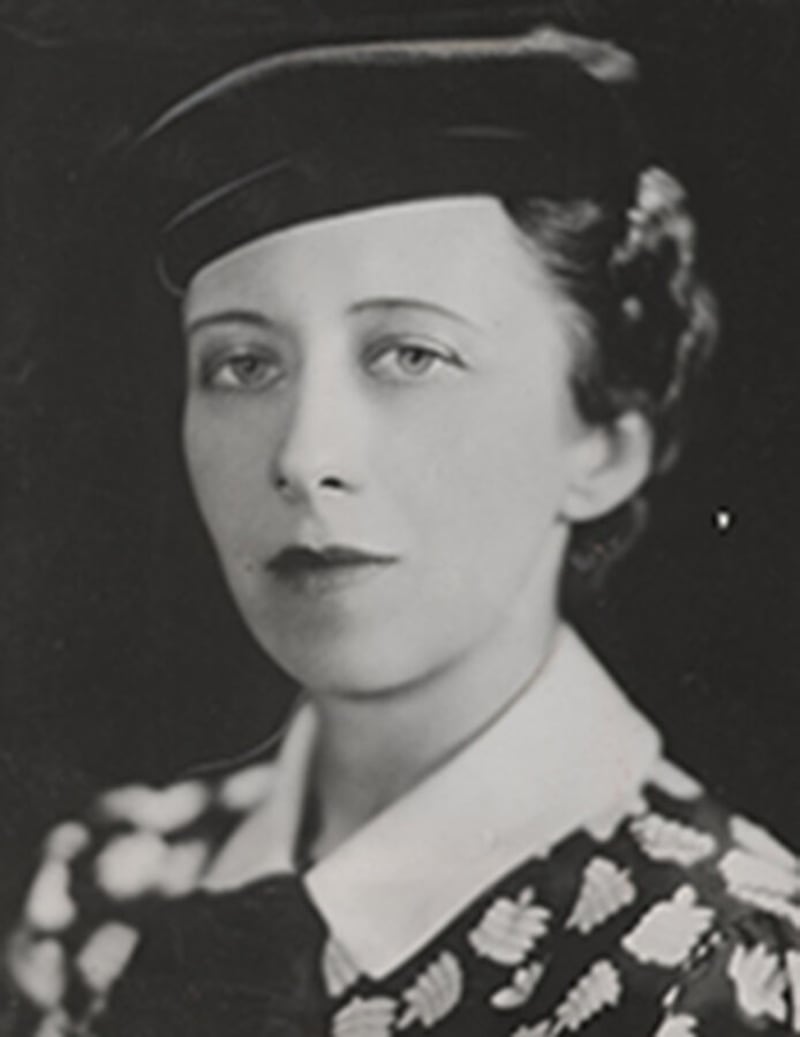
When Jessie Sumner left Watseka at the end of 1938 to travel some 700 miles to Washington, DC, she had just resigned her elected position as county judge of Iroquois County. On Jan. 3, 1939, shortly after she arrived in the nation’s capital, she was sworn in as a member of the United States House of Representatives.
At age 40, Congresswoman Sumner was the youngest woman among the 435 members of the House. The slim, five-foot, 3-inch woman with auburn hair would quickly become known as one of the feistiest and most outspoken Republican members of Congress — especially on the subject of President Franklin Delano Roosevelt.
Asked by reporters for her evaluation of FDR as a politician, she responded with a familiar quote from Shakespeare, “I come to bury Caesar, not to praise him.” One news story characterized her as having “a Shakespearian vocabulary and a William Jennings Bryan flow of oratory.”
Sumner’s strongly negative personal views on Roosevelt and his New Deal Democrats mirrored those of the heavily Republican 18th Congressional District that had sent her to Congress. The district consisted of six counties stretching 150 miles along the Illinois/Indiana state line: Kankakee, Iroquois, Vermilion, Edgar, Clark and Cumberland. At a time with war clouds looming over Europe, Sumner’s isolationist views on American involvement resonated with her constituents.
Born near Milford in Iroquois County on July 17, 1898, she was the oldest of three children and the only daughter of prosperous farmer/businessman Aaron Sumner and his wife, Elizabeth. She attended elementary school in Milford but spent her high school years as a boarding student at the Girton School in Winnetka. After graduating in 1916, she earned a degree in economics from Smith College in Massachusetts.
Following her 1920 graduation from Smith, Miss Sumner decided to pursue a law degree. She studied at a number of schools, including Oxford University in England (where she was the first American woman to study law). She was admitted to the Illinois bar in 1923 and established a successful practice in Chicago.
In 1928, she relocated to New York City to work for Chase National Bank but left there after four years to return home to Milford, where she resumed practicing law. She also served as a director of the financial institution founded by her father, the Sumner National Bank.
Jessie Sumner’s political career began in 1937, when she chose to run for the position of Iroquois County Judge, which had been vacated by the death of her uncle, John H. Gillan. Her opponent, attorney Clifford Beach of Gilman, built his campaign on the slogan, “You don’t want a woman for your county judge!”
Two thirds of the Iroquois County voters disagreed with Beach — they did want this woman for their county judge. The final tally of votes was 4,781 to 2,542. Jessie Sumner not only became the first woman in Illinois history to be elected a county judge, but (according to the American Bar Association) the first female county judge in the entire country.
Her tenure on the bench would be relatively short — by early 1938, she was campaigning hard to win the 18th Congressional District seat held for three terms by Democrat James A. Meeks, a Danville lawyer. In a March 21 interview with the Chicago Tribune, Sumner described her campaign: “I hold court in the mornings, sometimes all day, and speak at night. … My difficulty is not being able to campaign during the day.”
A biographical article compiled by the U.S. House of Representatives noted, “Her primary theme was a consistent attack against New Deal programs which, she argued, overtaxed Americans and intruded on their individual liberties. In particular, she singled out Roosevelt as practicing ’one-man government’ …. With the backing of the anti-Roosevelt Chicago Tribune, Sumner defeated Meeks with 55 percent of the vote.”
Jessie Sumner would go on to serve four two-year terms in the House of Representatives. Although she voted in favor of declaring war on Japan after the Dec. 7, 1941, attack on Pearl Harbor, she was otherwise uncompromising in her isolationist stance, especially regarding participation in the European conflict. “The difference between these two ambitious tyrants [Hitler and Stalin] is not worth the life of a single American boy,” she declared in a 1944 speech on the floor of the House.
In that same year, while campaigning for her fourth term in Congress, she spoke to a large group of women gathered at the home of Kankakee County Republican Party chairman Victor McBroom.
“American resources and American lives today are being dissipated all over the world. For what? …. To save England? England was saved before the war started, when Hitler, instead of invading England, turned and invaded Russia.” She noted that American aid to Russia enabled “our ally Stalin to make the same kind of aggressions in Europe as Hitler … Unless our policy is amended, Stalin, when war ends in Europe, will be stronger than Hitler ever was.”
The Chicago Tribune, which had consistently endorsed Sumner, proclaimed her in 1944 to be “A Woman America Needs.” In a Jan. 27 editorial, the newspaper observed, “Jessie Sumner has shown herself to be a leading member of the house of representatives and if she had been a man she would be a leading candidate for the Presidency of the United States today.”
During her final term in Congress (1945-47), Miss Sumner continued to campaign against American “internationalism” (involvement in world affairs). She fought particularly hard against U.S. membership in the newly formed United Nations. She was one of only 15 House members to vote against ratification of participation in the international body.
On Jan. 3, 1947, former Congresswoman Jessie Sumner of Illinois exited the House chamber for the last time, and returned to private life in Iroquois County. For nearly two decades, she served as a director of the family-owned Sumner National Bank; then assumed its presidency in 1966. Miss Sumner remained active in the bank’s operations until shortly before her death, at age 96, on Aug. 10, 1994. She is buried in the Sumner family plot at Milford’s Maple Grove Cemetery.
Local trivia Much of the same territory served by Representative Jessie Sumner was earlier represented for almost a half-century by one of the most powerful Republican politicians in Illinois history. Popularly known as “Uncle Joe,” this Danville native was elected to 23 two-year terms in the U.S. Congress, and served for eight years as Speaker of the House of Representatives. Who was he? <strong>Answer:</strong> Joseph Gurney Cannon. He was first elected to Congress in 1873 and served (with two interruptions), until 1923, a total of 46 years in office. As Speaker of the House from 1903 to 1911, he was considered the most dominant person to ever hold that office. The oldest of the House office buildings was named for Cannon in 1962. {related_content_uuid}cc39d84e-a715-4641-b659-3a8ea49f6f66{/related_content_uuid}
Much of the same territory served by Representative Jessie Sumner was earlier represented for almost a half-century by one of the most powerful Republican politicians in Illinois history. Popularly known as “Uncle Joe,” this Danville native was elected to 23 two-year terms in the U.S. Congress, and served for eight years as Speaker of the House of Representatives. Who was he?
Answer: Joseph Gurney Cannon. He was first elected to Congress in 1873 and served (with two interruptions), until 1923, a total of 46 years in office. As Speaker of the House from 1903 to 1911, he was considered the most dominant person to ever hold that office. The oldest of the House office buildings was named for Cannon in 1962.