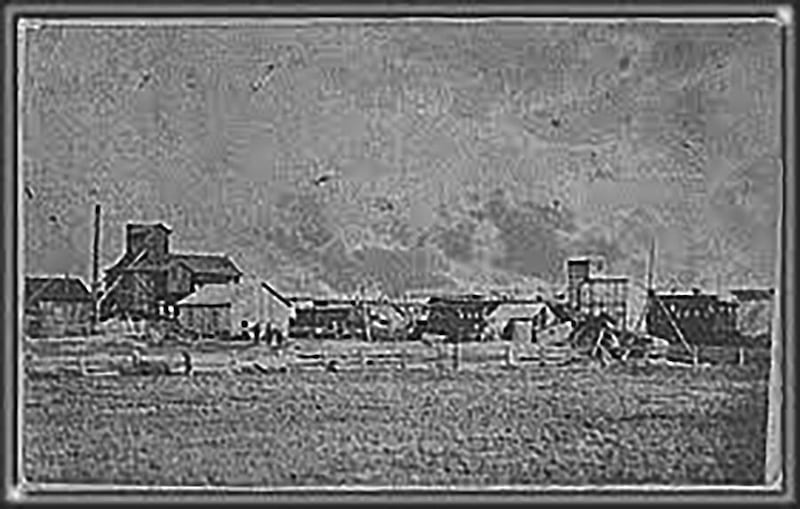
On Friday morning, Feb. 16, 1883, the flat prairie land surrounding the tiny village of Diamond on the Grundy/Will county line was saturated with rainwater and melted snow. Low spots had become pools of water as much as four feet deep.
Just west of the town, several hundred men and boys were at work far below ground, excavating soft coal at the Diamond Mine. They were working with pick and shovel in a sprawling network of tunnels radiating out from the mine’s 92-foot-deep main shaft. That shaft contained the lifting cage (hoist) that was used to bring the coal to the surface. It also was the workers’ means of entry and exit to the mine.
Working at the bottom of the main shaft that morning was a young man named Thomas Daly, who had two duties: signaling the engineer on the surface to operate the hoist, and making sure that the pumps used to remove seeping water from the mine were working properly.
Shortly before noon, reported the Chicago Tribune in its Feb. 17 edition, Daly “noticed that the water was increasing in the bottom of the shaft, and supposing that the engines [pumps] were not doing their full work, ascended to the top of the shaft to notify the engineer to put on more steam. On his arrival, he found that … the engines were working at the capacity requisite to keep down any ordinary inflow.”
When Daly returned to the bottom of the shaft, he found that the water was chest-deep; he immediately returned to the surface to sound an alarm.
The rush of water into the mine had apparently begun about 11:30 a.m., when the ground collapsed beneath a pond of water, east of the main shaft. Water from the pond, which was some forty by ninety feet in size and several feet deep, drained into an abandoned section of the mine and began flowing downward through the network of old tunnels.
At the time of the collapse, almost 300 miners — mostly immigrants from Scotland, Ireland and Germany — were at work below ground. The men were mining coal in galleries west of the main shaft, near a second shaft, appropriately termed the “air and escape shaft,” which was equipped with a ladder that would allow survivors to climb some 90 feet to the surface. “This morning from 290 to 300 went to work,” noted the Chicago Tribune, “and by noon one-fourth of the number were dead …. The escape of the majority was almost by a miracle.” A total of 74 men and boys died in the flooded mine.
The newspaper’s report included a harrowing and tragic first-person account from survivor John Huber: “I was working in one of the west sections of the main corridor … when I heard a voice … saying ‘Look out, the water is coming.’ For a few moments I did not comprehend the awful meaning of the language used … when I heard the same warning again and again, and [saw] a small stream of water running down the center of the track. The truth at once flashed upon me that I was in danger …. I rushed as fast as the nature of the passage would allow to where I thought my two sons were at work, but found that they had gone. I then … made as fast as I could for the air-shaft, where I knew there was a ladder and that I could get out. By this time, the water was up to my armpits, and I had a hard time to get up the shaft, so exhausted was I with the rapid run I had made in the stooping position.
“When I got home, great God! What did I see! There upon her bed lay my wife, tearing her hair and wailing in an almost crazy condition. ‘Oh John,’ she said, ‘where are the boys?’ The truth then flashed upon me that perhaps they were dead. I went back [to the mine] as fast as I could and found that my horrible anticipations were only too true, and that the boys had not been seen since they entered the shaft in the morning.”
An unsolved mystery: In the same Tribune story that included Huber’s eye-witness account, the printed list of victims of the mine disaster included “John Huber”— not once, but twice. Huber was shown (with the notation, “wife and four children”) in the list of married victims, and again, in the list of unmarried victims. Also listed among the unmarried dead was “Frank Huber.” On a memorial tablet at the site of the disaster, erected in 1926, three Hubers are listed: John, Chris and Lewis.
Regarding the death toll, the Tribune reported, “It was at first hoped that some of the men would come out alive, as there was a possible chance that the water would clog up somewhere in the various passages and the men be rescued, but by 3 o’clock it was generally conceded that they were all dead. The water had risen nearly eighty feet in the main shaft, and the possibility of a clog could no longer be conceived.”
Work to recover the bodies of the victims began within days, when large pumps were brought in to lower the water level. After 38 days, the level was reduced enough to allow recovery crews to enter. Only 28 bodies were found and brought out of the mine before authorities declared conditions were too dangerous to continue. The Diamond Mine, with the remaining 46 victims’ bodies, was sealed up.
In 1898, the United Mine Workers of America dedicated a monument on the site of the Diamond Mine. Inscribed on the marble face of the monument are the words, “Sacred to the memory of our deceased brothers who lost their lives by the flooding of the Diamond Mine, Feb. 16, 1883.” In September, 1926, a bronze tablet listing the names of the 74 victims was added to the monument by the Braidwood Homecoming Association.
The worst, with 250 lives lost, was a 1909 fire at Cherry in northwestern Illinois. A 1951 explosion at West Frankfort in southern Illinois claimed 119 miners; another southern Illinois explosion, at Centralia, killed 111 men in 1947.
Although shaft coal mines like Diamond were mostly located in Will and Grundy Counties in the late 1800s, Kankakee County also had a number of coal mining towns in that period. Where were they?
Answer: There were three such towns, all located along the western edge of Essex Township. Two of the towns, Tracy and Oklahoma, were very small, each with perhaps a dozen buildings. The third town, Clarke City, was more substantial, laid out in four square blocks of houses and business buildings. It had a peak population of about 900. When the coal seams ran out in the early 1900s, Tracy and Oklahoma quickly disappeared. Clarke City held on longer, with a population of 14 in the 1920 census. By the early 1960s, only a single building remained on the town site. In later years, coal production in Essex Township revived, with large surface (strip) mines that were active until the 1970s.