We have all seen the billboards, 90% of which are looking for accident victims. The common terms of such involvements are between injured people and a lawyer who wants one-third of any money he or she can get from another party, usually insurance companies. But there are some other class action suits that go directly against a producer of a product.
Perhaps one of the biggest class actions has been against Roundup, the manufacturer of a spray to kill crabgrass, dandelions, weeds, and other plants that invade our gardens. Who doesn’t get that this is a combination of chemicals that kills things? Yet Roundup has placed over a billion dollars in a fund that is to satisfy the lawsuits for damages, the leading claim being that it causes cancer.
I have this product, and I have read the warnings on the container. The description of its contents, what not to get it on, and lists of all the things outside of weeds that it will harm. It even says to bring the label with you if you are going to a poison control center or a doctor for treatment. Then it says that the buyer assumes all responsibility for safety and use not in accordance with directions. What it doesn’t say is that it can cause cancer because the company has stated openly that it cannot.
I am sure these details were not all listed back in the day. Garden workers probably used it more than was healthy, but what more can be said to make people respect the product and its risks?
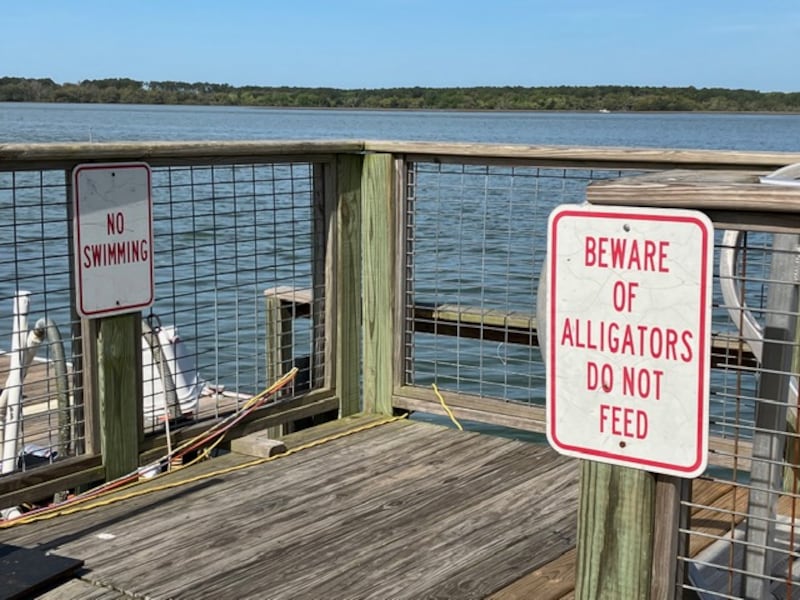
The attached picture was taken on a wharf that was used for fishing boats in South Carolina. I stared at the first sign with respect. I then cracked up as the second sign came into my view. Who needed the second sign after the first? But I suppose not all people respect the danger of the first sign.
This caused me to consider various labels and their warnings to protect against lawsuits as well as injuries. The more I viewed, the more I understood that there are a great number of our citizens who don’t think so well. Or perhaps they don’t comprehend basic safety measures. Here are some of my favorites with the product and its warning attached.
“Eating rocks may lead to broken teeth” ---- on a novelty rock garden set called “Popcorn Rock.”
“Do not recharge, put in backwards, or use” ---on a battery.
“Do not iron clothes on body” --- on packaging for a Rowenta iron.
“Do not turn upside down” --- on the bottom of a supermarket dessert box. A bit late if reading it?
“Not dishwasher safe” --- on a remote control for a TV.
“Remove plastic before eating “--- on a wrapper of a Fruit Roll-Up.
Now my favorites:
“Should not be used for signing checks or any legal documents” --- on a Vanishing Ink Marker.
“Shin pads cannot protect any part of the body they do not cover” ---on shin guards for bicyclists.
“Do not allow children to play in the dishwasher” ---- a label on the dishwasher.
“Warning: may cause drowsiness. Do not use when operating a car” --- on a bottle of dog medication.
“Warning. Never use a lit match to check fuel level “--- label on a jet ski.
“Remove child before folding” --- label on a baby stroller.
My most favorite:
“Warning: Once used rectally, the thermometer should not be used orally ‘’ ---on the thermometer box. I would think that those who don’t read may only do it once!
Some of my longer readers may remember that I wrote an entire article on the lawsuit that a lady filed against McDonald’s for having her coffee too hot in her drive-through coffee cup. She spilled it on her lap. Well, some coffee makers decided to avoid future lawsuits and actually have this label on their takeout coffee cups.
“CAUTION: AVOID POURING ON CROTCH AREA.” Really?
So, we live in a lawsuit world, and some labels make a lot more sense than others. Hope you enjoyed a break from the seriousness of our present times and can smile.
· Dennis Marek can be reached at llamalaw@gmail.com.