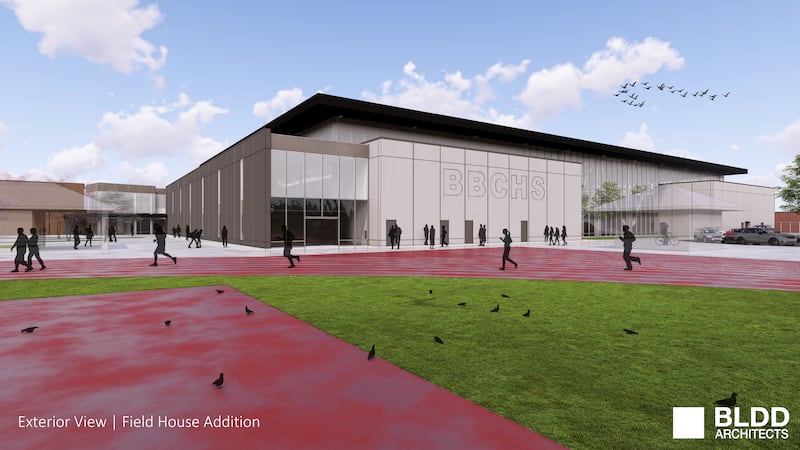
With total costs coming in at nearly $86 million, about $16 million over budget, Bradley-Bourbonnais Community High School officials are working with architects to reduce costs for the planned $70 million facility project.
On Thursday, the BBCHS District 307 School Board’s operations committee reviewed construction bids and project costs with BLDD Architects and PSI Construction.
After receiving construction bids in March and April, the subtotal cost for the project is $76,360,389.
The total base project cost — including a 4% construction contingency of about $2.7 million, a 2.75% construction management fee of about $2.2 million, a design fee of about $4.2 million, and a $500,000 furniture allowance — is approximately $85,936,679.
The BBCHS Board is slated to vote on approval of construction bids, which are divided into 13 bid packages, during its May 11 meeting.
Superintendent Matt Vosberg said he would be working with BLDD Architects in the coming days to come up with three or four reduced-cost scenarios for the board to consider.
He said the board could approve some of the bid packages, rather than the entire project at once, at its upcoming meeting.
“I know we have to approve probably three of them at the next board meeting to keep the project on schedule,” he said.
While work to relocate utilities behind the school began during spring break, Vosberg said there’s no set date yet for a groundbreaking on the rest of the project.
Damien Schlitt, director of K-12 education design with BLDD Architects, said a full redesign of the project would take at least three months.
Because of the likelihood for costs to increase if the project is rebid later, board members said they did not want a full redesign.
Bidding on the project again in a few months could result in a cost increase of 5 to 10%, particularly as prices of materials like steel and copper are on the rise.
Cost-saving options
Schlitt presented options for adjusting the design to reduce costs, a process known as value engineering, including switching to lower-cost building materials where possible.
The district could save about $6.5 million with proposed smaller-scale changes.
“We’ve taken some of the icing off the cake, if you will,” he said. “Now, it’s talking about taking it from a three-tier cake down to a two-and-a-half-tier cake.”
Bigger potential changes, which would alter building plans more noticeably, could include reducing planned physical education spaces in the field house from two stories down to one, saving about $1.5 million.
The single-story PE space could also be made smaller, saving about $330,000.
Alternatively, the PE portion of the addition could be eliminated, saving about 19,000 square feet and $4.5 million. That would mean the current weight room and library spaces in the existing building would remain where they are.
Other reductions could include creating only three science labs in the North Gym instead of five, saving about $1.6 million, or reducing performing arts spaces from three planned rooms to two, saving about $420,000.
The field house plans could also be reduced from a four-court, 200-meter track down to a three-court, 160-meter track, which would cut about 17,000 square feet and save about $3.3 million.
Making a decision
Vosberg said that deciding where to cut costs will have to be measured against the goals that were originally shared with the community.
“We’ve got a lot of pieces to the project, and we have to just prioritize what are our most important pieces,” he said.
Getting students under one roof by eliminating the need for mobile classrooms and ensuring adequate cafeteria space for the size of the school were two of the main objectives.
Vosberg said these two goals should be accomplished with any potential scenario to be considered.
“Now, we’re going to make some tougher decisions around the functionality of the building,” he said.
Other priorities included making sure academic spaces were separate from PE spaces due to noise issues, and creating a hub for fine arts.