America has to tell the hard truth of how we got to where we are.
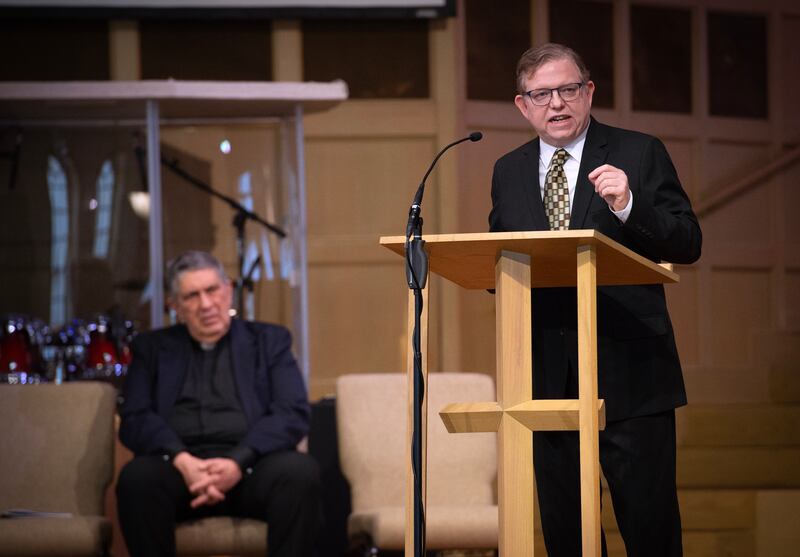
The Rev. Robert Bushey Jr. gave that message Monday morning as the keynote speaker of the Dr. Martin Luther King Jr. Foundation commemoration at the College Church of the Nazarene.
Rev. Bushey spoke at the annual interfaith service at Olivet Nazarene University that caps the local King Day activities.
Rev. Bushey is the executive director and founder of the Grow Center, in Bourbonnais, a community-based ministry of the Christian Church. He is an anti-racism trainer and the co-founder of the Stony Road, a podcast that considers historical patterns of racial inequality.
Rev. Bushey said his entire ministry has been shaped by the cause of battling racism. He pointed to example after example of racism and sexism shaping the traditional views of history that we were taught.
He told people at the outset of his talk that if they were uncomfortable with his remarks that they could leave. None did.
:quality(70)/cloudfront-us-east-1.images.arcpublishing.com/shawmedia/XWTQOWOGURA7ZJS5KPLXMRWQQI.jpg)
Rev. Bushey quoted Dr. Martin Luther King Jr.: “Our lives begin to end the day we become silent about things that matter.”
He added that he did not come here to cast today for the problems of the past. He hoped to go forward in a spirit “of hope and reconciliation,” but if there is to be reconciliation, it begins with telling the truth.
There were, he said, European colonizers who “discovered” a continent already inhabited by indigenous people. Slave kidnappers created a society with more than four million slaves in the United States.
He pointed, too, to the “godly men in Salem” who condemned women to be burned at the stake.
Thomas Jefferson’s famous line in the Declaration of Independence, that “all men are created equal,” he said, was really all white men are created equal.
Racism, the Rev. Bushey said, was really “in the very structure of this country.” The country was built on the “economic engines on the backs of the enslaved.” Even after the slaves were freed, systems of sharecropping and convict leasing exploited people, he said.
Indian removal, the practice of moving indigenous people off their traditional lands, was a form of racism. Redlining, the practice of denying mortgage loans, in Black communities, was modern racism.
Three Civil Rights Acts and a century after the Civil War, he said, have “still not eradicated racism.” If anything, the gaps in our society, have grown greater.
The Rev. Bushey said there are old racist myths embedded in our healthcare and that today we see the “militaristic occupation” of our cities.
He said that white male supremacy is “more emboldened than ever” today.
But, he added, that he has been encouraged by local demonstrations for justice, citing the 2020 rally after the murder of George Floyd Jr. by a Minneapolis police officer.
The Rev. Bushey noted that opposition to racism is not easy. Resistance comes at a price, he said. Freedom comes at a price. Victory comes at a price.
Kankakee County, the Rev. Bushey explained, is the site of $104,000 in Healing Illinois grants. Those funds, a joint project of the state and of the Field Foundation, have given anti-racist training to more than 300 residents.
The training consists of a six-week course of two-hours a week. The course is designed to show the patterns of racism in history.
The funds will also help create Healing Circles. An announcement on that should take place in the spring. The circles will foster discussions across religious and racial lines designed to combat prejudice.
“We must learn to live together as brothers — or perish as fools,” the Rev. Bushey quoted Dr. King again.
A summary of the Rev. Bushey’s career, printed in the program, noted that as a minister, community organizer and activist, the Rev. Bushey has led and participated in dozens of marches, direct actions and negotiations with local, state and federal officials on human rights issues such as: economic justice, racial equality fair and equitable housing, immigrants’ rights, women’s rights, LGBTQ+ rights, prisoners’ rights, pro-democracy and environmental justice.