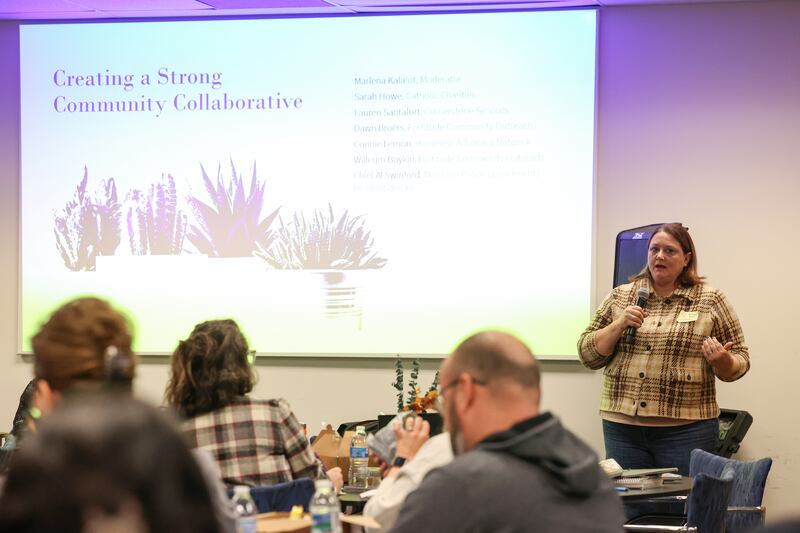
From September 2024 through August 2025, an average of 1.1 fewer individuals entered homelessness than became housed in Kankakee County.
That statistic means the county has reached “functional zero” homelessness, reported Dawn Broers, Fortitude Community Outreach executive director, at the third Summit on Homelessness.
“Our job now is to maintain that, which we are in a great place to do,” she said.
Hosted by the Kankakee County Homeless Task Force, Thursday’s summit at Kankakee Community College was attended by about 80 people from the continuum of care provider network.
The inaugural summit in 2023 resulted in the formation of the task force.
Reaching functional zero doesn’t mean homelessness has been eliminated, or that there isn’t work to do.
That will never be the case, Broers said.
“There will never be zero homeless, but what we want to shoot for is that there are less people coming into homelessness than there are leaving homelessness,” she said.
Data on those becoming homeless and housed is monitored from a confidential “by-name list,” a list maintained by Fortitude of every homeless individual in the community.
The by-name list was created two years ago after the task force visited Rockford, a city that had reached functional zero and made notable strides in helping its homeless population.
Local service providers meet on a weekly basis to discuss the status and needs of individuals on the by-name list.
“You will be on the by-name list forever, but the goal is to move to inactive or closed,” Broers said. “We’re able to collect data so we know how we’re doing with getting to functional zero.”
Homeless youth
Diane Nilan, who has worked in homelessness since the mid-1980s and is co-author of “The Three Melissas: The Practical Guide to Surviving Family Homelessness,” discussed issues with the underreporting of homeless youth.
“I’m here today because there’s an element of homelessness that doesn’t get talked about,” Nilan said.
She noted that homeless services and advocacy used to be virtually non-existent in the central Illinois region, and she was impressed to hear of all the efforts taking place today.
“Here, you’re struggling against all sorts of obstacles,” she said.
Homeless youth are being underreported across the nation, she said.
Differences in definitions of homelessness from different entities, such as the U.S. Department of Housing and Urban Development (HUD) and the U.S. Department of Education, lead to many individuals not being counted in statistics.
In Kankakee County, 362 students, or 2.35% of 13,376 students, were identified as homeless in 2022-23 based on the federal McKinney-Vento Homelessness Assistance Act.
In Iroquois County, it was 85 students, or 2.2% of 3,915 students.
With poverty rates of 13.9% in Kankakee County and 14.7% in Iroquois County, Nilan said the percentages of homeless students are likely higher.
“Illinois is grossly under-identifying students that are homeless,” she said.
:quality(70)/cloudfront-us-east-1.images.arcpublishing.com/shawmedia/ZIGVFTD5WFCU7MCJLNFMI6HKUA.jpg)
People experiencing homelessness as children are at an increased risk of becoming homeless as adults, she added.
“I would say, conservatively, 50% of the adults that we see on the streets, declared homeless by HUD, have been homeless as kids,” she said. “... There’s a really good reason to go beyond and do something for families that is not being done right now. The schools can’t do it all.”
Nilan managed shelters in the Chicago suburbs for 15 years and helped get a state law passed to remove educational barriers and increase school access for homeless students, the Illinois Education for Homeless Children Act of 1994.
She founded a program, Project Reach, with the goal of training educators in 305 Chicago-area school districts on their academic obligations to homeless students.
Nilan said she managed to step on the toes of school administrators who didn’t want to let homeless students attend their schools.
“I was aware of the fact that kids could really talk about their experience of homelessness, but nobody really listened to them,” she said.
In 2005, Nilan founded HEAR US Inc., a nonprofit dedicated to telling the stories of homeless youth and families through documentary filmmaking.
Addressing homelessness
A panel discussion with members of the task force explored ways homelessness is being addressed in the community.
:quality(70)/cloudfront-us-east-1.images.arcpublishing.com/shawmedia/MH63Y4FFQBCFFIVKEGHV4DOCDM.jpg)
Broers said the various organizations, municipalities and systems working to address homelessness have a history of operating in a siloed fashion, meaning in isolation.
That was the motivation behind hosting the first summit, she said.
To effect change, they would all need to work together and look at the issues from one another’s perspectives.
“We were all speaking a different language about the same thing,” Broers said.
Lauren Santafort, of Cornerstone Services, recalled that many lively discussions took place at the first summit. Attendees realized they couldn’t solve the issues in one day, so the task force was formed to keep the momentum going.
Task force meetings take place monthly, with goals including coordinating existing programs and services, increasing available services, and ultimately, reaching and maintaining functional zero.
“The idea of the ‘functional zero’ homelessness is that if somebody becomes homeless today, there’s an opportunity for them to get some services at that same time instead of having backlogs,” Santafort said.
Champion of Change
The Vincent Edward Clark Champion of Change Award was given to Manteno Police Chief Alan Swinford.
:quality(70)/cloudfront-us-east-1.images.arcpublishing.com/shawmedia/QMFX6G24WBAB7NZVTFCWCTYK3I.jpg)
The award was established in 2024, with Broers receiving the first award.
Connie Lemon, a member of the task force, said Swinford has been a consistent contributor to the task force and local continuum of care meetings.
“Having the perspective of law enforcement has been a critical component of the whole system of care for those experiencing homelessness,” Lemon said.
“In addition, Chief Swinford has been an influential leader for his Manteno Police Department, infusing a value of respect throughout his force that is a shining example of law enforcement relations with those experiencing homelessness.”
Swinford is program director for Building Blocks, a community-based deflection and diversion program that manages a federal grant and funds local efforts to identify and assist individuals experiencing mental health crises.
He has worked in Kankakee County law enforcement for more than 35 years and has been the police chief in Manteno since 2017.
“[Homelessness] is a community problem, and we need to solve it as a team,” Swinford said. “The only way we can do that is the police need to be involved. The police need to be at the table.”