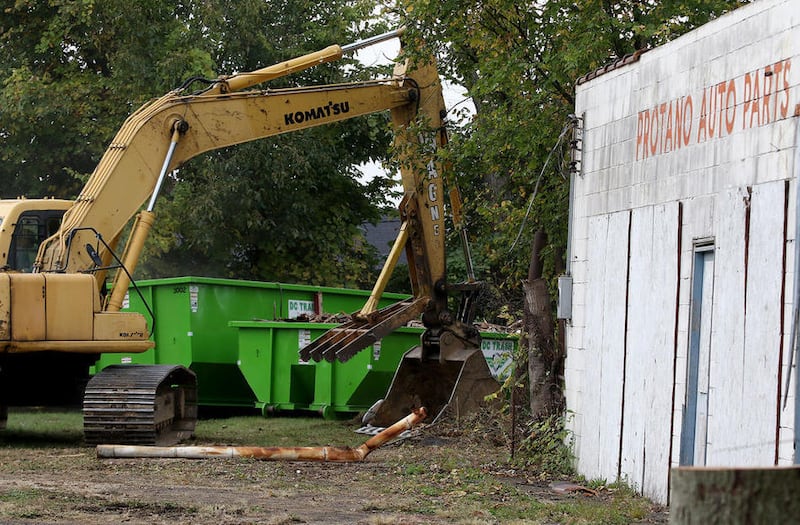
The city of DeKalb is planning to apply for grant assistance from the U.S. Environmental Protection Agency to shore up contamination of the former Protano’s Auto Salvage site.
The property, 1151 S. Fourth St., has been under DeKalb city ownership since 2015 and is cleared of structures, but it remains vacant due to environmental concerns.
In remarks to the City Council, Ross Grimes, senior project manager for Fehr Graham, emphasized the importance of securing grant funding for the brownfield.
The site used to be home to an auto parts salvage facility for more than 70 years and is considered a brownfield, Grimes said.
“The operation as an auto salvage facility is an environmental condition right off the bat,” Grimes said. “There’s a lot of things that are coming off vehicles. There’s hazardous lead, there’s polychlorinated biphenyls, there’s plastics, there’s all sorts of petroleum products that are coming off vehicles. So, it’s a big red flag.”
The city had enlisted the firm Fehr Graham to conduct three environmental investigations of the site on the city’s south side.
Results have since confirmed hazardous lead levels and other contaminants in shallow soil, city documents show.
More recently, in April, the City Council voted to authorize the services of Fehr Graham to prepare the former Protano’s Auto Salvage site for enrollment into the voluntary cleanup program through the Illinois Environmental Protection Agency.
:quality(70)/cloudfront-us-east-1.images.arcpublishing.com/shawmedia/MGRCCJQGEBE5LPRI47HYLEPZ3M.JPG)
Grimes said it’s clear that the site needs some attention.
“Overall, investigations found metals, as you would expect,” Grimes said. “We found some petroleum products, and we found some PCBs. So polychlorinated biphenyls, those are hazardous. They are carcinogenic at times as well.”
City staff said they have identified work on the estimated 2-acre property, which falls within the boundaries of the city’s tax increment financing district No. 4, as a priority for revitalization of the Fourth Street corridor.
Currently, there’s no redevelopment occurring there.
Grimes said these site assessments were important for the city.
“It seems odd to have three, but data changes, purposes change, development ideas change,” Grimes said.
He said there is a silver lining to be realized by the City Council.
“But again, I want the council to understand that contamination at this point is in a very shallow zone – surface to 2 feet below ground surface," he said. “Knowing this, we prepped the site. We prepped the documents to go into the site remediation program, which is a voluntary plan program with the Illinois EPA.”
The city has three options with regard to cleaning up the site. One scenario would be for the city to do nothing.
A second option comes with an estimated $1.9 million price tag and would rely on engineering barriers, groundwater-use ordinances and building control technologies, as well as the use of a stabilizing materials – such as calcium or phosphate – to blend into the soil. That would limit the amount of soil that would be removed from the site in doing so.
A third scenario comes with an estimated $2.6 million price tag and would necessitate carving out the site. That means all the contaminated soil would be removed.
Grimes tried to explain the effectiveness of the three options presented to the council.
“Now, when we talk about the effectiveness of each one of these, again – no action, not very effective,” he said. “Alternative two is effective at addressing contamination. Alternative three removes contamination.”
Grimes suggested that the best option will necessitate carving out the site to remove the contaminants from the soil.
“It’s going to allow the city to market the property to get rid of contamination, to not have an encumbrance or a restriction to have an engineered barrier over top of the site,” he said. “You don’t have to maintain that into the future. And it also reduces contamination from leaking into the groundwater and affecting other properties.”
The team at Fehr Graham has worked with brownfield redevelopment projects in the past.
Grimes touted the work of his firm.
“Our team works on brownfield redevelopment with municipalities all around,” Grimes said. “We’ve been pretty successful in helping municipalities unlock very unique sites – some very complex sites – and find some funding options for them as well.”
The grant application window for submittals is open until Jan. 28. If awarded, the city would be notified in June, and the money would become available beginning in October.
City documents show that the IEPA grant program extends $315 million nationally and covers 100% of remediation costs.
City staff said they view the cleanup of the site as a 2027 project.
Mayor Cohen Barnes chimed in, saying, “Let’s go for the grant.”
:quality(70)/author-service-images-prod-us-east-1.publishing.aws.arc.pub/shawmedia/670e1b81-921a-4140-9c50-69b66cad217c.jpg)