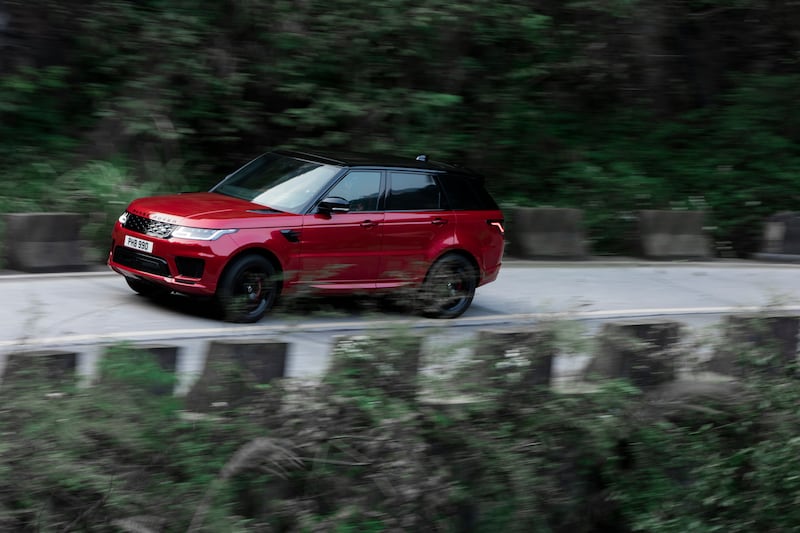
The 2026 Range Rover Sport Dynamic SE PHEV continues to walk a careful line between luxury SUV opulence and forward-thinking EV efficiency. As part of the broader Land Rover family, it meets all the expectations of refinement, capability and image one might expect.
For me, this plug-in hybrid powertrain delivers serious output that can be outright fun to drive. While the exterior design leans more toward refinement than rugged, this latest iteration proves that evolution doesn’t have to come at the expense of identity.
My first impressions of the Range Rover Sport always start with its unmistakable exterior look. I’ve never found it to be flashy or gimmicky, but I must make a point of suggesting that the optional Varesine Blue paint ($710 ) is worth every penny. Depending on lighting conditions, the blue changes from deep navy tones to a brighter metallic blue. It adds a layer of sophistication that elevates the already clean and minimalistic design.
Paired with the Black Exterior Package ($750), which replaces chrome accents with gloss black trim, and the 22-inch Satin Dark Gray wheels ($1,100), the overall look leans modern and slightly aggressive without tipping into excess. The proportions remain balanced, with a low roofline and planted stance that make the Sport feel more athletic than its larger sibling.
Under the hood, the plug-in hybrid system pairs a 3.0-liter inline-six engine with an electric motor, producing a combined 454 horsepower and 487 pound-feet of torque. Power is routed through an 8-speed automatic transmission, delivering smooth, confident acceleration.
The PHEV system allows for short all-electric drives, ideal for commuting or errand runs, while the gasoline engine ensures long-distance flexibility. Fuel economy comes in at 21 MPG combined on gasoline alone, with a more impressive 53 MPGe when utilizing both electric and gas power.
Always on trial for the pure EVs, the hybrid charging is straightforward at home thanks to the included cable, though public charging will likely require adapters. For a vehicle in this price range, a more seamless charging solution would be expected.
I found the power delivery to be effortless. The electric motor fills in gaps seamlessly, and the transition between electric and gas operation is nearly imperceptible. It’s not a performance SUV in the traditional sense, but it’s quick enough to feel fun and confident in any driving scenario.
The Range Rover Sport cabin delivers on its luxury promise. The cabin offers high-quality materials used thoughtfully rather than extravagantly. Soft-touch surfaces, finely stitched leather, and subtle metallic accents create an environment that feels both upscale and never overdone.
Seating is supportive and spacious, particularly in the front row, though the sloping roofline slightly compromises rear headroom for taller passengers. Cargo space is competitive, though not class-leading.
The available Meridian Audio 3D Surround Sound System ($1,200) is a standout feature. Audio clarity is exceptional, with immersive sound staging that enhances everything from podcasts to full orchestral tracks. Again, worth every penny if you are anywhere close to an audiophile.
The Convenience Package ($595) adds useful touches like a hands-free power tailgate and additional driver aids, while the Cold Climate Package ($450) ensures comfort in colder regions with heated surfaces throughout the cabin.
The infotainment system is visually clean and relatively responsive, though some functions require digging through menus. Physical controls are minimal, which contributes to the sleek look but was frustrating at times during my week-long review.
As expected, the Range Rover Sport is equipped with a full suite of driver-assistance technologies. Features include adaptive cruise control, lane-keeping assist, blind-spot monitoring, and a 360-degree camera system. These systems generally perform well, though some alerts can feel overly sensitive in real-world driving.
The interface for managing these features is integrated into the infotainment system, which can make quick adjustments less intuitive than they should be. Still, the breadth of safety tech is impressive and aligns with expectations in this segment.
On the road, the Range Rover Sport leans heavily toward comfort. The suspension absorbs imperfections with ease, making it an excellent long-distance cruiser. Body control is well-managed, though it doesn’t encourage aggressive driving.
Steering is precise but somewhat detached, reinforcing the vehicle’s focus on refinement over sportiness. For most buyers, this will be a positive, though those expecting a more dynamic driving experience may find it lacking engagement.
Even if most owners never venture off the pavement, the Range Rover Sport remains impressively capable. Terrain Response systems, adjustable ride height, and advanced traction control allow it to tackle challenging conditions with confidence. This duality, luxury on the road, capability off it, is part of what continues to define the Range Rover identity. It’s reassuring to know the capability is there, even if it goes unused.
Starting at $95,100 and reaching $101,600 as tested, the 2026 Range Rover Sport Dynamic SE PHEV sits firmly in the premium SUV category. For buyers seeking a refined, stylish SUV with modern hybrid efficiency and authentic off-road capability, the Range Rover Sport PHEV remains a compelling option. It doesn’t try to reinvent the formula – it simply evolves it in a way that feels thoughtful and, for the most part, well-executed.
• John Stein is a freelance journalist based in Chicago. He has more than 25 years of experience driving, testing and writing about the automotive industry, its latest innovations and vehicle performance.