The safety and all-wheel capability of the Subaru brand have created a legacy far more focused on performance than exterior aesthetics. And for most, that’s enough.
It would be fair to say the 2026 Subaru Forester Wilderness doesn’t reinvent the Forester formula, but what it does do differently is push the compact SUV a little further into serious‐terrain capability without compromising the everyday usability.
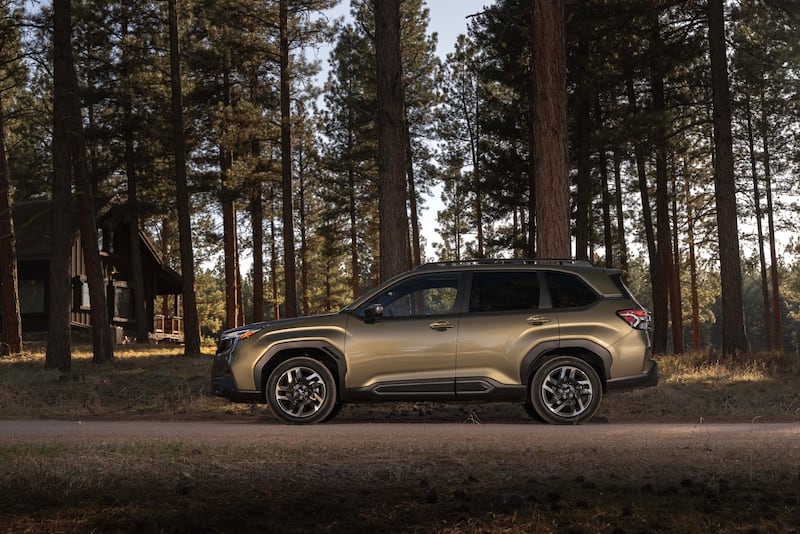
My recent test drive of the 2026 Forester Wilderness was impressive for a couple of reasons. First, the rugged “Wilderness” styling gets big points for attention-grabbing accents; second, I appreciated that the off-road enhancements of this latest Wilderness model balance a “weekend adventure” vibe with a daily driver performance.
My tester came equipped with several noteworthy features that speak directly to the Wilderness mission: 17-inch matte-black alloy wheels wrapped in all-terrain tires (complete with a full-size spare), a robust 3,500-pound towing capacity – the highest ever offered on a Forester – dual front and rear bumper tow points, aluminum underbody protection, an external oil cooler, and raised ladder-type roof rails rated for an 800-pound static load. Inside, you get gray water-resistant upholstery accented with copper stitching and embossed Wilderness logos, and an upgraded Harman Kardon audio system.
All of this goes a long way to making you feel like your Forester could go anywhere you might want to point it. And if you went off the pavement, there would be a certain level of comfort and capacity to bring all the necessities with you.
The Wilderness trim’s key differentiator is capability. Thanks to the all-terrain tires and modest suspension tweaks, the Forester is more confident off the pavement than a standard Forester. Torque delivery from the familiar 2.5-liter DOHC four-cylinder Boxer engine, producing 180 horsepower and 178 pound-feet of torque at 3,700 rpm, isn’t earth-shaking, but I found the engine to be smooth with a predictable power curve.
Mated to Subaru’s Lineartronic continuously variable transmission, the drivetrain emphasizes composure over drama. With the CVT, you won’t have the capability to jump to attention when getting up to highway speeds, and aggressive throttle inputs are met with the kind of patient power curve (think: crossover rather than performance SUV).
The Forester Wilderness is exactly what it’s engineered to be: a versatile, go-anywhere household vehicle, not a rally car in hiking boots. I think this SUV stands out most for its effortless adaptability. Road trips with gear, weekend camp runs with bikes on the roof, and traversing trailheads with confidence all feel well within this vehicle’s comfort zone.
Another key feature is the 3,500-pound towing capacity, a genuine asset if you’re hauling small boats, trailers or toys. This was an area where I feel previous Foresters felt underpowered. The dual tow points on the front and rear bumpers are a small but thoughtful touch for anyone who anticipates remote road travel where a winch or recovery strap could be needed.
I found the road noise is pleasantly muted on smooth surfaces, and visibility (one of the Forester’s longstanding strong points given its higher seating position) remains excellent in all directions thanks to tall glass and slim pillars.
Inside, the Wilderness’s fabric upholstery is comfortable. The water-resistant material is ideal for muddy boots and wet jackets, though it lacks the premium feel of genuine leather or higher-end synthetics in competitors. The contrasting copper stitching and Wilderness logos add character, but the overall cabin materials still lean toward function over flair.
I found space to be generous in both rows. Rear seats fold easily and flat for longer gear hauls, while abundant cubbies and storage bins help keep the cabin organized. The Harman Kardon premium audio, a worthwhile option, delivers clear, rich sound.
Smartphone integration via Apple CarPlay and Android Auto is standard and works well. If I had to focus on a downside for the Forester, it would be the infotainment responsiveness and its design. While the touchscreen system is serviceable and intuitive for basic functions, I found it to lag or be a bit unresponsive throughout my week-long test.
Of course, safety is one of the Forester’s strong suits. Subaru’s EyeSight Driver Assist Technology is standard and bundles adaptive cruise control, lane-keeping assist, pre-collision braking, and a host of monitoring systems that provide effective low-speed and highway support. Newer enhancements like lane-center keep and automatic emergency steering are particularly reassuring on long highway drives. Subaru’s suite of airbags, stable chassis and solid crash-test results further bolster peace of mind.
At a base price of about $38,385, and $42,035 on my tester after $2,200 in added options and destination, the Wilderness sits at a premium over the standard Forester. The payoff in the added cost depends on how much you value the off-road-oriented upgrades and rugged styling.
The 2026 Subaru Forester Wilderness is a compelling choice for drivers who want a capable SUV without sacrificing everyday livability. It doesn’t push the envelope in performance or luxury, but its thoughtful enhancements, from its towing capacity and rugged tires/wheels to robust roof rails, are more than cosmetic.
• John Stein is a freelance journalist based in Chicago. He has more than 25 years of experience driving, testing and writing about the automotive industry, its latest innovations and vehicle performance.