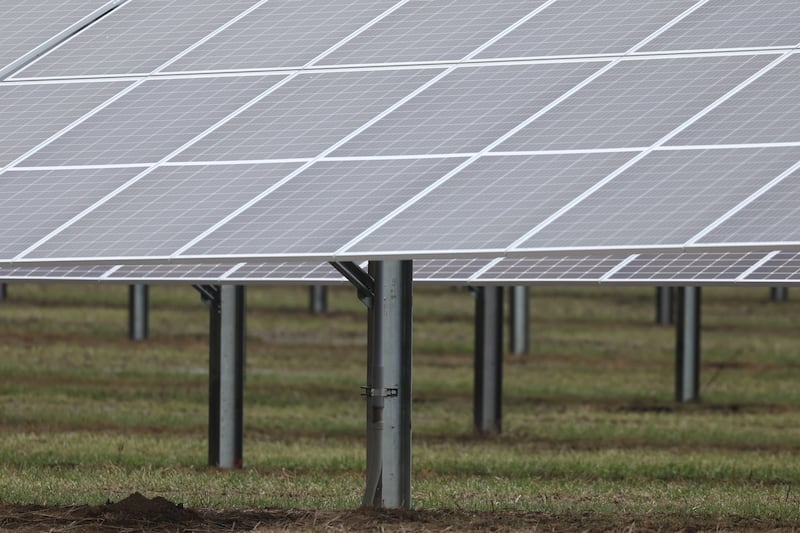
Battles over what amounts to state-mandated solar energy development have reached new heights.
A Will County Board leader suggests that board members who may dare to vote against court-ordered approval of a handful of solar projects could face jail time or fines for contempt of court.
The county has moved the meeting for that vote and others on solar projects to a hotel banquet room to accommodate what is expected to be a huge number of speakers for and against the projects.
That meeting will include plans for the biggest solar plant yet in Will County– a 6,100-acre spread of panels scattered across 96 properties in Manhattan, Green Garden and Wilton townships.
Sixteen neighbors of the so-called Pride of the Prairie solar complex have filed a lawsuit to stop a county board vote on the project.
How this all pans out should be known by Friday when Will County Judge Ben Braun will hold a hearing to find out if the county has complied with his order to reverse previous votes that denied permission for solar farms planned for fields in an and around Joliet, New Lenox, Channahon and Wilmington.
:quality(70)/cloudfront-us-east-1.images.arcpublishing.com/shawmedia/XVLHPV3XC5A43HV4CZRWED2AGQ.JPG)
Will County Board Speaker Joe Van Duyne, D-Wilmington, said members who vote against those solar plans when they come up for a vote Thursday could face jail time or fines.
“According to the judge, the county board is required to approve the projects,” Van Duyne said. “The individual board members can be held in contempt of court.”
Such a ruling would be an unusual catalyst for a conflict that is intensifying between the state and county officials over limits that all but preclude local authorities from having a say over where solar plants can be built.
Van Duyne, who plans to vote in favor of the pending solar projects, has introduced a resolution for the county to send to Gov. JB Pritzker and state legislators calling for changes in the state law that encourages solar energy development and takes away local control over where it can be built.
That law was the basis for Judge Braun’s order demanding that the county board change its vote to approve projects it previously denied.
Those projects are small in comparison to the more recent Earthrise plan to build the 6,000-acre Pride of the Prairie solar plant and another Plum Valley solar complex on 2,400 acres in Crete, Monee, Will, and Washington townships.
:quality(70)/cloudfront-us-east-1.images.arcpublishing.com/shawmedia/ZVLIEXXC2WEFWVXTC5RE7QHOXM.jpg)
The projects covered in Judge Braun’s orders include:
• 140 acres in the Joliet area for Black Road 1 and 2, projects that will include 69 acres at Black and County Line roads and 71 acres at Baltz and County Line Roads
• 142 acres for a Soltage project on South Gougar Road in the New Lenox area
• 64 acres for a Channahon-area project along South McKinley Woods Road
• 139 acres for a Nexamp Solar plan in the Wilmington area along Wilmington-Peotone Road
• 85 acres for a Renewable Properties project in the Wilmington area along Rivals Road
All of that pales in comparison to the 8,500 acres of solar-panel sprawl planned by Earthrise Energy, a plan that also may be unstoppable due to state law aimed at accelerating development of solar energy.
:quality(70)/cloudfront-us-east-1.images.arcpublishing.com/shawmedia/P7ESKBSDXNDJDD4YHHWK6GSOWU.JPG)
But the Will County Board Planning and Zoning Commission on March 31 voted 4-2 recommending against approval of a special use permit for the Pride of the Prairie project.
The Will County Board Land Use and Development Committee was tied 3-3 in a vote on the Pride of the Prairie project, which amounted to no recommendation on the project.
The committee voted 4-2 to recommend the Plum Valley project.
The future of the Pride of the Prairie project could get tied up in a lawsuit brought by neighbors of the future solar complex.
Attorney Steven Becker filed the lawsuit on Tuesday alleging that he was illegally denied an opportunity to present evidence on the project and pose questions to developer Earthrise.
Becker contends that both county ordinance and state law allowed for cross-examination of Earthrise and the presentation of evidence counter to its proposal at the public hearing held by the planning commission.
:quality(70)/cloudfront-us-east-1.images.arcpublishing.com/shawmedia/SRNDB6TMW5C63JU43ULE7DJLFU.JPG)
Instead, he, like everyone else at the public hearing, was given five minutes to state his case.
“This is more than 6,000 acres with 96 parcels,” Becker said of the Pride of the Prairie plan. “You would have to allow cross examination. All of my clients have different parcels. And, they all might have different problems with it.”
Becker is seeking a court ruling that would force the Pride of the Prairie case back to the planning commission, so he could make a case for his clients.
A ruling on his side, if it comes before Thursday, would delay a county board vote on the Pride of the Prairie case.
Even though the planning commission recommended against the solar plan, Becker said his client’s case should be made to provide more information to the county board before it considers the Pride of the Prairie plan.
Also, Becker suggested more litigation could be in the works on the Pride of the Prairie plan.
Without his clients’ case being made at the plan commission stage, he said, “We wouldn’t have anything in the record for litigation.”
:quality(70)/s3.amazonaws.com/arc-authors/shawmedia/c957a8ff-14a0-492e-82d7-3c005b3cd732.png)