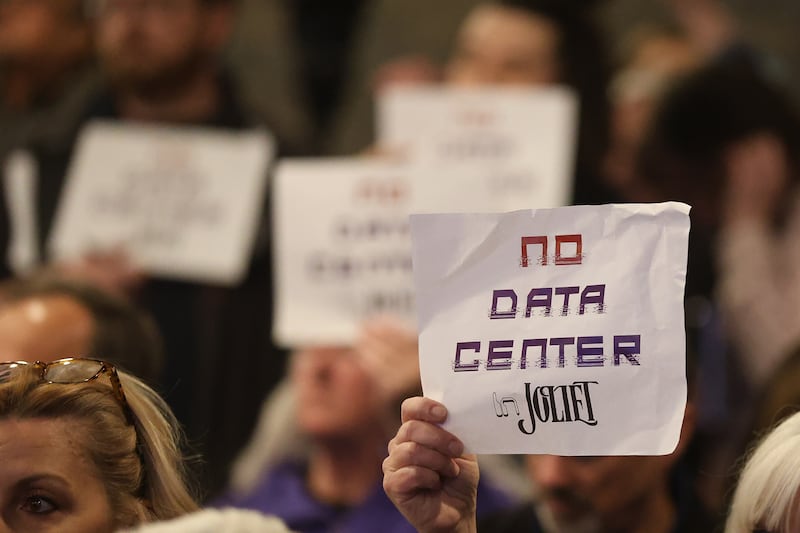
The Joliet City Council on Thursday approved a controversial 795-acre data center that will be built over the next several years.
The vote was 8-1 in favor, with District 5 Councilwoman Suzanna Ibarra being the lone no vote. The data center property is on the edge of her district, which Ibarra said has been “the dumping ground for what other districts don’t want.”
Councilman Cesar Cardenas said the data center is “good for Joliet.”
“We are the third largest city in Illinois, and with that comes opportunity,” Cardenas said.
Mayor Terry D’Arcy emphasized the $677 million in property taxes the data center is expected to generate for Joliet Township High School District 204.
“There are a lot of good things that will come from this,” D’Arcy said.
:quality(70)/cloudfront-us-east-1.images.arcpublishing.com/shawmedia/MJI4J257OJB7FAJDJ5GTJRA3D4.JPG)
The City Council chambers were filled 30 minutes before the meeting, mostly with union construction workers there to show support for the data center. Seats in an overflow room outside the chambers also were full with people watching the meeting on a television.
The council approval was for an annexation agreement for the Jackson Township site located in the area of Rowell and Bernhard roads.
It was the green light needed for the Joliet Technology Center amid opposition that showed up Monday night for a public hearing that lasted 6 1/2 hours.
The hearing lasted so long that it pushed the council meeting past midnight, when it had to be recessed so as not to violate a state law banning public meetings on election days. Tuesday was the day of the primary election in Illinois.
Developers Hillwood and PowerHouse Data Centers plan to start building in early 2027, Hillwood Executive Vice President Don Schoenheider told the council on Monday.
:quality(70)/cloudfront-us-east-1.images.arcpublishing.com/shawmedia/PMHJJPN7F5FO3AAHB7S6VXWXNI.JPG)
The plan is to complete the first sub-campus by 2028 and to continue building the remainder of the Joliet Technolocy Center through 2032, Schoenheider said.
The Joliet Technology Center is designed for four sub-campuses, each of which would contain six buildings. Buildings would be two stories, and the total square footage is planned at more than 6.9 million square feet.
At full use, the Joliet Technology Center would use 1.8 gigawatts of power, which is nearly the entire generation capacity of the Hoover Dam. According to the U.S. Department of Energy website, the Hoover Dam generates about 2 gigawatts of power.
:quality(70)/cloudfront-us-east-1.images.arcpublishing.com/shawmedia/ZLJMRR3MLZDXNPNKLZJKQLPBCU.JPG)
Experts testifying on behalf of the project at the public hearing on Monday said the Joliet plan was presented to PJM, a regional transmission organization that coordinates the movement of electricity in 13 states, including Illinois, and no concerns were expressed there about the availability of power.
But many residents opposing the plan said they were worried about the impact the Joliet Technology Center would have on the availability and cost of electricity.
“Who will be favored if there is a brownout?” asked Craig Herr, a Joliet resident and retired pastor of the First Presbyterian Church of Joliet.
“How comfortable are you with rising electric bills, and they are rising,” Herr said to the council.
Proponents argued that if the project was not built in Joliet, it would be built elsewhere and have the same impact on the availability of electricity, which is spread over a multi-state power grid.
What Joliet would lose are the benefits, advocates argued.
The project promises between 7,000 and 10,000 jobs through construction, 700 permanent high-paying jobs once it’s fully operational and millions of tax dollars in the coming years.
Joliet expects to get $310 million in property taxes and $41 million in property taxes over 30 years.
But the Joliet Technology Center would generate a total of $2.1 billion for all taxing bodies, including schools and other units of local government, over 30 years, according to Hillwood.
Joliet also has an agreement in which Hillwood will provide the city with an additional $100 million in the coming years as the project is built.
:quality(70)/s3.amazonaws.com/arc-authors/shawmedia/c957a8ff-14a0-492e-82d7-3c005b3cd732.png)