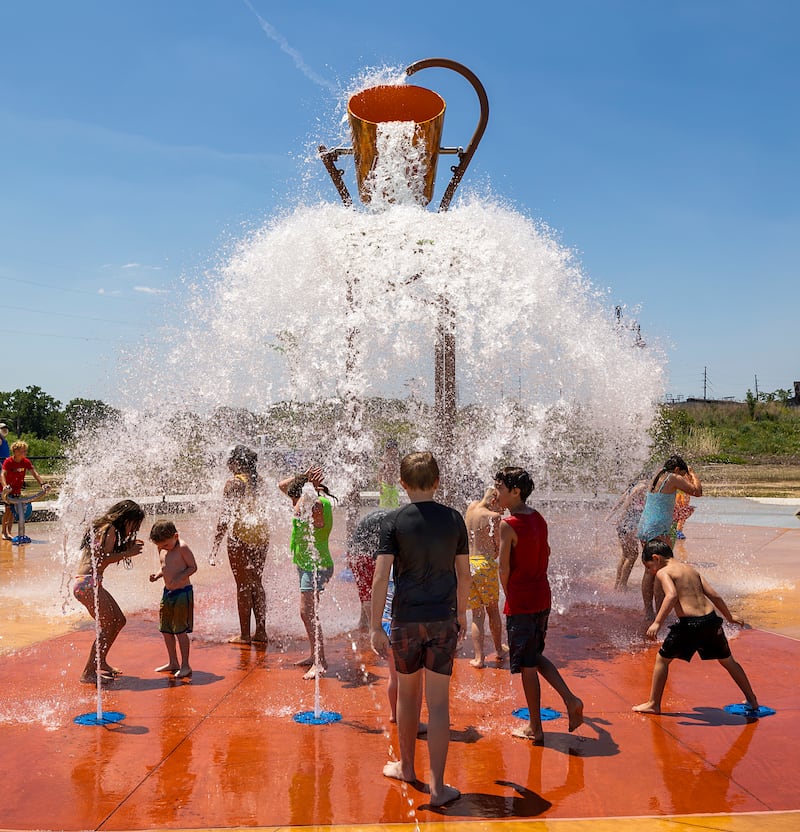
A ribbon-cutting set for Saturday, June 13, will officially open Northwestern Steel and Wire Park on Sterling’s riverfront but for Riverfront Commission co-chair Terry McGuire, the work put in by the commission over the last four years already has been rewarded.
“We were at the farmer’s market late Saturday morning, and I looked over. The park was just packed. The fact that so many members of the community are enjoying the park already and will be enjoying it for many years to come, that is very, very rewarding,” McGuire said.
A little more than four years ago, McGuire was approached by city officials and asked to co-chair, along with Marc Geil, then global director of culture and employee experience at Wahl Clipper and now vice president of talent development and culture at Integrated Dermatology, to chair a commission to develop Sterling’s riverfront.
The task was enormous: Come up with a plan to develop and redevelop former heavy industrial sites, including the former Lawrence Brothers site, the former National Manufacturing site and the stretch of riverfront that used to be the site of some of the Northwestern Steel and Wire steel mill complex.
“They said one of the first goals of this is to build a park in this riverfront space,” said McGuire, senior vice president of the supplier network for Halo Branded Solutions.
McGuire and Geil both accepted and brought other volunteers onto the committee.
The first year of the project involved meeting with representatives throughout the Sterling community.
“We wanted representation from the entire community so we could find out what they would find value in for that space. So this really is a community park in the respect that members of the community had input in what you see in the park today,” McGuire said.
Fundraising was the next step, and McGuire and the commission found out quickly that their dream would cost more than expected.
“The city had an original budget of around $6 million for the park portion of this. With all the things the community members wanted, we got estimates of how much those things would cost, and it ended up being closer to $10 million,” McGuire said.
One of the common themes that the commission heard from community members and groups was that they wanted a space that could be used year-round.
“The focus groups we met with weren’t interested in a park that would be open from Memorial Day to Labor Day. They wanted a space to use year-round,” McGuire said.
The park was separated into three phases: the first to be a playground and splash pad, then the second and third phases to be the construction of parking next to the park and then the construction of an amphitheater behind the park pavilion.
“We did the design in a way that the park can be useful today. It’s open today. And the second and third phases, as they get developed, won’t disrupt use of the park while they are getting developed,” he said.
Once a concept was developed, fundraising was started by the Sterling Riverfront Foundation, the 501(c)(3) foundation arm of the riverfront project.
“The reason we created the foundation was to try to raise more funds for the second and third phases of the park,” McGuire said.
He said that when local donors saw the concept, especially the year-round use aspect of the park, they were all in. So far, over $3 million has been committed to the park project by donors to the Riverfront Foundation.
Once the ribbon is cut Saturday, the commission’s work isn’t finished, nor is the park complete.
Enough money has been raised so that the components in the third phase plans have been able to be included in the first and second phases.
“We were able to raise more money than we thought. There was just a lot more enthusiasm and energy in the community to get the park completed,” he said.
The second phase, expected to be completed in the second half of 2027, includes a parking lot next to the NWSW Park, and an amphitheater in back of the NWSW Park pavilion.
“The biggest feature will be the amphitheater. Between the current pavilion and the river, that space will be turned into a grass amphitheater so you can have performances. There’s an area in back of the pavilion that could be set up as a stage for concerts and performances,” McGuire said.
The commission will continue to meet.
“We want to make sure that we move forward and come to completion on the second phase of the park so the park will be completed. Then there still will be work to do in terms of developing the rest of the riverfront,” McGuire said.
McGuire said the park complex reflects the legacy of the manufacturing giants that helped build and grow the local community for generations.
“This park will be used, and used year-round, for years to come. It really is a generational park for the city of Sterling, something that generations of residents will be able to use and enjoy,” he said.
:quality(70)/s3.amazonaws.com/arc-authors/shawmedia/45a20eef-b8d1-4d42-b8b1-b5f9fb81a1b3.png)