Since its founding in 1894, the Reynolds Wire mill employed thousands of workers over a span of more than 65 years. This final episode tells the story of how the company finally ended its long tenure in Dixon.
President Lucile
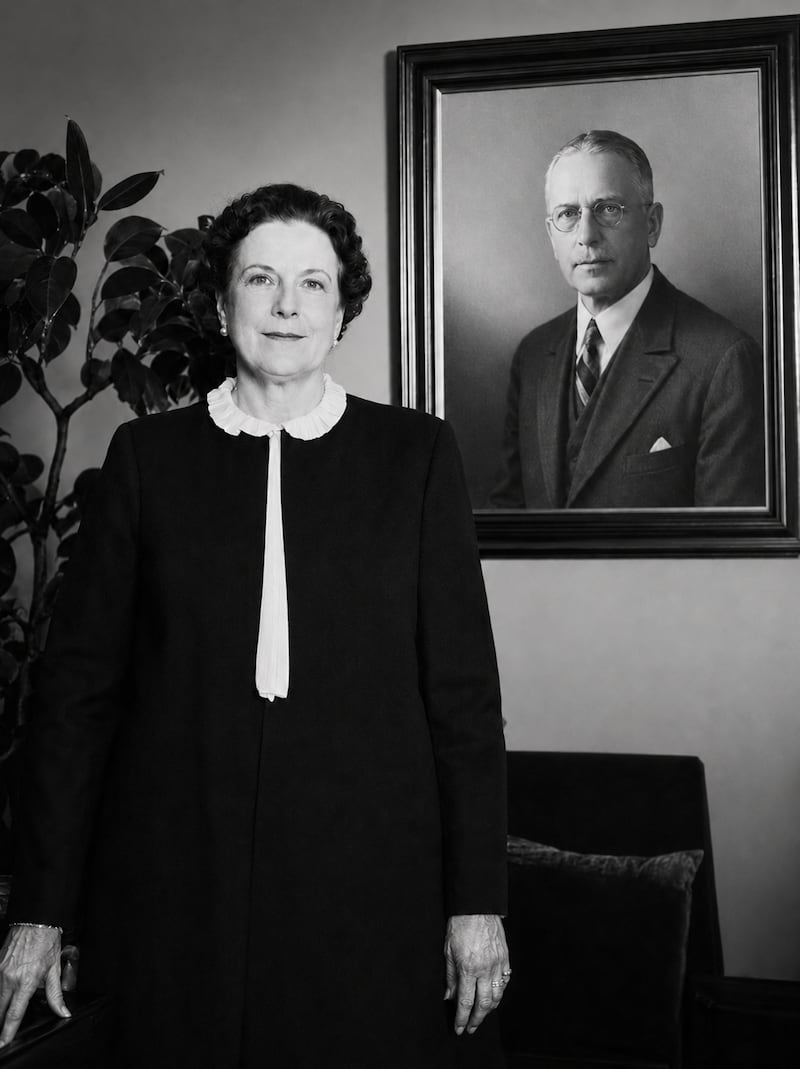
When John Gould Ralston died suddenly in 1937, the Reynolds family had run out of men to run the company. So, the company’s board of directors turned over the reins to John’s widow, 49-year-old Lucile Ralston, the daughter of company founder Horace Reynolds.
Lucile then had two daughters, aged 13 and 11. She had the Reynoldswood farm in Dixon, a 250-acre estate with several household and farm employees. And now, she had responsibility for the success of the Reynolds Wire factory, a market stretching across most of the country, and the livelihood of hundreds of employees.
At that time, manufacturing was heavily male dominated, and women made up only about 25% of the U.S. workforce. Less than 1% of all company leaders were female, and Lucile was described as “the only woman executive in her field of manufacturing.”
Reynolds Wire in the atomic bomb
Yet, under her leadership, the company prospered, even working around the clock through World War II. On Aug. 15, after the U.S. dropped atomic bombs on Hiroshima and Nagasaki, Emperor Hirohito announced Japan’s acceptance of the unconditional surrender terms.
Three days later, the government informed Reynolds Wire that it had played a role in the super-secret Manhattan Project that produced the bomb. The Telegraph published the news that same day, noting that the Dixon firm had produced a “very fine mesh woven wire made from pure nickel” that was used to create the bomb.
For years, the Dixon employees at Reynolds Wire took pride in their role in ending the war in the Pacific.
The Reynolds-Dillon connection
The Reynolds story includes noteworthy connections between the Reynolds family of Reynolds Wire in Dixon and the Dillon family of Northwestern Steel & Wire in Sterling.
In 1931, W. Martin Dillon of Sterling, the son of Paul W. Dillon (1883-1980), married Helene Reynolds of Dixon. Helene was the daughter of Elmer Reynolds, an executive with Reynolds Wire and the nephew of founder Horace Reynolds.
“Martin” Dillon (1910-1989), who grew up in the Dillon Home (now Museum) in Sterling, became president of Northwestern Steel & Wire in 1951 and was chairman of the board until 1986. Helene’s Garden is now a feature of the Dillon Museum property.
In 1949, Crete Bowman of Sterling, the granddaughter of Paul W. Dillon, married Douglas Gray Harvey Jr. of Dixon. Douglas was the grandson of Horace Reynolds, former president of Reynolds Wire.
When they married, the Telegraph headline announced, “Wedding Unites Prominent Dixon and Sterling Families.” Crete Harvey became well known in Republican politics and as owner of the Harvey Arabian Horse Farm near Sterling.
Time to sell
By 1950, the Reynolds Wire workforce included 450 employees in Dixon. Its net earnings in 1949 were $516,000, $7.2 million in today’s dollars.
Lucile, now 62, had led the company through the end of the Depression, World War II, and the post-war boom. With her two girls grown and no family successor waiting in the wings, she decided it was time to sell and retire.
National-Standard, based in Niles, Michigan, bought the Reynolds Wire factory, including the 126-acre Reynoldswood estate, for $4.5 million in cash ($62 million today). The new owner had 10 plants from California to England.
Lauding Lucile
On June 8, 1950, a large community banquet at the Masonic Temple honored Lucile Ralston as the outgoing president of “Dixon’s last major home-owned industry.” Business leaders throughout the Midwest attended, including Illinois Lt. Gov. Sherwood Dixon, who praised Lucile for her “strong character” and “courage in abundance.”
Dixon businessman Ed Vaile, emcee, read a letter from John Steelman, assistant to President Harry Truman. Steelman wrote that Lucile was “one of the ablest business administrators I have known … a most talented, gracious and pleasant personality.”
Responding to the many accolades, Lucile humbly said, “I never wanted to be a businesswoman, but once I took over, I tried to do a good job.” Later, an article in Hong Kong would dub her “the Gentle Lady of Steel.”
Why they left Dixon
After the departure of Reynolds family management, the company suffered its first-ever strike by the steelworkers’ union in 1952. The management-union clashes peaked in 1961 when the company said that the Dixon plant was inefficient and a threat to profitability.
To rectify the problem, the company asked its 350 union employees to accept an average hourly wage reduction of 69 cents/hour and a three-year freeze on wage increases. At the time, the average wage at Reynolds was $2.60 per hour, the equivalent of $28.70 per hour in 2026. The proposal would have cut the average worker’s pay by 26%.
If the union accepted these measures, the company would build a new, efficient factory in Dixon. If the union rejected the proposal, the company would close Dixon and move to Kentucky.
The union refused the offer. So, National-Standard closed the Reynolds Wire plants in Dixon on March 21, 1962, and moved its operations to Corbin, Kentucky. Dixon employees had the option of moving to Kentucky, but few did. Hundreds lost their jobs.
Picking up the pieces
Within two months, C. K. Willett’s engineering firm bought the Reynolds office building on East Second Street, and Beier and Co. of Chicago purchased the east-end Reynolds plant on River Road.
Years later, in 1974, a group of local investors bought the vacant four-story Reynolds Wire factory at First Street and Crawford Avenue. After renovations, they named the building Commerce Towers. KSB Hospital then bought it in 1988.
In 1958, the Reynoldswood estate became Camp Reynoldswood, a Methodist church camp. All these properties, except the Beier factory, continue operations today.
The rest of the story
After the death of Douglas Gray Harvey in 1930, his wife, Pauline (Reynolds) Harvey, married composer Emerson Whithorne and moved to New York. She died there in 1965 at age 80 but was buried in the family plot at Oakwood Cemetery in Dixon.
Lucile never remarried but remained close to her family. After leaving Dixon in 1951, she soon moved to Nantucket Island in Massachusetts. In 1975, she had her husband’s coffin and gravestone moved from Oakwood to Nantucket Island. After a long and fulfilling life, Lucile died there in 1977 at age 88 and was buried next to her husband.
Today, 75 years have passed since the Reynolds family left Dixon. But the family legacy lives on through Reynolds Field, Camp Reynoldswood, Commerce Towers, Girl Scout memories of Camp Ralston and Harvey Hall, and the stunning Reynolds-Harvey-Ralston monument at Oakwood Cemetery.
- Dixon native Tom Wadsworth, PhD, is an author, speaker and occasional historian. His popular new book, “Distinctive Dixon: Fascinating Stories of Dixon’s Rich History,” is available at Books on First in Dixon.