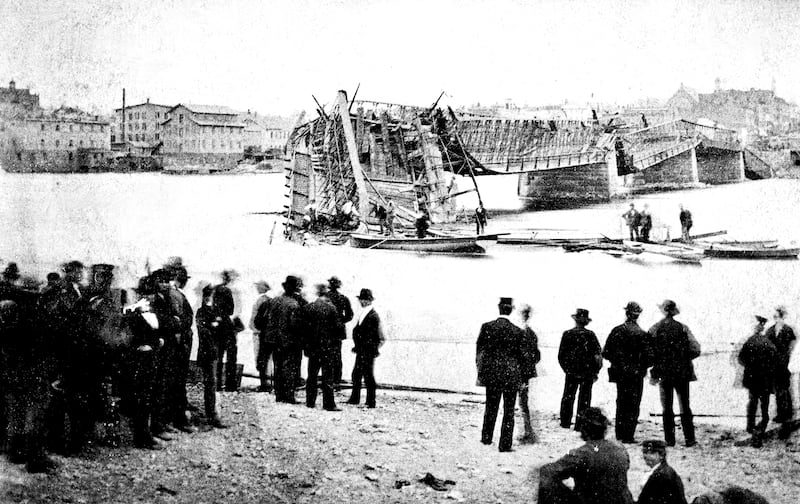
With its 46 deaths and 56 injuries, the Dixon’s Truesdell bridge disaster is the worst road bridge disaster in American history. Stories about “Dixon’s Darkest Day” often focus on its horrific elements. But this column will focus on its heroic elements.
Saving souls
The bridge collapsed on Sunday, May 4, 1873, while pastor J. H. Pratt of the Baptist church was conducting the baptism of six people on the north shore of the Rock River, just west of the Galena Avenue bridge. After a crowd of 150 to 200 observers had amassed on the bridge’s sidewalk, the bridge suddenly collapsed, plunging all these victims into the strong current of the Rock.
Rev. Pratt later admitted that he delayed the start of the baptism ceremony, hoping to maximize the crowd. As the Chicago Daily Tribune reported, he “detained the crowd longer than is customary, feeling the importance of impressing upon them the advantage to be derived from ‘coming to Jesus.’”
While Pratt bore significant grief over the event, he was also one of the heroes of the day. The Tribune noted that Pratt knew the river’s depth from conducting previous baptisms at that spot. So, “through his individual efforts, 10 or 15 were saved.”
Quick thinking
When the calamity struck, many people panicked and didn’t know what to do. But as newspapers reported, several citizens “more self-possessed … went nobly to work to rescue the living and recover the dead.”
For example, when the bridge crashed into the river, two little sisters clung to each other and to a portion of the bridge’s ironwork. One man saw their desperate situation and quickly launched his boat. Speedily rowing to them, he pulled the exhausted girls aboard before the waves could carry them away.
Only the strong survive
Men performed 100% of the daring rescues. By contrast, 80% of the fatalities were women and girls. Women were certainly compassionate and helpful, but the layers of fabric in women’s dress styles hampered their chances of survival and their usefulness in water-borne rescue efforts.
Rescuers needed to be able to swim against a swift current, stay focused during a panic and endure the cold spring water without succumbing to its relentless flow. Such a disaster required the intervention of athletic, strong and brave men whose clothing styles did not restrict their efforts.
B. F. Shaw’s son
The Telegraph praised three young men for their daring escape and rescue efforts. “Will Schuler, Joe Haden, and Eustace Shaw narrowly escaped by swimming to the shore after freeing themselves from the ironwork on leaping from the bridge into the river.”
The Tribune described Shaw as “a young man of amphibious ability, who can swim like an otter.” After rescuing himself, he “bravely sallied forth to rescue the drowning, bringing several to shore.”
Eustace Shaw, then only 16, was the son of B. F. Shaw, the founder of the Shaw chain of newspapers. Eustace would later become the associate editor of the Telegraph before his untimely death from a heart attack in 1902 at age 45.
:quality(70)/cloudfront-us-east-1.images.arcpublishing.com/shawmedia/4L3SHBNE5JCOBBASZSHU7GHROE.JPG)
B. F. Shaw’s nephew
B. F. Shaw’s nephew, 23-year-old Edgar Patrick, “leaped into the river and saved several lives.” While he was pulling one victim toward shore, he felt the body of a woman brushing against his leg.
Patrick then reached down with his free hand, grabbed the woman’s dress and “struggled toward shore with both.” As he reached shallow water, William Van Epps ran down to the bank to help him, only to find that the woman Edgar just saved was William’s mother.
Jacob Armstrong Jr.
The crash also plunged Jacob Armstrong Jr., a 22-year-old shoemaker, deep into the water. He then crawled on the bottom of the river to escape the trappings of the bridge. Underwater, he fought off others who were grabbing at him, desperately trying to reach the surface.
Armstrong, described by the Telegraph as “an athletic young man,” finally reached the surface. But after saving himself, he then ventured forth to save others.
Reviving Clara Burr
John Barry, 28, saw an unconscious female floating “some distance below the bridge.” Springing into the river, he pulled out 15-year-old Clara Burr. Since she showed no signs of life, he attempted to revive her by using some lifesaving tactics that were popular at the time.
First, he rolled her body on a barrel to release water from her lungs. Then, he removed her clothing and “rubbed and chafed” her for over an hour.
According to the Dixon Sun, the rubbing and chafing brought her back to life. Her father and brother, who had been frantically searching for her, found her just as she revived.
Dailey and Means
When the bridge collapsed, the long wooden planks of the bridge floor were released into the water. Many survivors saved themselves by clasping onto these planks.
William Dailey, seeing the lifesaving qualities of these planks, waded into the river, grabbed a floating plank and extended it repeatedly to retrieve those who were thrashing in the cold water. In all, Dailey saved 16 souls from the cold current.
Older men were also fully engaged in rescue efforts. Isaac Means, the 58-year-old brother of Charlotte Means (the victim of the 1851 “fatal fluid” tragedy reported in our last column), “worked hard all day Sunday and Monday,” said the Dixon Sun. “He was everywhere.”
Heroes of North Dixon
Many North Dixon residents opened their nearby homes, where rescuers brought survivors and the dead. As the Dixon Sun reported, these citizens were not wealthy, yet they “did not spare their substance during our trouble.”
They shared blankets, clothing, sheets, quilts and beds as “materials of every description were demanded and were freely given and without a question.” The Sun said that their services “ought to give us a nobler estimate of humanity than has ever entered our conceptions.”
Soon after the collapse, the “blame game” began. People started pointing fingers at various suspects who might have contributed to the bridge disaster. The bridge builder was rightly blamed, but the City Council, the Baptists and the bridge superintendent endured harsh criticism.
But for this column, I’m pleased to commemorate the Dixon heroes who jumped into action and helped their neighbors when it was needed most on Dixon’s Darkest Day.
- Dixon native Tom Wadsworth, PhD, is an author, speaker and occasional historian. His popular new book, “Distinctive Dixon: Fascinating Stories of Dixon’s Rich History”, is available at Books on First in Dixon.