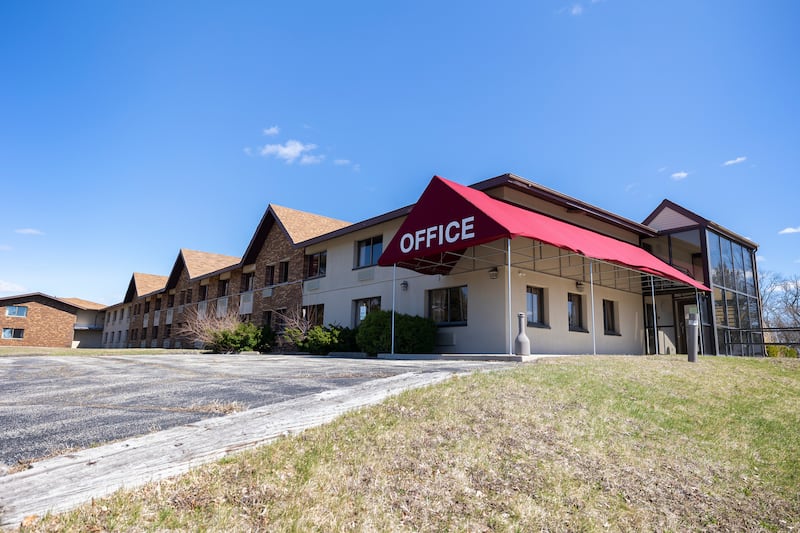
A Chicago developer made his pitch Wednesday to turn the former Magnuson Hotel near Dixon into apartments during a hearing in front of Lee County’s zoning officer, but faced opposition from nearby residents.
The former Magnuson Hotel, at 443 Route 2 in Dixon, was ordered by a Lee County judge to close down due to safety concerns in late 2024. The building’s new owners, Tomasz Klimowski and Edin “Eddie” Begic, plan to convert it into a modern, 70-unit apartment building.
Lee County officials believe that plan is a good thing, but residents of a riverside subdivision behind it aren’t convinced.
The Magnuson “went through a really bad period there and the neighborhood is scarred,” Lee County Zoning Administrator Alice Henkel told Shaw Local.
Prior to the hotel’s 2024 closure, the former owner was operating it as an extended-stay hotel and there were many issues that negatively impacted the area, specifically subdivisions Castellan and Castellan Heights, Henkel said.
Henkel said county officials “heard of standoffs, police presence, raids, people running through yards.”
One such event happened in late 2023, when one of the hotel’s residents threatened a man with a gun and triggered a lengthy armed standoff with police.
“Our goal is to see that that does not happen again in the future,” Henkel said.
The property’s new owners, who own and manage several Chicago rental properties, plan to offer 12 studios, 36 one-bedrooms, 17 two-bedrooms and five three-bedrooms for a one-year lease at market value. It’s also planned to have a shared outdoor space for residents and sufficient on-site parking, Klimowski said at Wednesday’s hearing.
Klimowski said they’re investing about $2 million of their own funds for the renovations, which would largely gut the entire building.
But before that can happen, the Lee County Board needs to approve the owners’ petition to change the property’s zoning from general business to multi-family residential, which was the subject of Wednesday’s hearing in front of county Zoning Hearing Officer Brian F. Brim. The change previously received a vote of “no objection” from the Palmyra Township Board and Dixon City Council.
Henkel said changing the zoning to a residential district “is really going to limit what can be done with that property and will be better for the neighborhood in the long run.”
There are over 100 possible ways an owner could use a property in that current business district, but in multi-family residential there are only 15 residential or institutional land- use options. The surrounding areas, including Castellan, are also primarily residential districts, Henkel said.
However, many Castellan residents who attended Wednesday’s meeting said that a large apartment building would differ greatly from the character of their subdivision and negatively impact their property values.
At full capacity, it could be home to upward of 100 people which, resident Teresa Cisneros said, is probably the entire population of their “quiet subdivision on the river.”
There will be “a lot of noise. A lot of light. A lot of traffic,” Teresa Cisneros said. “It’s going to affect our resale of our houses and it’s really important to all of us because that’s where all of our money is.”
At the meeting, residents also expressed concern about its potential impact on the area’s infrastructure and, particularly, the private well water.
The owners “bought this building without doing any real tests to see how it’s going to affect the infrastructure,” resident Ashley Kaecker told Shaw Local.
It’ll likely have “a lot of wear and tear on the infrastructure,” resident John Cisneros said and noted worries of the well going dry, pollution to the river and fungus in the building.
Klimowski said that based on his experience with these types of projects, he doesn’t anticipate it being a problem. The plans will also have to be approved by engineers, architects and meet all building department requirements, he said.
Lee County Building Official Joe Bay told Shaw Local both areas are hooked up to Dixon city sewer and that department’s manager did not have any concerns, nor did the engineer.
Before the Magnuson was ordered to close in 2024, it had several safety and some mold issues because the plumbing wasn’t properly maintained. After the water was shut off, the mold began abating itself because it lost its moisture source, Bay said.
Bay recently visited the Magnuson property and determined it to be sound. The building is mostly concrete and the new owners will be tearing out a majority of the walls.
“I was very much shocked as to how bad the condition was not,” Bay said.
Prior to Jan. 1, 2025, the county didn’t have its own building regulations. The state now requires counties and municipalities to adopt their own and, Bay said, officials have been working on those for the last eight months.
“What we’re trying to accomplish with this is just a standard”, which includes property maintenance, contractor registration and the energy efficiency of new structures to ensure “they’re not going to be a substantial drain on our infrastructure,” Bay said.
It’s also intended to ensure that structures don’t become run down and dilapidated, which should help residents’ property values, Bay said.
The proposed regulations will be presented to the board at its April 23 meeting and are expected to be voted on at the May 21 meeting.
Another question residents asked Wednesday is if the apartments would offer any kind of low-income housing.
Klimowski said no, explaining he’s had experience with such housing and wouldn’t go down that road again. A property manager will be at the building at all times, and for renters to qualify for a lease they’d need to complete a background and credit score check, he said.
Henkel said that “area is not suitable for low-income housing because it is so far away from amenities.”
“Another big concern is that we don’t actually know anything about” the owners. “We know that they’re from Chicago and anyone who lives in Dixon looks at Chicago like it’s a third- world country,” Kaecker said.
Teresa Cisneros also asked county officials if they considered the La Salle factors, which is a list of criteria intended to balance individual property rights with public welfare that local officials are required to evaluate when making zoning decisions.
“It’s really not in our welfare and the job of the county...is to make sure that it’s in the best interest of the people who live there [and] the people in the county,” Teresa Cisneros said.
Henkel said the county did evaluate those factors and believes the project meets that criteria.
“At the end of the day, we [Lee County] need housing,” Bay said. That’s “one of the reasons that I feel positively about this, that there’s somebody who’s taken an interest and is willing to invest into the community.”
Dixon residents have expressed a need for more housing since at least August 2024 when the city began drafting its comprehensive plan that outlines the city’s long-term goals.
One major area of the plan, approved Jan. 20, is increasing the amount of available housing. It specifically identifies one solution, referred to as the “missing middle,” that would mix small apartment buildings into existing neighborhoods.
The county board is also working to increase available housing. One of those projects utilizes a grant from the Illinois Housing Development Authority to demolish and rehabilitate abandoned residential properties. Another is an ordinance the board approved March 19 that allows single-family homes in certain zoning districts to have a second, smaller, house on its lot.
Based on Wednesday’s zoning hearing, Brim will write a report for Henkel to present to the board before members cast their votes.
“It’s important to remember that this is not a permit for them to get started building anything,” Brim said, adding that it’s just one step in a process that will require several more approvals going forward.
:quality(70)/s3.amazonaws.com/arc-authors/shawmedia/0e4ec010-1273-46f1-8fc4-c5fe7fe40794.png)