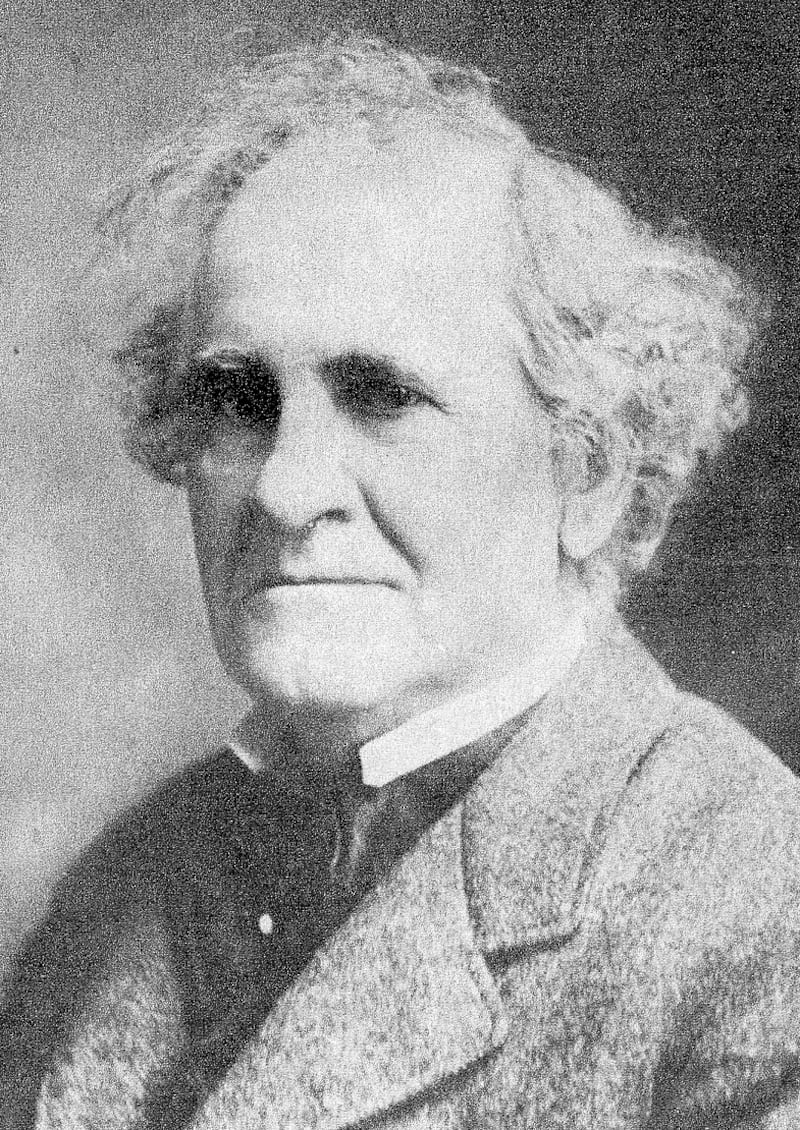
Editor’s Note: This article commemorates the 175th anniversary of Shaw Local in 2026.
Contrary to some reports, Benjamin Flower Shaw was not involved with the Dixon Telegraph when it first came off the press on May 1, 1851. At that time, Shaw had been working in Rock Island since 1847, learning the printing and newspaper business with the Rock Island Advertiser.
Shaw and Patrick
But in the fall of 1851, 20-year-old B. F. Shaw came to Dixon to visit his sister, Phoebe, who had married a Dixon attorney, Shepard G. Patrick. Shaw then became involved with the new Dixon newspaper and its owner and founder, Charles Fisk. Even though Shaw was only 20, he brought four valuable years of newspaper experience.
In October 1851, Fisk sold the paper to M. T. Bull and J. F. Hopper. Bull happened to be a relative of S. G. Patrick, B. F. Shaw’s brother-in-law. On Jan. 10, 1852, Hopper left the business, and Shaw became co-publisher with Bull, his shirttail relative.
Shaw and Eustace
But two weeks later, on Jan. 24, 1852, 30-year-old John V. Eustace, an attorney in partnership with S. G. Patrick, bought out Bull. Eustace then became the proprietor and editor of the newspaper, while Shaw became the publisher (the general manager), working daily with Eustace.
For the young and single B. F. Shaw, his collaboration with Eustace provided an additional personal benefit. John Eustace had a little sister, “the beautiful Anna Eustace,” who was only 15 and living with her brother.
We know no details of the courtship of Ben Shaw and Anna Eustace, but they were married in November 1853 when Ben was 22, and Anna had just turned 17. To their union, three children were born: Fred (1855), Eustace (1857) and Lloyd Shaw (1864).
Side note: Eustace Drive in Dixon likely was named after Eustace Shaw by his widow, Mabel Shaw, who bought and developed that area in the 1940s.
By April 1854, the demands of John V. Eustace’s legal career led him to sell the Telegraph to B. F. Shaw. The paper has remained in the Shaw family ever since.
Nonpartisan watchman upon the walls
In Benjamin Shaw’s first issue as editor and publisher on April 27, 1854, he likened his editorial role to that of “a watchman upon the walls of a city … to warn you of a coming enemy … of any unscrupulous politicians, who would sell you for the sake of self-aggrandizement.”
He promised, as did his predecessors, that the paper would not align with either of the two major political parties, the Whigs or the Democrats. Shaw wrote, “We shall not be ruled or dictated to, by any party or faction, but always endeavor to expose the follies or advocate the wise principles of either.”
However, only one month later, the Democratic-controlled U.S. Congress passed the Kansas-Nebraska Act, which effectively allowed the expansion of slavery in new Western territories. Anti-slavery citizens were irate. The Dixon area, which had been largely settled by people from abolitionist states in the Northeast, was strongly anti-slavery.
No longer neutral
By 1856, the Telegraph — and other Illinois newspapers —could remain neutral no longer. On Feb. 22, 1856, 24-year-old Ben Shaw was one of 12 Illinois newspaper editors who held an “Editorial Convention” in Decatur to forge an effective opposition to the expansion of slavery.
Abraham Lincoln, the only non-editor in attendance, addressed these editors “for some half hour, in his usual masterly manner, frequently interrupted by the cheers of his hearers.” The assembled editors then resolved that a state convention be held on May 29 in Bloomington, which became known as the state’s first convention of the newborn Republican party.
The mass meeting in Amboy
On March 15, Shaw reported in the Telegraph about the Decatur meeting and the growing Republican movement. Six weeks later, at a “mass meeting of the citizens of Lee County” in Amboy on April 26, 1856, the attendees declared their “adherence to the Republican party” in opposing “the accursed institution” of slavery.
In the May 3 Telegraph, Shaw published all the resolutions passed at the Amboy meeting, urging “an attentive perusal by every reader of the Telegraph.” He then openly declared, “We intend to fight during the coming [presidential] campaign” for these “fundamental principles.”
Lincoln in Dixon
Two months later, Lincoln came to Dixon in July 1856, speaking on the courthouse lawn in support of John C. Fremont, the first Republican candidate for president. Shaw then reported that Lincoln “took the stand and for over two hours held that vast audience in breathless silence, save when interrupted by an uncontrollable outburst of applause.”
“Mr. Lincoln … proved the Democratic party to be a slavery-extending party and a sectional party,” said Shaw. “We only regret that every voter was not present to [hear] his convincing arguments.”
The Telegraph thus ended its position of neutrality in politics. For the next 150 years, the Telegraph would be widely known as a Republican-leaning newspaper, yet still retaining the freedom “to expose the follies or advocate the wise principles of either.”
The story of B. F. Shaw reveals his remarkable role in Illinois’ opposition to slavery, the history of the Republican party and Dixon’s relationship with Abraham Lincoln.
Shaw continued his leadership of The Telegraph until he died in 1909 at age 78. To this day, The Telegraph is known as “the third oldest, continuously owned and operated family newspaper company in the United States.”
- Dixon native Tom Wadsworth is a writer, speaker and occasional historian. He holds a Ph.D. in New Testament.