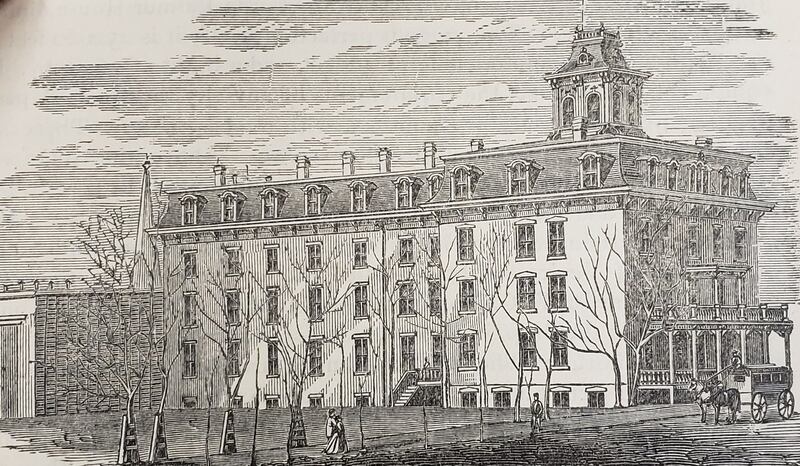
In 1880, when the Dixon Telegraph published the “History of Dixon and Palmyra,” the Nachusa House stood proudly as the hospitality centerpiece of Dixon.
As the Telegraph then noted, “The hotels of a place take considerable prominence in the mind of the traveling public in forming an opinion of a town, and in this way good hotels greatly assist in creating a favorable knowledge of a city over a wide extent of country.”
It then added, “First in the list we shall mention the Nachusa House.”
Perfect timing
Erected in 1853, the timing was perfect. The village of about 1,000 was filled with “the great thrill of excitement” that two railroads were being constructed to merge at Dixon. One came from the south, the Illinois Central, and the other came from the east, later called the Chicago & North Western.
Anticipating growth, the hotel built a huge four-story west wing behind the hotel, adding 60 rooms, in 1854. In September of that year, the Telegraph reported, “So rapidly is the march of progress in our town that we are hardly able to keep our readers advised of all the improvements that are going on in our midst.”
The ‘welcome scream’
In 1853 and 1854, the hotel largely served the needs of stagecoach travelers. But in January 1855, the “welcome scream” of the locomotive finally reached Dixon, complete with a towering railroad bridge over the Rock River, where the new pedestrian bridge is now being built.
“With the approach of the railroads came many strangers from near and far. It stimulated trade and had a reviving influence everywhere,” said the “1881 History of Lee County.”
By the end of 1855, Dixon’s population had tripled to 3,000. The village had about a dozen businesses in 1851, but by August 1855, the town mushroomed to “128 places of business.” The newly expanded Nachusa House was already prepared for this growth.
The Nachusa House Omnibus
When the railroads came to Dixon, the two depot stations were rather inconveniently placed west of downtown by Depot Avenue. Why? Col. John Dement had used his considerable political clout to orchestrate their location there, seeking to boost his “Dement Town.”
So, when passengers got off the train, they were almost a mile from the center of Dixon. Two hotels were soon built in Dement Town, but they struggled to survive. The Nachusa House, despite its distance from the depots, retained its reputation as the premier hotel of Dixon.
Seeing a business opportunity, Edward Sterling launched his “Nachusa House Omnibus and Hack,” providing prompt transportation between the depots and the Nachusa House.
A hack was a horse-drawn carriage for one or two passengers, while an omnibus was a horse-drawn wagon that could carry six or more passengers. Sterling’s shuttle service responded to “calls for all trains day and night.”
The Nachusa and the Civil War
When the Civil War broke out and the area’s first recruits assembled in Dixon on May 9, 1861, the government was not yet prepared to provide food for the soldiers. So, the newly minted officers stepped forward to buy supper for the regiment at the Nachusa House, which was equipped to serve large numbers.
The special treat became a treasured memory for these local soldiers. After the war, “the Nachusa” became the soldiers’ preferred venue for their frequent regimental reunions.
The commanding site
In 1867, the hotel added an impressive fifth story atop the main building, along with a cupola and a flagpole for Old Glory at its pinnacle. These eye-catching additions accentuated the hotel’s prominence and its spectacular views that were mostly unimpeded by the smaller downtown structures at the time.
Dixon’s 1878-1879 city directory noted, “From its commanding site, (the Nachusa) is among the first objects that catch the visitor’s eye and the last upon leaving.”
More than a hotel
In the late 1800s, the Nachusa was more than a hotel and restaurant. Several prominent citizens also took up residence there. For example, the renowned architect William J. McAlpine lived at the Nachusa House, as did Col. Henry T. Noble, part owner of the Grand Detour Plow Company.
Since it was the only major structure along Galena on the block, its “large lawns” provided “grass billiards” (croquet) and “lawn tennis” for hotel guests. Its upscale provisions included a barbershop and a billiard parlor that was active for at least 40 years.
Traveling salesmen, physicians and various experts often set up shop at their Nachusa House hotel room, offering temporary services to the locals. For example, in 1886, a traveling artist gave drawing classes in one room, while specialty wines were sold in another room.
On the 10th and 11th of each month in 1871, Professor R. J. Lyons rendered his medical expertise from his hotel room, claiming to be a “physician for diseases of head, throat, lungs, heart, liver, stomach, the blood, and all other complicated complaints … and diseases of women.”
‘First class in all respects’
Like most hotels through most of the 1800s, the typical Nachusa room lacked a bathtub, shower, electric lighting, central heating, and hot-and-cold running water. Nonetheless, in 1886, Telegraph publisher B. F. Shaw could claim that the hotel was “first class in all respects … has delightfully cool rooms and is free from mosquitoes.”
That same year, the editor of the Morrison Herald stayed at the Nachusa House and was surprised at its “metropolitan elegance and comfort in a city the size of Dixon.” He added that patrons “call the Nachusa the best hotel between Chicago and Omaha.”
The reputation of the Nachusa House spread far and wide, attracting an impressive guest list of presidents and celebrities. In an upcoming column, I’ll reveal some fascinating stories of notables who slept there, dined there or addressed the public from its prominent veranda.
- Dixon native Tom Wadsworth is a writer, speaker and occasional historian. He holds a Ph.D. in New Testament.