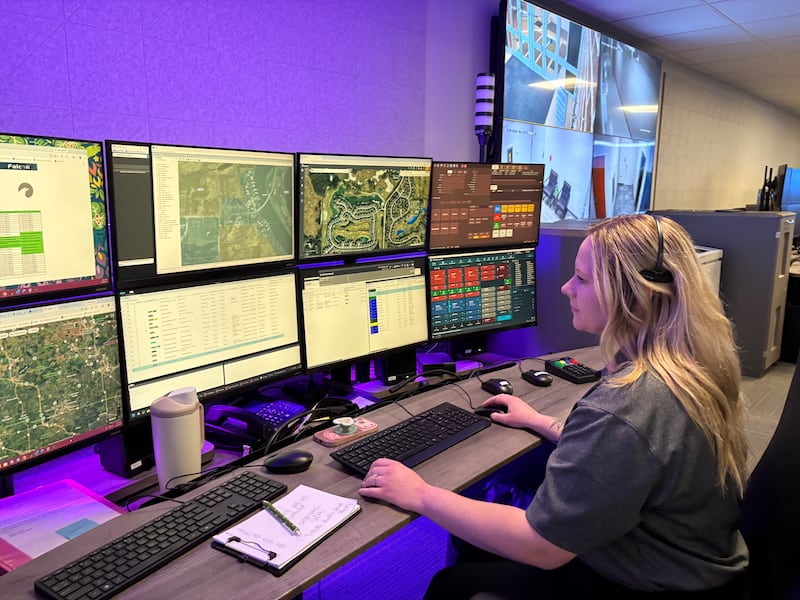
When people call 911, they sometimes think they’re speaking with their local police or fire department.
But usually they’re on the phone with a regional dispatcher, who connects them to help.
Dispatchers field a variety of calls – and the people they speak to are often experiencing the worst moments of their lives. The dispatchers calmly connect people to help, but the job takes its toll. They miss birthdays and holidays and, a lot of times, they don’t know what happened to the person on the other end of the call.
:quality(70):focal(3883x1560:3893x1570)/cloudfront-us-east-1.images.arcpublishing.com/shawmedia/TH4EIC25GVB4NLOJKSUSC6OIPU.jpeg)
Stephanie Burzynski, an operations manager at the Crystal Lake-based regional dispatch agency Southeast Emergency Communication said dispatchers are the first link in the chain of survival. And the lack of closure can be difficult for dispatchers, she said.
SEECOM handles 911 service for southern portions of McHenry County, including Crystal Lake, Cary and Huntley, among other communities.
:quality(70):focal(1012x1072:1022x1082)/cloudfront-us-east-1.images.arcpublishing.com/shawmedia/HEJSBDT5XNFM3A35IL4TEWPNWM.jpeg)
Burzynski said dispatchers work birthdays, holidays and make other sacrifices.
“You miss your children’s events,” Burzynski said, adding that people who work more regular jobs may not think about that.
“We get to be with this family,” Kelli Donahue, a dispatcher born and raised in DeKalb, said of her coworkers.
Burzynski and Executive Director Don Burr said both began as dispatchers, so they understand what dispatchers go through and the “stressful” calls they must take.
The agency has a public education side that helps move dispatchers away from their desks and gives them a chance to go out in public.
:quality(70):focal(1371x1849:1381x1859)/cloudfront-us-east-1.images.arcpublishing.com/shawmedia/BJJYWR22JFGVLAQENIJ2DBPEEM.jpeg)
The agency also tries to support its staff. Burr said he encourages dispatchers to get up and take breaks. SEECOM has a wellness room where staff can go to decompress after a hard call.
Burr has also changed his hours to ensure he works all three shifts every day. He wanted to make sure that, when dispatchers see him, they think it’s just Don rather than, “‘Oh, crud, the executive director is here,’” he said.
Burzynski said SEECOM has been partnering with its member fire agencies to get dispatchers involved when lifesaving awards are handed out to first responders, so dispatchers, too, can see people who’ve been helped and their families face-to-face and celebrate their successes.
The agency is also honoring employees who have stayed 20 years, which she said is “a long time in 911.” Burzynski said SEECOM employees stay longer than at other agencies.
It is likely the support, the understanding leadership and the camaraderie that keep dispatchers at SEECOM.
Donahue, who attended a lifesaving ceremony once, said she meets random people at events, but rarely meets callers face-to-face.
Donahue once got a call from a woman whose husband needed CPR. She was able to help walk the woman through CPR, and the husband survived.
And while dispatchers don’t often get to interact with callers afterward, Donahue met the couple at a life-saving ceremony in Huntley.
Donahue said it was good to see the couple, meet them and give them a hug: “I’m a giant hugger.”
The ceremony, she said, was the highlight of her 11-year career.
Donahue spent eight years working as a dispatcher in DeKalb before moving to SEECOM. In DeKalb, she took calls only for one city, but covers multiple places at SEECOM. DeKalb calls tended to be more police-focused, while SEECOM calls often are more medical. It’s made her a “more well-rounded” dispatcher, she said.
Donahue said supervisors have brought in a therapy dog after a tough call and made sure she had the resources she needed.
Natalie Pergler was a firefighter in the Wonder Lake area before becoming a dispatcher at SEECOM.
She’s been at SEECOM for four years, but has seen some differences being on the other side of a call. One of the big ones was the shift change. At dispatch, she works eight-hour shifts instead of 12-hour shifts at the firehouse.
“I usually worked nights,” Pergler said, adding she would wake up for calls. The firehouse was more physically demanding.
“I was on my feet a lot,” Pergler said.
But dispatching can be mentally taxing. While dispatching involves more sitting, Pergler said, you’re listening to some of people’s worst moments.
The camaraderie at SEECOM, though, sometimes feels like that of a firehouse, Pergler said. Coworkers are supportive, she said, adding they cover when you need a break. They sometimes have a silly movie or a Disney film playing in the background while they work.
“We’re all fairly close,” and hang out outside of work, Pergler said.
SEECOM dispatcher Tina Tagaris received such a call after only a couple of months at the agency.
The caller was a father-to-be, and “the mother was obviously in labor,” Tagaris said.
It was “pretty nerve-wracking,” she said. But she was able to walk them through the delivery over the phone. The baby was born in a Crystal Lake apartment. She said both mother and baby were doing well, and she could hear the baby over the phone.
Before Tagaris ended the call, with first responders on the scene, she learned that the baby was a girl.
SEECOM has a Tree of Life in the dispatch center to honor dispatchers who’ve helped callers deliver babies, administer CPR or otherwise save a life.
And for Donahue, her favorite part of the job is making sure nobody feels alone in this world.