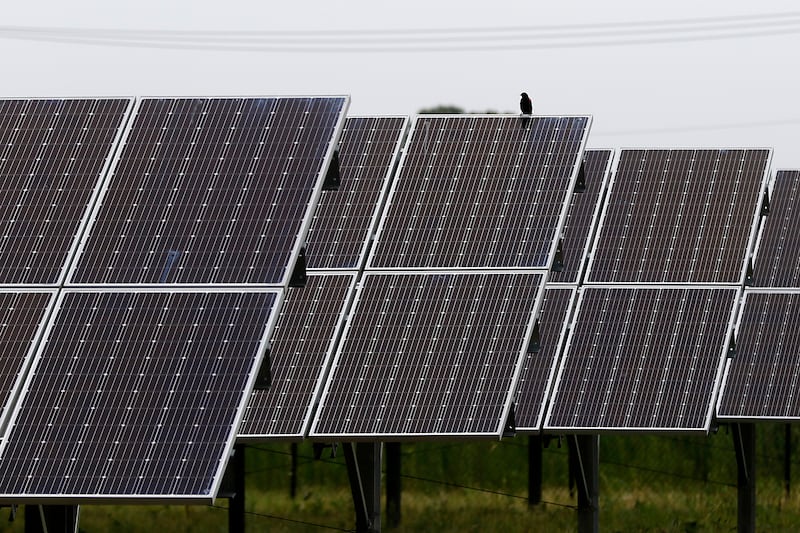
McHenry County is facing a lawsuit over the County Board’s denial of a pair of solar farms, according to court records.
The board turned down four solar farms in December, and the developer of two of them has filed a lawsuit asking the courts to reverse the county’s decision and compel it to approve permits for the farms.
The proposed farms involved include the Pebble Solar project near McHenry and the proposed Water Locust Solar project near Johnsburg, according to the lawsuit. The same parent company is behind both of the farms, according to the lawsuit.
The Water Locust proposal garnered significant neighbor pushback, with residents packing the County Board meeting room multiple times in opposition to the farm. The County Board delayed final action on the project in November before voting 13-4 against it in December.
At the time of the delay, county officials said state law requires a vote on a solar farm within 30 days of a public hearing. State law doesn’t outline specific consequences for failing to meet that timeline, but the county has the potential for court action, officials said.
The lawsuit does not mention the one-month delay.
Before the County Board voted on the Water Locust farm, Chair Mike Buehler said he passed along residents’ petitions to state lawmakers representing McHenry County, noting state law hindered the board from acting on residents’ concerns.
The lawsuit nodded to public opposition to the Water Locust farm, saying, “The fact that other citizens expressed various concerns is not permissible bases for denial of a conditional use permit application for a commercial solar energy facility under Illinois law.”
The lawsuit said the Water Locust project complied with the county’s Unified Development Ordinance, among other regulations. The suit also said the County Board can’t deny permits for “arbitrary or capricious” reasons and that the denial will cause the company to lose money and time invested in predevelopment work.
Pebble Solar is a proposed solar farm near McHenry. for which the county’s Zoning Board of Appeals recommended a denial. McHenry city officials also expressed opposition. The County Board voted it down 16-1.
According to the lawsuit, solar applicants “are not bound to Solar Ordinance standards that deviate from state law requirements and limitations.”
The suit also states that members of the public at a zoning board hearing asked for a tree study, which the developer provided, along with a wetland delineation study.
That led to comments among zoning board members about whether Pebble Solar should be expected “to further relocate or remove panels in order to minimize impacts to woodlands and wetlands. ... Other Board members shared similar concerns and questioned whether adequate measures were taken to minimize impact,” according to the lawsuit.
But the solar company contended in its legal filing that the zoning board’s “recommendation that the Pebble Solar Project minimize impacts to woodlands and wetlands is a standard that is more restrictive than specified in” state or federal law.
The lawsuit contends that denial based on that is “unlawful” because state law does not allow counties to add more restrictive requirements.
Despite the claim that the company is not required to do so, the suit also asserts that “the evidentiary record does not support that the Pebble Solar Project does not minimize impacts to woodlands and wetlands.”
The attorney representing the developer in the lawsuit, different from the one who spoke before the County Board, could not be reached for comment. McHenry County officials said the county does not comment on pending litigation.
Two other farms were turned down that evening, but court records do not show any lawsuits have been filed over them.
Under Illinois law, McHenry County is limited in the regulations it can impose on solar projects. County Board members have expressed feeling like their hands are tied with state law, but some also feel the legal landscape has shifted enough to give leeway to turn down the farms, even though state law has not changed.
The case is due back in court May 19, according to court records. The developer is also asking for plaintiff’s fees in addition to permits, according to the lawsuit.
It is not the first time the county has faced legal action over solar projects.
McHenry County has previously been sued over regulations placed on solar farms that solar developers said were tighter than what state law allowed. The county board walked back the restrictions in early 2024 in response to the lawsuit, which was dropped.