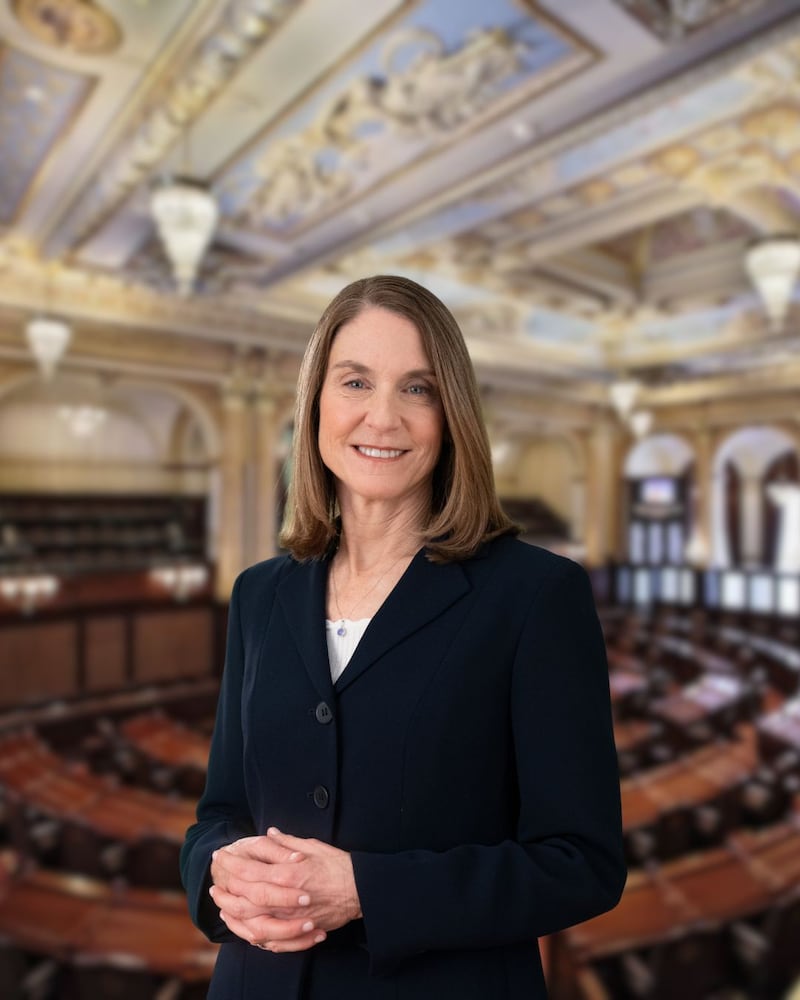
Name: Laura Fine
What office are you seeking: Laura Fine, U.S. Representative- 9th Congressional District
What is your political party? Democratic
What is your current age? 59
Occupation and employer: Illinois State Senator
What offices, if any, have you previously held? 2018-Present: State Senator, 2013-2018: State Representative, 2009-2012: Northfield Township Clerk
City: Glenview
Campaign website: www.laurafineforcongress.org
Education: B.A. in Telecommunications, Indiana University,M.A. in Political Science, Northeastern Illinois University
Community involvement: I am a member of the Kiwanis Club of Glenview/Northbrook, the Sunrise Rotary Club of Glenview, and the Glenview/Glencoe League of Women Voters.
Marital status/Immediate family: My husband, Michael, and I have two adult children.
What are your top three legislative priorities for your first year in the U.S. House?
Grocery prices and overall inflation remain unacceptably high for most Americans, and families are feeling the strain every single day. To improve the economic outlook, we must take decisive steps.
First, we need to lower costs for families by reversing harmful policies that are driving prices up. Rolling back tariffs that make groceries and electronics more expensive would provide immediate relief to small businesses and consumers. At the same time, we must address health care costs. In my 13 years in Springfield, I have passed nearly 200 bills to make Illinois a leader in consumer protection. I sponsored the Healthcare Protection Act to ban insurance companies from using patient premiums for CEO bonuses and helped pass a law to cap out-of-pocket insulin costs at $35. I want to continue along this affordability path in Washington by reinstating ACA subsidies and capping prescription drug costs for everyone.
Second, we must tackle the biggest drivers of family budgets by expanding access to housing and childcare. In the Senate, I have fought to expand affordable housing and protect renter rights to ensure every family has a stable place to call home. I support enacting universal childcare and pre-K to ease one of the highest costs families face. These investments will strengthen our workforce and support parents while creating good jobs in growing industries.
Third, we need to ensure that rising productivity finally translates into rising wages. For decades, workers have delivered more value while seeing their paychecks stagnate. I am a former union member who has passed legislation giving graduate researchers the right to unionize and requiring wage transparency in job postings. We must now raise the federal minimum wage and pass the PRO Act to protect the right to organize nationwide.
What specific local issues in this district will guide your work in Congress?
Our country is in crisis, and this moment demands a fighter, someone who listens and delivers. For the past 13 years, I’ve worked side by side with constituents, advocacy groups, nonprofits, and local small businesses to make sure our state responds to the real needs of our district.
I first ran for office after my husband’s car accident left us drowning in medical debt and unsure how we were going to pay our bills. I took on the insurance industry in Springfield and passed legislation reining in their worst abuses to bring down insurance costs. When healthcare became more expensive and harder to access, I cut prior authorization requirements and gave the state the authority to rein in excessive premium increases. As housing costs soared, I created a fund to help Cook County build more affordable homes. When families raised concerns about flooding in their neighborhoods and plastic pollution along Lake Michigan’s shores, I banned certain single-use plastics and secured millions in funding for stormwater improvements to prevent future flooding.
Because of my leadership on healthcare, affordable housing, and the environment, more than a dozen organizations have named me Legislator of the Year. In Congress, I will continue to lead, delivering results and fighting for the issues my constituents face every day.
What federal funding priorities would you advocate for this district, including infrastructure needs like roads, bridges, broadband, and transit?
Federal investments must reflect the real needs of the district. In Springfield, I have advocated for, and delivered, critical funding for our communities, from stormwater improvements that reduce flooding, to a $1.5 billion sustained investment in public transit, to long-overdue repairs to our roads and bridges. In addition, I have securedfunding that has supported a wide range of community priorities: expanding food pantries and social services, increasing access to mental health care, improving stormwater systems to prevent flooding, enhancing parks and green spaces, and revitalizing cultural institutions like museums and theaters. Every effort I’ve made in Springfield has been guided by one goal: improving the lives of my constituents.
In Washington, I will continue this proven record of delivering the investments our district needs and deserves.
How will you prioritize the concerns of your district versus the priorities of your party?
As a state legislator, I have always made it a priority to listen to the people I serve, my constituents, local leaders, and community organizations that understand our district’s needs firsthand. That commitment will not change in Congress. My first responsibility will always be to the people of my district, and their priorities will come before party pressure or political convenience.
Has Congress given up its Article I powers during the Trump administration? How would you restore congressional authority?
For nearly fourteen years, I taught constitutional studies at Northeastern Illinois University. The Constitution envisions Congress as a robust, co-equal branch of government, not a passive bystander. Yet today’s Republican-led Congress has reduced itself to a rubber stamp for the Trump administration’s most dangerous abuses of power. When Democrats retake the House in 2027, and we will, Congress must reassert its constitutional authority. I have spent my career standing up to bullies, and I will bring that same resolve to Washington.
Restoring congressional authority requires action, not rhetoric. First, Congress must exercise its power of the purse by refusing to fund Trump’s unlawful and cruel agenda. That means restoring full funding for Medicaid, SNAP, and ACA subsidies, while dismantling or significantly reducing ICE’s bloated budget.
Second, Congress must conduct aggressive, sustained oversight of federal agencies, holding them accountable for reckless, illegal, and harmful decisions. Oversight is not optional—it is essential to the survival of democratic governance.
Third, even in the face of a presidential veto, Congress must advance a bold, progressive legislative agenda that lowers costs for working families and protects fundamental rights. Legislating is how we set national values, draw clear contrasts, and build momentum for lasting change.
What is your position on U.S. intervention, specifically Ukraine, Israel and Venezuela?
I believe the United States should lead with diplomacy, respect for international law, and a commitment to reducing harm. That belief comes from my faith as well as my public service. I was raised with the values ofTikkun Olam— the responsibility to help repair a broken world — and that’s shaped how I think about our role globally.
Israel is America’s closest ally in the Middle East and the spiritual home of the Jewish people. As a proud Jewish woman, I will always stand up for Israel and against antisemitism. I have long supported a two-state solution so that Israel and Palestinians can live with dignity and peace. Everyone agrees that more must be done to address the devastating humanitarian crisis in the Middle East and the U.S. must lead the international community in ensuring Gaza can rebuild. I have grave concerns Trump and this administration will fall far short in that effort so it is incumbent upon Congress to demand more and continuous humanitarian aid.
Continuing support for Ukraine is not only the right thing to do, it is essential for global security. Putin continues his unprovoked invasion of Ukraine in his quest to redraw Russia’s borders by force. The U.S. must continue sustained military and humanitarian assistance for Ukraine, work with our NATO allies to deter additional Russian aggression, and continue to hold Russia accountable through strong sanctions.
While Nicolás Maduro is a tyrant, capturing him without congressional approval was reckless and unconstitutional. That action undermined international norms and further destabilized the region. The Trump administration’s approach to Venezuela has relied on unchecked executive power and undue interference, without a serious, lawful strategy beyond benefiting U.S. oil interests. Venezuela deserves the right to self-determination, and Congress must reassert its constitutional authority to rein in the President’s war powers.
Do you believe the President should have the constitutional authority to order military strikes and detain a foreign head of state without prior Congressional authorization? Why or why not, and where should Congress draw the line between executive action and its own constitutional war powers?
Presidential military action without Congressional authorization should be limited to narrowly tailored, defensive responses to imminent threats. Actions such as detaining a foreign head of state, pursuing regime change, or engaging in sustained or offensive military strikes must fall squarely under Congressional authority and oversight. As demonstrated during the Trump administration, the absence of meaningful oversight has enabled unconstitutional uses of military force that have destabilized international order, alienated U.S. allies, and emboldened authoritarian leaders. Congress has a constitutional obligation to rein in executive overreach by repealing or updating the outdated 2001 Authorization for Use of Military Force and by reasserting its central role in authorizing the use of military power.
Do you believe any conduct of the current administration needs to be investigated?
The Trump administration has operated with near impunity, enabled by a Republican-led Congress acting as a de facto “rubber stamp.” They have repeatedly paused or eliminated critical funding, made regulatory and personnel decisions based on ideology rather than science or facts, and in some cases blatantly violated the Constitution and international law.
I’m used to standing up to the biggest bullies in Springfield like the insurance industry to the fossil fuel industry to ICE. I’ve fought back and built coalitions some thought impossible to deliver real results for my constituents. I’m ready on day one to work with theDemocratic Majorityandhold Trump and his cabinet accountable for the harm they’ve caused to our state and our country. Oversight, paired with a commitment of prioritizing legislation that brings down costs for everyday families. must guide our work moving forward.
Has the Department of Government Efficiency (DOGE) gone too far in its recommendations?
DOGE was a misguided and harmful endeavor from the start. It operated with virtually no oversight, slashing government programs without regard for the real-world impact of those cuts. It hired unqualified employees and often had to reverse decisions after public outcry or court rulings. On top of that, there is little evidence that DOGE produced any meaningful savings.
Efforts to reduce waste in government spending must be grounded in evidence, accountable, and transparent, not driven by ideology or politics. Our focus should always be on strengthening government services, not undermining them.
How will you work across the aisle to pass legislation?
In Springfield, I have passed nearly 200 pieces of legislation into law, many on a bipartisan basis. Because of my effectiveness and the relationships I’ve built, I’vebeen named “Legislator of the Year by over a dozen organizations andearned the respect of my Republican colleagues, even when we disagree on the issues.
In Congress, I will continue that approach. I will work across the aisle when it leads to real progress for the people I represent, finding common ground on shared priorities as long as negotiations are in good faith. But while I seek compromise where possible, I will never compromise my core values: making health care more affordable, lifting up working families, and protecting our environment.
Do you support term limits for House members, and if so, what limits?
As an experience legislator, I understand the value of that experience in effectively pursuing and negotiating legislation. I would be interested in exploring the idea of term limits, especially term limits for leadership positions which is something I’ve supported in the Illinois legislature.
What is your stance on border security and immigration reform?
Our immigration system is broken and has been in need of reform for decades. We need an immigration system built on compassion, that treats people with dignity and respect.Our immigration system must be built to keep families together, prioritize swift processing of work authorizations, green cards, and asylum claims, and provide a clear, accessible path to citizenship for otherwise law-abiding people who are already part of our communities.
Do you support changes to Social Security or Medicare to ensure long-term solvency?
Social Security is a promise and an earned benefit. Reducing benefits by raising the eligibility age or means testing it undermines that promise and these are proposals I would not support. To ensure it is sustainable moving forward, I would first remove the payroll tax cap that currently only taxes social security up to the first $184,000 of income. Studies show that this policy alone would raise significant revenue and cut the social security shortfall by well over half. Then we could study other options and revenue streams to close the remaining gap.
What should Congress do to address healthcare affordability?
The longer we wait, the clearer it becomes that our healthcare system is broken, and it’s not improving. Premiums keep skyrocketing, more doctors are leaving traditional insurance to offer boutique services, venture capital is buying up hospitals and practices, and drug and insurance companies are prioritizing profits over patients. This system is unsustainable, leading to worse health outcomes and leaving too many people behind.
It has been my main priority to lower the cost of healthcare in Illinois. I’ve been able to pass dozens of laws to expand insurance coverage, cut prior authorization requirements, ban junk insurance plans, and expand access to mental healthcare.
In Congress,I support working towards a Medicare for All system because it guarantees healthcare access for every person and refocuses our system on keeping people healthy, rather than generating revenue. As a leader in healthcare policy in Illinois, I am committed to working with my colleagues in Washington to accomplish that goal. In the meantime, I would support restoring the ACA subsidies, capping prescription drug costs, and eliminating medical debt.
Is the CDC a trustworthy, qualified source of information under RFK Jr.? How should public health policy be managed?
RFK Jr. has severely undermined the credibility of the CDC by installing anti-vaccine, anti-science figures in key policymaking roles. Decisions about public health and science policy must be guided by accomplished scientists who rely on facts and evidence-based research, not ideological actors whose loyalty is to Trump or RFK Jr. rather than the facts.
How should Congress regulate artificial intelligence, if at all?
The growth and deployment of AI represents one of the most significant economic transformations since the advent of the internet. Globally, more than $1.5 trillion was invested in AI tools last year alone. As other countries aggressively develop their own AI systems and research capabilities, it is imperative that the United States remain the world leader in AI. Strategic investment in AI research and talent will drive sustained economic growth while positioning the United States to lead in setting global ethical standards. These standards must ensure that AI is developed and deployed in accordance with democratic values, and used responsibly to augment people’s jobs, not replace them.
If Democrats win the House in 2026, how do you feel about calls for impeaching President Trump?
When Democrats win back the House, we must use all the tools at our disposal to conduct serious, fact-based oversight of the Trump administration. Allegations of abuse of power, using the Justice Department as a personal legal shield, constitutional violations, and profiting from the presidency all warrant thorough investigation. If those investigations substantiate impeachable conduct, I would support impeachment based on the evidence and in defense of the rule of law.
If Democrats win the House, what issues should oversight committees investigate first?
When Democrats win the House, oversight must begin with the misuse of ICE and the unchecked expansion of its power. ICE agents have been roaming our streets and terrorizing communitiesthrough fear and violence, with little transparency or meaningful oversight.Recent reporting has revealed a serious lack of training for more than 12,000 ICE agents hired since Trump took office, raising alarming concerns about public safety and civil rights.
That is unacceptable. I will fight for strong congressional oversight to ensure ICE and Border Patrol leadership are held accountable for illegal conduct, including prosecution when warranted.
And while I look forward to holding federal agencies accountable, I am not waiting to protect Illinoisans from ICE’s worst abuses. That’s why I introduced legislation in Springfield to ensure untrained ICE agents can never hold a police badge in Illinois. Law enforcement officers in our state are trained to de-escalate conflict and build community trust, and ICE agents who lack that training should not be policing our communities.
What issues, if any, do you agree with Republicans on?
In the Illinois Senate, I’m the Chair of the Senate Behavioral Health Committee. I frequently challenge constituents to watch my committee hearings and then point out to me who are the Democrats and who are the Republicans. We work well together and frequently pass bipartisan legislation to improve the accessibility and affordability of mental healthcare. In addition, because of the relationships I’ve built in Springfield, I’ve gained the respect of many of my Republican colleagues and I did it all without compromising my progressive values or beliefs.
Should private equity and hedge funds be allowed to purchase so many homes?
No, absolutely not. One of the major reasons housing costs have skyrocketed, and why the average first-time homebuyer is now around 40 years old, is that private equity firms and hedge funds are buying up large swaths of housing, then renting or reselling them at exorbitant prices. This practice squeezes working families out of the market and turns homes into speculative assets rather than places to live.I’ve already passed legislation in Illinois to start combatting this harmful practice by starting the Cook County Housing Fund which receives funds to help Cook County build more affordable housing.
In Congress,I will support caps on large-scale investor ownership, stronger tenant protections, and increased investment in affordable housing construction. These are not theoretical ideas, they are policies I have already passed or supported in Springfield, because housing policy should put families and communities first, not Wall Street profits.
Do you support or oppose the expansion of work requirements for SNAP recipients? Why?
I oppose the expansion of work requirements. Study after study shows that stricter requirements do not meaningfully increase employment. Instead, they increase hunger—discouraging eligible people from applying in the first place and causing others to lose benefits due to paperwork hurdles, unstable work hours, or lack of access to child care.
Rather than punishing people who need help putting food on the table, I support investments in job training, affordable child care and transportation, and raising the minimum wage, policies that actually help people work and achieve long-term stability.
Who are your top donors? How often do you speak with them?
My campaign is powered primarily by small-dollar donors, and like all campaigns, our full donor list is publicly available through required disclosure filings. I don’t have a set of “top donors” who receive special treatment or access.
I prioritize speaking regularly with my constituents and community members, not donors. Financial support for my campaign does not buy influence, and donors do not shape my positions, my values and the needs of the people I represent do. I’ve been consistent about that both in Springfield and on the campaign trail.
How would you reform U.S. trade policy so that farms don’t need repeated bailouts from tariff impacts?
If I had the authority to reverse Trump’s tariffs, I would. Trump treats tariffs like a child’s tantrum, lashing out without a plan and making everyone else pay for it. His approach has raised costs for consumers, hurt small businesses in my district, and damaged farmers and manufacturers across Illinois.
That said, tariffs can be a legitimate tool of international trade policy. Decisions about when and how to use them should rest with Congress, not the president acting unilaterally. We need a consistent, democratic trade policy that enforces strong environmental standards, holds other countries accountable for unfair labor practices and human rights abuses, and ensures U.S. businesses and farmers have a fair shot in the global marketplace. Those trade agreements must be negotiated with farmers at the table, protecting international crop markets, preventing retaliation, and guarding against unfair trade practices so agriculture isn’t left needing repeated bailouts for avoidable policy failures.