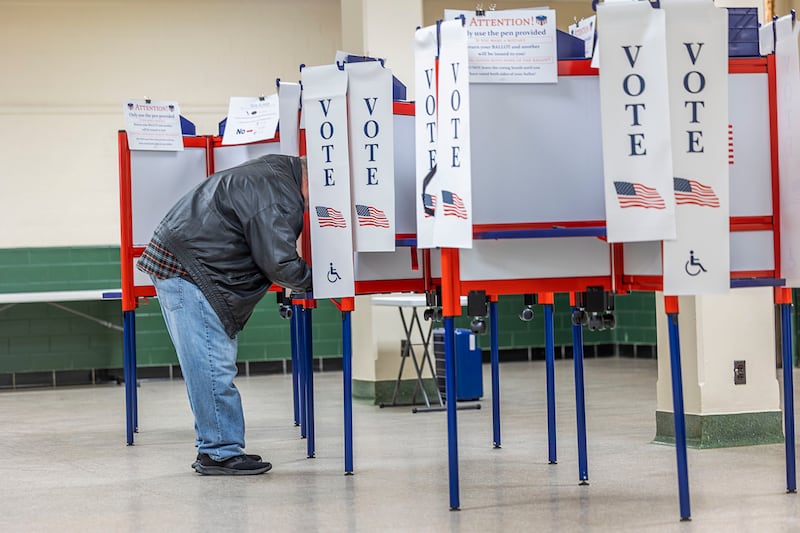
Voters in McHenry, Ogle, Lee, Grundy and many other counties across the state weighed in a voucher-style federal scholarship program that would give donors a tax credit.
The new federal program, called the Education Freedom Tax Credit, was enacted as part of the One Big, Beautiful Bill Act. It’s due to kick in at the start of next year.
The Illinois referendums are not binding. But their inclusion on the ballot – championed in many places by Republican leaders like McHenry County Board Chair Mike Buehler – is intended to gauge whether Illinoisans want the state to opt into the program.
As of Tuesday night, McHenry, Ogle, Lee and Grundy counties were reporting a lead in voters supporting the program, in unofficial results. Voters wanting to opt-in have a major lead in Grundy County at over 77%.
McHenry County is seeing a closer outcome, with just over 56% wanting to opt in, with 46% of precincts reported as of 10 p.m. Tuesday.
In Ogle County, nearly 60% of voters cast in favor, and opt-in votes are also leading in Lee County at 61% with all precincts reported Tuesday night.
Ultimately, the decision is up to Gov. JB Pritzker if the state will opt in. A spokesperson for Pritzker has not yet addressed whether the governor would be swayed by the referendums.
But critics say it would hurt public schools and effectively channel public money to private schools. The Illinois Federation of Teachers called it “dishonestly worded.”
The teachers union asserted in a news release that “Project 2025’s Illinois branch wasted taxpayer dollars in more than a dozen counties for voters to weigh in on vouchers with a ballot question that was so dishonestly worded it’s impossible to make any actual meaning out of it.”
The way the federal tax program works is that people donate to what are called scholarship-granting organizations, and donors get a dollar-for-dollar tax credit, up to $1,700 per year.
:quality(70)/cloudfront-us-east-1.images.arcpublishing.com/shawmedia/WF5ZV667FRCYJCZJCO6BOP4QIQ.jpg)
It is not clear exactly what the scholarship-granting organizations will be. Many details surrounding the program haven’t been worked out yet. Chalkbeat reported: “It’s unclear, for example, whether the money could be used for tutoring provided by public schools or be restricted to outside tutoring groups.”
About two dozen of the 102 counties in Illinois had nonbinding questions on primary ballots about the federal scholarship tax credit. Those counties include McHenry, Grundy, Ogle, Lee, Winnebago, Carroll, JoDaviess, Bond, Moultrie, Cumberland, DeWitt, Shelby, Jasper, Wayne, Williamson, Christian, Randolph, Logan, Madison, McDonough, Edgar, Effingham, Coles, Clark and Clay counties, according to state records.
The vast majority of the counties, including McHenry County, voted for President Trump in the 2024 presidential election. Trump narrowly won in McHenry County with 51% of the votes, according to the county clerk’s records.
Orland and Palos townships in Cook County and Shields and Cuba townships in Lake County also had the referendum question.
In total, the Illinois Education Association estimates the participating counties make up about 10% of the state’s voters.
Funds from the program can be used for certain public, private and homeschool expenses for families making up to 300% of their area’s median household income.
That means families making up to $305,433 in McHenry County would qualify, according to 2024 U.S. Census Bureau data.
The effort to get the federal scholarship question on the ballot around the state has been led by Illinois Policy, the Illinois Policy Institute’s nonpartisan advocacy arm, Chalkbeat reported.
Buehler told a McHenry County Board committee in October that because the program offers a dollar-for-dollar tax credit, not a deduction on federal income taxes, it “can save a substantial amount of income taxes due.”
Buehler said the county is limited in its ability to substantially reduce tax burdens for residents, but the program offers the opportunity for a “very significant reduction in their overall tax burden.”
Although the measure is nonbinding, Buehler said, “What we’ll be doing here is letting our residents voice their opinion, one way or the other, whether they want to participate in the program as a state. And this will let Springfield know our desire to participate or not to opt into the program.”
McHenry County’s Democratic Party came out against the initiative, saying the “tax credit of up to $1,700 is much more generous than the tax deduction for donating to any other type of non-profit.”
The party also argues that using a scholarship organization to distribute funds to private schools, many of which are religious, is an attempt by school voucher supporters “to cover up the use of tax dollars for religious purposes.”
The League of Women Voters of Illinois also urged a “no” vote.
Illinois previously had a similar statewide program called Invest in Kids. The program, which lasted from 2017 to 2023, offered a 75% income tax credit to individuals and businesses that contributed to qualified Scholarship Granting Organizations, according to the Illinois Department of Revenue. Scholarships with to qualified students who attended non-public schools and technical academies in the state.