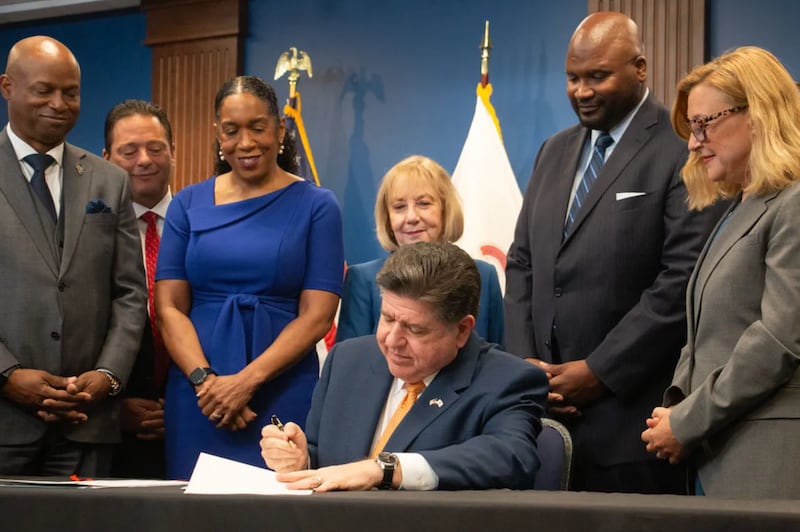
Gov. JB Pritzker signed the eighth budget of his tenure on Tuesday as he and Illinois Democrats gear up for an election-year battle centered around affordability – although he had to issue a clean-up veto aimed at addressing late-night drafting errors.
The fiscal 2027 spending and corresponding revenue plans that will take effect on July 1 total $55.9 billion, which is slightly less than what Pritzker initially proposed in February. Although that’s about $900 million more than what lawmakers initially approved for fiscal 2026, discretionary spending will be largely flat year-over-year after lawmakers approved supplemental spending for the current year.
The fiscal 2027 budget raises hundreds of millions in new taxes, however, focusing on businesses, social media, fantasy sports and digital assets.
Despite calls from progressive lawmakers to more aggressively increase taxes on businesses and the ultra-wealthy, which largely did not materialize, the budget passed with relative ease in both chambers about 4 a.m. June 1 with all Republicans voting against it and just a few dissenting Democrats.
“In a year marked by economic uncertainty, rising costs and unprecedented fiscal challenges created by Donald Trump and the MAGA Congress, Illinois has once again demonstrated that responsible governing and balanced budgets go hand in hand with making life more affordable for working families and investing in the future,” Pritzker said.
Although the budget contains fewer bells and whistles than might have been expected in an election-year plan designed to attract voters, Pritzker said Democrats’ spending priorities stand in sharp contrast to Republican initiatives at the federal level.
“In Washington, they continue to run massive deficits and pile debt onto future generations to fund tax breaks for corporations, brutal ICE occupations, vanity projects like a new White House ballroom, painting the reflecting pool blue – which already is an epic fail – and holding UFC matches on the White House lawn,” Pritzker said.
Illinois lawmakers included some tax breaks in the budget. It pushes the 1.3-cent gas tax increase that was scheduled for July 1 back until after the election to Jan. 1. It also reduces the sales tax on school supplies from 6.25% to 1.25% between Aug. 7 to 16.
Lt. Gov. Juliana Stratton, who is running her own race for U.S. Senate, compared those breaks to Trump’s comment last week that he “loves the inflation.” She said Illinois’ budget should be a “model” for other states.
“We have never lost sight of your family’s budget,” Stratton said. “From groceries to gas to health care, everything is more expensive right now, and families in every corner of our state are feeling the squeeze and letting us know it’s getting harder and harder to make ends meet.”
Pritzker also reminded voters he took office in 2019, shortly after a two-year budget impasse during which many state services were depleted. Preempting criticism from Republicans that spending has grown significantly under his tenure, Pritzker argued it has grown slower than the rate of inflation and the federal budget.
“It is worth pausing to reflect on just how far we have come in Illinois,” he said. “Seven-and-a-half years ago, our state faced an entirely different reality.”
House Republican Leader Tony McCombie, R-Savanna, said new taxes in the budget contradict Pritzker’s message.
“Gov. Pritzker can’t campaign on affordability then govern through tax hikes,” she said in a statement. “By signing this budget, he chose to put more spending and more pressure on family budgets instead of pursuing property tax relief, energy affordability, and economic growth.”
Pritzker issued what are known as “item” and “reduction” vetoes on the budget, reducing or eliminating erroneous line items – such as removing $500 billion for an NAACP branch and cutting $60 million for a youth employment program to $30 million – that were apparently included inadvertently. The thousands of pages of budget legislation came to fruition in the final 24 hours of the spring session before its early-morning passage.
The bill can take effect despite the vetoes, because the state constitution gives the governor the authority to alter line items. Lawmakers could overturn the reductions, although Pritzker said he made the move in consultation with them.
“Majority Leader Robyn Gabel and Sen. Elgie Sims Jr., the House and Senate sponsors, respectively, of the bill have identified a number of individual appropriation lines included in the enrolled bill sent to me for consideration that either contain errors or are duplicative of other appropriation lines already contained in the bill,” Pritzker said in his veto message. “Upon review, I concur with their assessment.”
New taxes on businesses
Democrats approved hundreds of millions of dollars in new revenue through new taxes on social media companies, businesses, digital asset sales and fantasy sports.
Social media companies would be taxed on a progressive scale starting with platforms with 100,000 to 499,999 users paying 10 cents per month for each user all the way up to platforms with at least 1 million users paying a $165,000 fee plus 50 cents per each user each month. Although a similar tax in Chicago is being challenged in court, the state still expects to collect $200 million in revenue from the tax Pritzker proposed in February. Pritzker said he’s confident it’ll survive legal scrutiny.
Lawmakers also granted Pritzker’s request to lower the cap on corporate net operating loss deductions for businesses, which would generate about $300 million in new revenue.
A new 0.2% tax on digital asset sales will take effect Jan. 1 and raise $60 million for the state.
Lawmakers also established a licensing process for fantasy sports operators. Each business granted a license will pay a 15% tax on receipts from fantasy contests. The state is expected to receive $5 million from it, but participants in the leagues themselves will not be taxed.
Sports bets made on prediction markets also will be taxed starting at 1.75%.
Remote tobacco retailers will have to collect taxes from the sale of cigars, pipe tobacco and alternative nicotine products to Illinois customers. That’s expected to generate $3.8 million.
There’s another new tax that lawmakers aren’t planning to collect this year. The revenue package creates a Targeted Advertising Services Tax, more commonly known as a digital ad tax. It would be a 10% tax on providers of digital ad services on revenue from those ads over $1 million. Lawmakers expect it will face legal challenges, but its inclusion in the budget satisfies progressives who demanded more aggressive taxes on businesses.
Business organizations, however, are worried small businesses will be hit hardest by paying a tax on revenue derived from digital ads as those ads account for the bulk of their marketing.
Lawmakers also “decoupled” Illinois tax code from the federal code and now will require individuals who sell small business stocks within five years of buying it to pay taxes on their gains.
The budget itself does not eliminate tax incentives for data centers, but Pritzker has directed the Department of Commerce and Economic Opportunity to pause processing those requests at the beginning of fiscal 2027. It’s not clear how much that will save the state.
The budget also sweeps dollars from several funds to boost spending, including diverting $150 million in sales tax revenue from motor fuel to the General Revenue Fund once public transportation is fully funded.
Little new spending
Spending will be relatively flat in fiscal 2027, and the budget includes about $65 million in reductions for government operations, House Majority Leader Robyn Gabel, D-Evanston, said during debate over the budget in the House weeks ago.
“There is no budget that solves every problem. There is no budget that finishes the work, but this budget definitely moves us forward,” said House Speaker Emanuel “Chris” Welch, D-Hillside.
The budget creates a key program to respond to federal cuts to the Supplemental Nutrition Assistance Program. The budget establishes the Families Receiving Emergency Support for Hunger, and people who have lost or seen their SNAP benefits reduced would be eligible for a one-time $400 payment. The program is scheduled to last just one year and is estimated to cost about $70 million.
The state also plans to spend $55 million to hire 450 new employees at the Department of Human Services, including to help update the state’s systems to comply with federal changes to SNAP and Medicaid eligibility.
But not all state agencies were winners in the budget. Attorney General Kwame Raoul is not happy with the funding he got as his office struggles to keep up with high caseloads.
“We were shorted about $10 million from what our overall appropriation was for [fiscal 2026] and I can’t imagine why,” Raoul said on June 9 at a City Club of Chicago event, adding “all iterations of it all the way until 3 a.m. in the morning had us fully funded.”
Pritzker said he expects money the attorney general will receive from winning settlements to make up the difference and Raoul “deserves as much support as we can provide him.”
Local governments are getting more funding than expected after Pritzker’s initial proposal, however. Lawmakers allowed the percentage of the income tax that they receive to stay flat at 6.47% after Pritzker proposed reducing it. Because of natural income tax growth, the total dollar amount received will grow.
Illinois lawmakers also are in line for an about 3% pay raise, which will bring their base salaries to $101,450. State law ties their pay each year to the rate of inflation.
Lawmakers also appropriated $143 million to the healthcare program for undocumented immigrant seniors and $4 million for welcoming centers that provide services to immigrants arriving in Illinois.
Direct service providers will receive a 60-cent wage increase, which is half of what is recommended. The state’s “rainy day” fund will grow by an estimated $197 million in other state funds, although lawmakers didn’t direct any new general funds toward it.
It also fully funds pensions and extends a buyout program for two years aimed at reducing unfunded liabilities. When the state’s income tax refund fund carries a surplus of $150 million or more, money over that amount will be directed to pensions.
Senate Republican Leader John Curran, R-Downers Grove, still was displeased with the larger spending plan, which is the largest in state history despite its minimal growth.
“Record spending, supported by $800 million in tax increases, while Illinois families are forced to make cuts in their own households, is not a responsible budget,” Curran said in a statement. “It does nothing to address the structural deficits that directly result in Illinois being a bottom six state in both economic growth and job opportunities under Gov. Pritzker.”
Other spending measures include:
• $263.7 million from Home Illinois, the state’s primary homelessness prevention program.
• $5 million to continue the Medical Debt Relief Pilot Program.
• $19.8 million more to improve reimbursement rates for Department of Children and Family Services partners.
• $18 million for reproductive health initiatives.
• $111 million for the Reimagine Public Safety program aimed at reducing gun violence.
• $5 million to continue the Nonprofit Security Grant Program.
• $103 million more for personal services at correctional facilities, including for hiring additional correctional officers.
• $2 million for two new Illinois State Police cadet classes to train 100 new troopers.
• $200 million for infrastructure grants.
• $100 million for the Site Readiness program to prepare unused state land for development.
• $1.2 billion for lead service line replacement.
• $32.8 million for a hemp and cannabis testing facility in central Illinois.
• $1.4 billion for deferred maintenance at state facilities, including colleges and universities.
• $500 million for downstate road and bridge construction.
• $143 million for the healthcare program for undocumented immigrant seniors.
Education
Pritzker said he authorized an additional 2% spending increase for higher education in the current year, which was initially held back over fears federal funding cuts could hamper the fiscal 2026 budget’s ability to remain balanced. Instead, revenue is higher than expected and colleges and universities will receive about $30 million more. However, the fiscal 2027 budget signed on Tuesday calls for increasing higher education funding by 1%.
The budget fully funds the annual Evidence-Based Funding increase for K-12 schools, including restoring $47 million for property tax relief grants that were not included in fiscal 2026.
School districts must agree to reduce their tax levy for three years to receive the grants, however.
Funding for free breakfast and lunch programs at public schools also tripled to $26 million.
“When Washington threatens food assistance for families, Illinois is investing in children and making sure more students can get a healthy meal at school,” Welch said.
The budget appropriates $10.8 billion to the State Board of Education, which is about $120 million more than Pritzker requested, but less than the agency hoped for.
Some funds also are shifting out of ISBE this year to the new Department of Early Childhood, which will become active on July 1.
Other education spending includes:
• $748 million for the Early Childhood Block Grant, which continues funding for Pritzker’s Smart Start preschool initiative.
• $15 million for the Teacher Vacancy Grant pilot program.
• $721.6 million for the Monetary Award Program – an amount equal to fiscal 2029.
Capitol News Illinois is a nonprofit, nonpartisan news service that distributes state government coverage to hundreds of news outlets statewide. It is funded primarily by the Illinois Press Foundation and the Robert R. McCormick Foundation.
:quality(70)/author-service-images-prod-us-east-1.publishing.aws.arc.pub/shawmedia/f831fdce-695a-47fc-8b7b-234f336b1d8a.png)