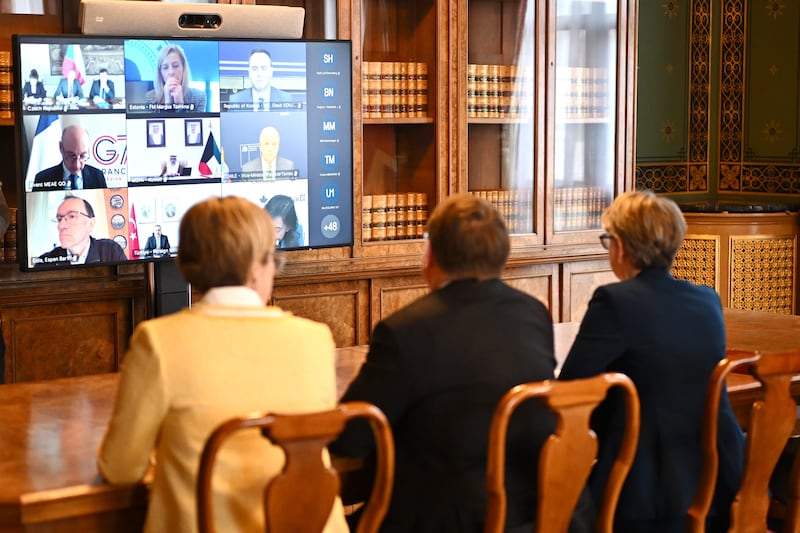
LONDON (AP) — Britain accused Iran on Thursday of holding the world’s economy hostage as diplomats from more than 40 countries held talks on ways to reopen the Strait of Hormuz, a vital shipping route that has been choked off by the U.S.-Israeli war against Iran.
The U.S. is not attending the virtual meeting, which comes after President Donald Trump made clear that he thinks securing the waterway, closed as a consequence of the U.S.-Israeli war on Iran, is not America’s job. Trump has also disparaged America’s European allies for failing to support the war and renewed his threats to pull the U.S. out of NATO.
U.K. Foreign Secretary Yvette Cooper said the talks, which focus on political and diplomatic rather than military means, showed “the strength of our international determination” to reopen the strait.
“We have seen Iran hijack an international shipping route to hold the global economy hostage,” she said at the start of the meeting. Cooper said “unsustainable” spikes in oil and food prices were “hitting households and businesses in every corner of the world.”
Shipping in the strait has slowed to a trickle
Iranian attacks on commercial ships, and the threat of more, have halted nearly all traffic in the waterway that connects the Persian Gulf to the rest of the globe’s oceans, shutting a critical path for the world’s flow of oil and sending petroleum prices soaring.
There have been 23 direct attacks on commercial vessels in the Gulf since the war began on Feb. 28, and 11 crew members have been killed, according to Lloyd’s List Intelligence, a shipping data firm.
Traffic through the strait has slowed to a trickle, with remaining tanker traffic dominated by sanctions-evading tankers carrying Iranian oil, Lloyd’s List Intelligence said in a briefing Thursday. It said a murky operation under which Iran vets who can pass continues to operate as Tehran maintains its chokehold over the key waterway.
In a televised address on Wednesday night, Trump said countries that depend on oil flowing through the Strait of Hormuz “must grab it and cherish it” — because the U.S. would not.
No country appears willing to try and open the strait by force while fighting rages and Iran can target vessels with anti-ship missiles, drones, attack craft and mines. Cooper said military planners from an unspecified number of countries will meet later to plot ways to ensure security once the fighting ends, including potential mine-clearing work and “reassurance” for commercial shipping.
In the meantime, more than three dozen countries including the U.K., France, Germany, Italy, Canada, Japan and the United Arab Emirates have signed a statement demanding Iran stop its attempts to block the strait and pledging to “contribute to appropriate efforts to ensure safe passage” through the waterway.
Cooper said the 40-plus countries at the meeting — up from the 35 announced Wednesday — discussed “diplomatic and international planning measures” to ensure the strait can reopen safely, and action to guarantee the safety of 20,000 seafarers on 2,000 ships trapped by the conflict.
The meeting sends a message to Trump
The international effort idea has echoes of the international “coalition of the willing” that has been assembled, led by the U.K. and France, to underpin Ukraine’s security after a future ceasefire in that war. The coalition is, in part, an attempt to demonstrate to the Trump administration that Europe is stepping up to do more for its own security.
The urgency of stronger continental defenses has been reinforced by Trump’s renewed suggestion that the U.S. could leave NATO. He said Wednesday that the military alliance had “treated us very badly.”
David B. Roberts, reader in Middle East Security Studies at King’s College London, said international coalition-building efforts are “definitely linked to the wider Trumpian antagonism toward NATO, that other members of NATO are not pulling their weight.
“Without a doubt, this is Britain and France, notably, trying to lead the way, to very visibly show a certain sort of utility” to the Trump administration.
“There’s also the very pragmatic reality that America is an oil exporter,” he added. “The immediate pressures about the fallout of the of the energy blockage in the Gulf, they fall on Europe and of course Asia, far more than America.”