CAIRO (AP) — Gulf states reported new missile and drone attacks on Sunday after Iran threatened to widen its campaign and called for the evacuation of three major ports in the United Arab Emirates as the war in the Middle East, now in its third week, expands further.
Israel and the United States attacked Iran on Feb. 28, saying they were striking nuclear and military sites and encouraging the Iranian people to rise against their leaders. Iran has responded with attacks against Israel and neighboring countries in the Persian Gulf.
The war, which shows no signs of ending soon, has upended global air travel, disrupted oil exports from the region and sent fuel prices rising across the world.
U.S. President Donald Trump said he hoped countries reliant on oil and gas exports would send warships to secure the Strait of Hormuz. None responded with firm commitments by Sunday though some said they were considering action.
Bahrain, Saudi Arabia and the UAE told residents Sunday they were working to intercept incoming projectiles, a day after Iran threatened three Emirati ports, the first time it has done so against a neighboring country’s non-U.S. assets.
Iran had earlier accused the U.S. of launching Friday’s strikes on Kharg Island from the UAE, without providing evidence for the claim. The UAE and other Gulf countries that host U.S. bases have denied allowing their land or airspace to be used for military operations against Iran, including toward the island, home to Iran’s primary oil terminal.
Since the war started, Iranian strikes have killed at least a dozen civilians in Gulf states, most of them migrant workers. In Iran, the International Committee for the Red Cross said more than 1,300 people have been killed so far. Iran’s Health Ministry says 223 women and 202 children are among those killed, according to Mizan, the judiciary’s official news agency.
In Israel, 12 people have been killed by Iranian missile fire since the war started. More have been injured, including three on Sunday. At least 13 members of the U.S. military have also been killed since the war began; six of them died in a plane crash in Iraq last week.
Meanwhile, Lebanon’s humanitarian crisis deepened, with over 820 people killed there, according to the Ministry of Health, and 850,000 displaced since Iran-backed Hezbollah started hitting Israel and Israel responded with strikes and sent additional troops into southern Lebanon.
Iran says the US attacked from the UAE
Iran’s foreign minister, Abbas Araghchi, said the U.S. attacked Kharg and Abu Musa islands from two locations in the UAE — Ras Al Khaimah and a place “very close to Dubai.” He called the escalation dangerous and said Iran “will try to be careful not to attack any populated area” there.
U.S. Central Command said it had no response to Iran’s claim.
Anwar Gargash, a diplomatic adviser to the UAE president, rejected Iranian claim that the U.S. used Emirati land or air space for its attacks on Kharg Island.
Iran has fired hundreds of missiles and drones at Gulf neighbors — Bahrain, UAE, Saudi Arabia, Qatar and Oman — during the war.
It says it targets U.S. assets, even as Iranian strikes are reported at civilian sites such as airports and oil fields. Though their air defenses have intercepted most, the war has caused significant damage and rattled economies in the Gulf.
Araghchi also told the London-based Al-Araby al-Jadeed on Sunday that Iran is ready to consider any proposal that includes “a complete end” to the war and said mediation efforts were ongoing between Iran and its neighbors to de-escalate.
He gave no indication on whether progress has been made.
Trump urges countries to send warships to Strait of Hormuz
As global anxiety soars over oil prices and supplies, Trump said Saturday that he hopes China, France, Japan, South Korea, the United Kingdom and others send warships to keep the Strait of Hormuz “open and safe.” Those countries rely more heavily than the U.S. on oil and gas that passes through the strait.
“We are intensively looking with our allies at what can be done, because it’s so important that we get the strait reopened,” U.K. Energy Secretary Ed Miliband told Sky News, adding that “ending this conflict is the best and surest way to get the strait reopened.”
South Korea’s Foreign Ministry said it would coordinate closely with Washington and review Trump’s proposal.
Araghchi, in a social media post, described Trump’s call as “begging.”
Iran’s joint military command has reiterated its threat to attack U.S.-linked “oil, economic and energy infrastructures” in the region if the Islamic Republic’s oil infrastructure is hit.
Beirut suburbs hit by overnight strikes
Collapsed concrete, exposed rebar and sheets of plastic spilled into the streets on the outskirts of Lebanon’s capital as smoke rose into the air and fires smoldered.
“The important thing is that the roads remain open for hospitals and for people,” excavator driver Hachem Fadlallah said after spending the morning clearing the streets in Haret Hreik, one of Beirut’s southern suburbs.
There was scarcely another person in sight. In just 10 days, more than 800,000 people — nearly one out of every seven residents of Lebanon — have been displaced, just over a year since the last conflict uprooted over a million Lebanese from their homes.
Israel is hit with more Iranian missile strikes
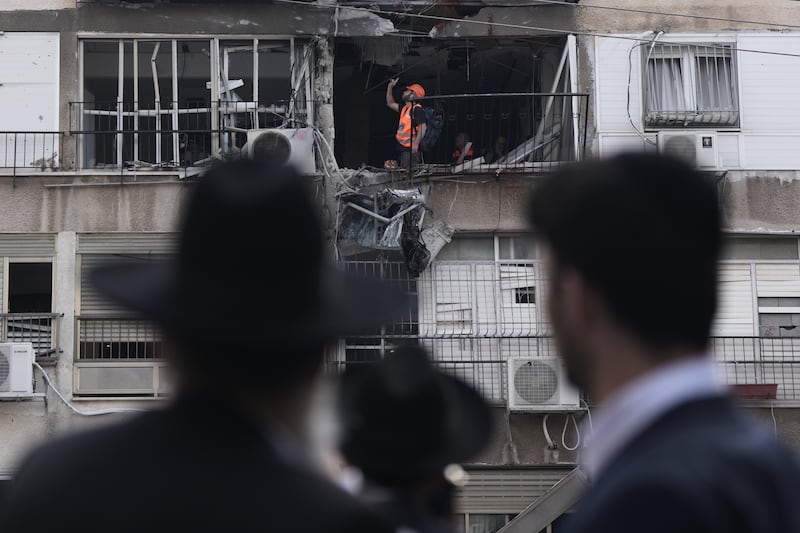
Iran fired barrages of missiles toward Israel on Sunday, sending residents rushing to shelters as sirens sounded and several strikes hit central Israel and the Tel Aviv area.
Magen David Adom, Israel’s rescue service, released video showing a large crater in a street and shrapnel damage to an apartment building.
Strikes in the Tel Aviv region caused damage at 23 sites and sparked a small fire Sunday.
Multi-site impacts have become a hallmark of the war, as Israel’s military says Iran is firing cluster bombs that can evade some air defenses and scatter submunitions across multiple locations.