As winter’s chill begins to fade, Illinois is shifting into storm season, bringing an increased risk of severe weather.
Now is the time to download the National Weather Service app and apps from your local emergency management agency, if available in your region.
While weather apps and local news issue alerts and warnings as storms approach, the meaning and severity of these warnings are not always clear.
Shaw Local takes a look at understanding different kinds of storms and what levels of alerts mean for emergency preparedness.
:quality(70)/cloudfront-us-east-1.images.arcpublishing.com/shawmedia/SBZA4RS25VEELJQV6MQS33LFRQ.JPG)
Tornadoes becoming more frequent
Tornado season officially runs from April through June, however, these severe storms have been known to form into late fall.
Tornadoes form as a result of high, spinning winds inside of thunderstorms, which extend down in a column, or funnel cloud, to the ground. These funnel clouds can cause significant damage to property and pose a life-threatening danger.
Between 2020 and 2024, the Illinois State Climatologist reported 452 confirmed tornadoes in the state, with the vast majority of storms occurring before July.
The frequency of these storms varies widely by year with 34 tornadoes confirmed in 2022, and a record breaking 142 confirmed in 2024. Unofficial numbers for 2025 indicate a similar number as the prior year.
In addition to extensive property damage and personal injuries, there have been 10 tornado-related deaths since 2020 in Illinois.
When radar systems detect rotation in the atmosphere, tornado alerts are issued. These warnings can increase in severity, depending on the storm system.
:quality(70)/cloudfront-us-east-1.images.arcpublishing.com/shawmedia/ATUZ6EK6XFLSXDJN225S4J56KE.jpg)
A watch or a warning
According to the National Weather Service, a tornado watch means weather conditions in the area could result in tornadoes.
People in the impacted area should take inventory of their emergency plans and supplies and should “be ready to act quickly if a warning is issued or you suspect a tornado is approaching,” the agency said.
A tornado warning is an indication to take action because a tornado has been spotted or indicated on radar. A warning means there is “imminent danger to life and property” and that people in the area should move to an interior room on the lowest floor of a building away from windows, the weather service said.
Tornado warnings usually impact a smaller area than tornado watches.
If a tornado emergency alert is issued the National Weather Service said that people in the area should “seek shelter immediately.”
These alerts are only declared when “a violent tornado has touched down in the watch area” and indicate a “severe threat to human life and property with catastrophic damage confirmed,” the agency said.
People in an area experiencing a tornado emergency are instructed to seek refuge in the safest location possible.
:quality(70)/cloudfront-us-east-1.images.arcpublishing.com/shawmedia/FZHO3QJDE5B4FDHYLVAS3NF7BQ.JPG)
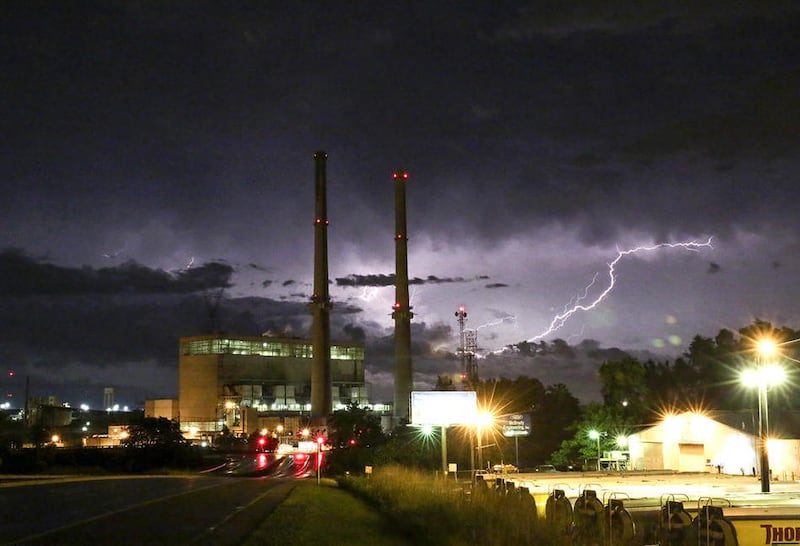
Thunderstorms
Unlike tornadoes, there are only two levels of alerts for thunderstorms: a watch and a warning.
A warning is the more severe of the two alerts.
If a thunderstorm watch is called, severe storms are possible in the area and residents should “stay informed and be ready to act” if a warning is issued, the weather service said.
During a severe thunderstorm warning, life and property could be in imminent danger from high winds, hail, or lightning. People in the area of a thunderstorm warning are advised to take shelter in a substantial building.
:quality(70)/cloudfront-us-east-1.images.arcpublishing.com/shawmedia/FT3H7EF2S5K7ZIIOIL5U4DP3A4.jpg)
Floods and flash floods
Another potentially dangerous side effect of heavy storms is the possibility of flooding or flash flooding.
A flood advisory is issued “when a specific weather event that is forecast to occur may become a nuisance,” the NWS said. These alerts are issued when flooding is not expected to be serious but could cause “significant inconvenience” and could be dangerous if caution is not used, the agency said.
A flood watch is issued when “conditions are favorable for flooding,” according to the NWS, however, it does not mean that flooding will occur in the watch area.
A flood warning is issued when flooding is imminent or already occurring due to heavy rain.
Flash floods differ from regular flooding because they are “sudden and violent floods that can take between minutes and hours to develop,” the NWS said.
If a flash flood warning is issued, it means a flash flood is imminent or already occurring in an area and people who live in flood prone areas should move immediately to higher ground.
:quality(70)/cloudfront-us-east-1.images.arcpublishing.com/shawmedia/MEDFJE6ZQVBC3DGKVY37WGMGSE.jpeg)
What’s a derecho?
During storm season, areas of Illinois can experience derechos, also sometimes called “inland hurricanes.”
The National Environmental Satellite, Data, and Information Service defines derechos as “fast-moving bands of thunderstorms with destructive winds.”
These winds can be as strong as those found in hurricanes or tornadoes, but move in straight lines instead of cyclone patterns.
Derechos form due to a phenomenon known as a downburst. These downbursts occur when wet air from a thunderstorm meets the drier air surrounding it and the water in the air evaporates, cooling the surrounding air.
The cooled air rapidly sinks to the ground creating intense winds. These downbursts create a chain reaction, expanding the derecho, which can stretch for hundreds of miles, the NESDIS said.
Derechos are rare occurrences but can cause extreme damage. If one occurs, people are advised to take shelter indoors. While radar can spot a derecho forming, there are no official warning systems for them, the NESDIS said.
The Illinois State Climatologist estimates that a derecho will hit in Illinois every year or two. Two of these storms impacted parts of Illinois in 2024, with the larger of the two moving through the northern Illinois and Chicago on July 15.
The storm left thousands without power across Iowa, Illinois and Indiana and spawned flash flooding and more than 30 tornadoes. Meteorologists at the time said the storms of that intensity typically only occur every five to 10 years.
:quality(70)/cloudfront-us-east-1.images.arcpublishing.com/shawmedia/GUTDFA23JBCOTH6I3BP7DOB4XM.jpg)
Microbursts, small but powerful
Similarly, a microburst also can form from highly specific atmospheric conditions within a thunderstorm, however, unlike derechos, microbursts only impact a very small area.
The National Weather Service describes microbursts as “a localized column of sinking air, or downdraft, within a thunderstorm less than or equal to 2.5 miles in diameter.”
During a thunderstorm’s development, some raindrops and hailstones can become suspended in an updraft and hang in the upper portion of the storm system. When the air cools and sinks, the updraft weakens and no longer can support the precipitation.
“As a result, the core plummets to the ground. As it hits the ground it spreads out in all directions. The location in which the microburst first hits the ground experiences the highest wind and greatest damage,” the NWS said.
Wind in a microburst can reach up to 100 mph and can do major damage to property, trees, or people caught in the burst area.
The NWS advises that rare events like these are why severe thunderstorm alerts should be taken as seriously as tornado alerts. Microbursts cannot be predicted more than a few hours before they could potentially form.