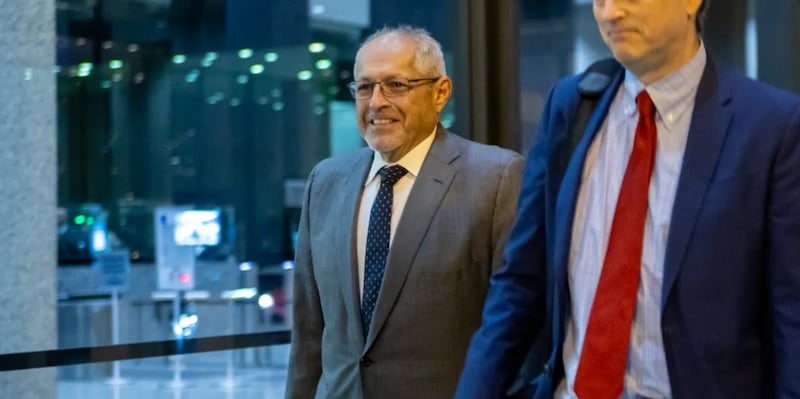
CHICAGO – Former Commonwealth Edison executive Fidel Marquez, whose role as an FBI mole furthered the feds’ investigation into then-Illinois House Speaker Michael Madigan, was sentenced to two years of probation Thursday for his role in a bribery scheme meant to influence the powerful speaker.
Marquez’s sentence, which also includes a $50,000 fine, is punishment for his involvement in the scheme before January 2019, when the FBI confronted him with wiretapped recordings of him discussing do-nothing contracts for Madigan allies.
Marquez immediately agreed to cooperate, and over the following weeks he secretly recorded meetings with his colleagues, several of which were played during his testimony in the trials of those same colleagues and Madigan himself.
In handing down her sentence, U.S. District Judge Mary Rowland told Marquez it was “a credit to your parents” that he immediately agreed to cooperate “when the FBI came calling.” But referencing the current political climate, the judge implored would-be cooperators or whistleblowers: “We need people like you to stand up sooner.”
“In a time when we’re seeing people exhibiting courage when they’re being asked to do something that’s wrong, stand up and say, ‘I’m not going to do this … that’s immoral, that’s illegal,’ … You didn’t do that,” Rowland said.
In his statement to the court moments before, Marquez acknowledged the same.
“I sincerely regret my actions and participation in the bribery of Michael Madigan,” he said, reading from a prepared script. “I am ashamed. I did not like what was taking place, but I could have tried to do more. And I didn’t.”
Bribery scheme
As the utility’s chief governmental affairs executive, Marquez oversaw a roster of lobbyists including ComEd’s longtime top contractor, Mike McClain. Owing to their longtime friendship dating back to the 1970s when they were both young Democratic lawmakers, McClain was tasked with maintaining ComEd’s relationship with Madigan. Plenty of witnesses at both trials testified Madigan had never trusted utilities, but his relationship with ComEd had been particularly rocky.
ComEd’s finances were also rocky; the utility had been contemplating bankruptcy in the mid-2000s, and by 2010 the company was struggling to keep up with demands to its power grid, which serves the northern half of Illinois. But after a multi-year legislative push, ComEd’s fortunes began to change after 2011 when the General Assembly passed a law changing how the utility could recoup the costs of major infrastructure upgrades.
Prosecutors theorized that the utility’s success in Springfield could be traced back to the months before that legislation passed, when ComEd arranged for a do-nothing lobbying subcontract for a close Madigan ally and retained a law firm owned by another.
Along with a successful pressure campaign to appoint a Madigan-backed candidate to ComEd’s board and set-aside slots reserved for interns from the speaker’s power base in Chicago’s 13th Ward, the roster of do-nothing subcontractors paid indirectly by ComEd eventually totaled five Madigan allies. Over the course of eight years, they were paid more than $1.3 million.
All the while, ComEd and its parent company negotiated and the legislature ultimately passed two more laws favorable to the utility, which the feds say was made possible by the company’s accommodations of Madigan’s requests. Defense lawyers and even some trial witnesses maintained ComEd’s success in Springfield was due to the company’s effective lobbying strategy.
The passage of the 2011 “Formula Rate” law was worth hundreds of millions of dollars to ComEd. Witnesses at both trials testified that the infusion of capital was critical to the utility’s ability to modernize its aging electric grid, which also helped ComEd significantly reduce the number and length of power outages, especially after heavy storms.
Still, Judge Rowland on Thursday described the cost born by ComEd’s customers as “sickening.”
“I mean, what about the ratepayers?” she asked.
Plea deal
Rowland acknowledged Marquez wasn’t the “architect” of the bribery scheme; in secret recordings played at trial, McClain and Marquez’s predecessor, John Hooker, took responsibility for the subcontracting arrangements.
But he and ComEd CEO Anne Pramaggiore continued them beginning in 2012 when they both stepped into new leadership roles. Assistant U.S. Attorney Timothy Chapman grew emotional Thursday when describing Marquez’s career trajectory at ComEd, saying that even when promoted into leadership, he was still at his core “an engineer that wants to make things work well.”
Chapman said Marquez “sensed that there was some danger going into this world of politics and lobbying, especially the way Hooker set it up with McClain.”
“If there’s one checkmark on his character, it’s that when he came to this moral fork in the road, he made the wrong choice,” Chapman said.
Prosecutors were recommending probation along with a $250,000 fine and 320 hours of community service. But Marquez’s lawyer, Christopher Niewoehner, said his client’s “extraordinary cooperation” should be taken into consideration and wipe away a fine or mandated community service, as Marquez has already put in more than the government’s recommendation volunteering at Pima Community College in Tucson Arizona, close to where he lives.
Niewoehner pointed back to the FBI’s pre-sunrise meeting with Marquez more than seven years ago, when he immediately agreed to cooperate with the feds.
“He doesn’t say, ‘Let me think about it, let me talk to a lawyer.’ He doesn’t say, ‘Gosh, what’s in it for me?’” Niewoehner said of his client. “Because he truly didn’t think at that point in time that there was something in it for him. He saw it as a chance to stop something he thought was wrong.”
Niewoehner said he knew Marquez wasn’t thinking about a plea deal in January 2019 because when Marquez retained him as a lawyer, “I’m the one who laid it out for him.”
“And when his eyes were opened and he does indeed now understand why it was legally wrong, not just morally wrong, it doesn’t change him,” Niewoehner said. “He continues to sit with the FBI session after session and do his best to explain.”
During Marquez’s cross-examination during the 2023 “ComEd Four” trial of his former close colleagues, including McClain and Hooker, he acknowledged that he told the FBI early on that “I did nothing illegal” and did not believe that he’d bribed Madigan during his years as the utility’s chief internal lobbyist.
Eventually, Marquez agreed to a plea deal, which he accepted in September 2020. Earlier that summer, ComEd agreed to a $200 million deferred prosecution agreement acknowledging the bribery scheme, which was laid out in charging documents that referred to Madigan as “Public Official A.” Marquez’s former colleagues were charged later that year, while the speaker himself wasn’t charged until 2022, more than a year after leaving office as the longest-serving legislative leader in the country.
The ComEd Four – McClain, Pramaggiore, Hooker and ComEd lobbyist Jay Doherty, who paid some of the ComEd subcontractors — are all currently serving one to two-year prison sentences. Madigan, who reported to a West Virginia facility in October to begin his 7 ½-year term, is continuing his legal fight with appellate arguments set in his case for April.
Capitol News Illinois is a nonprofit, nonpartisan news service that distributes state government coverage to hundreds of news outlets statewide. It is funded primarily by the Illinois Press Foundation and the Robert R. McCormick Foundation.