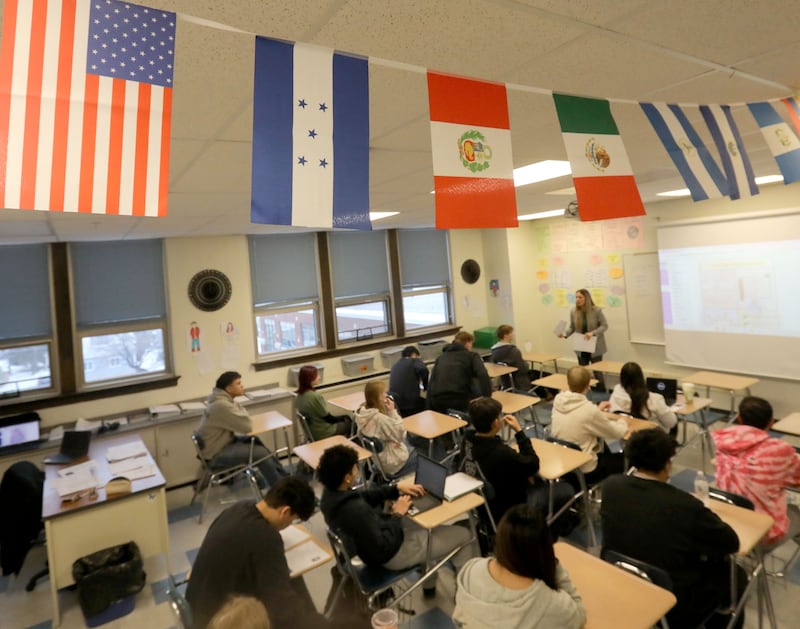
Harvard, a town of less than 10,000 people located 70 miles from downtown Chicago, is rural, marks its summer with its annual Milk Days and is – perhaps surprising to some – largely bilingual.
Its school system is working hard to embrace that, becoming one of just 33 districts identified by the University of Illinois at Chicago to implement a full dual language program.
“Bilingualism is part of our community, and it’s part of our district culture,” said Monica Diaz, the director of bilingual and dual language programs for Harvard School District 50. “I’m sure there are some people who don’t like it, but they’re a small minority.”
As the state of Illinois celebrates 10 full years of its Seal of Biliteracy program, more schools around the state are adapting to accommodate the continuously expanding need for and interest in bilingual education, some through program’s like Harvard’s.
The Seal of Biliteracy is a recognition given to high school students who, through a series of tests, demonstrate proficiency in English as well as at least one other language.
In the graduating class of 2025, the state awarded the Seal of Biliteracy to 11,131 students, with an additional 5,980 students receiving the Commendation Towards Biliteracy recognition, according to the Illinois State Board of Education. That number represents about 12% of all graduating Illinois seniors.
By comparison, only 503 students received the Seal of Biliteracy in 2015, the first year in which students were recognized.
“The Seal of Biliteracy celebrates the rich linguistic heritage of our students and acknowledges the hard work of those who set out to learn an additional language,” State Superintendent of Education Tony Sanders said in a December 2025 statement. “Multilingualism is a powerful asset – one that prepares graduates to lead, collaborate, and problem-solve in an increasingly interconnected world. The program’s continued expansion shows that more students than ever are seizing the opportunities that multilingualism creates."
The increase has been driven both by a steadily increasing population of English learner and bilingual students as well as a growing increase in dual language education programs for native English speakers. In 2016, the Illinois State Report Card showed about 10.5% of Illinois students were English learners. In 2025, that number had risen to 17.5%.
In 2022, it was reported by the ISBE that 72% of English learner students in the state spoke Spanish. Similarly, about 80% of biliteracy awards given in the state in 2025 were awarded for fluency in Spanish, and just under half of all the Seals of Biliteracy presented went to current or former EL students.
Illinois Seal of Biliteracy
Seals Awarded for 62 Languages
Award Distribution
As demand for bilingual education services has grown, two distinct approaches have arisen in Illinois schools: traditional English learner programs that work with students to improve their English proficiency, often while still fostering skills in their native language, and dual language programs that use bilingual staff to teach students in both English and Spanish.
Traditional English learners programs
In order to ensure students who are not fluent in English can receive an education, most Illinois schools provide some sort of English learner services or classes designed to help improve their English proficiency.
Joliet Township High School District 204 is home to a very high number of English learner students, with just under a quarter of the district’s students qualifying as English learners.
Less than 10% of the students qualified as English leaners just 10 years ago when the program was restructured to offer classes at both of its schools, Superintendent Karla Guseman said.
Currently, the district offers all of its announcements and materials in both English and Spanish and offers some classes primarily in Spanish for Spanish-speaking English learners, though District Director of Multilingual Services Edgar Palacios said the goal is to move to more of a 50/50 model so students can get a better mastery of English.
Most of the district’s English learners, however, speak a mix of English and Spanish and are primarily taught in English with access to extra services and supports, including being placed in co-taught classes to receive extra help when needed.
“Most of the students were born here, but they need supports because English is not their primary home language,” Palacios said.
“We’re really proud of our EL programming,” Guseman said. “We’ve ensured we have an instructional coach at each campus who works with teachers to help them with their EL students, and we also have bilingual social workers and family liaisons at each campus to help with those students.”
Since District 204 launched its program for earning the Seal of Biliteracy in 2020, 250 students have earned the recognition, many of them from bilingual households.
“It’s been really popular,” Curriculum Director for Social Science and World Language Paul Oswald said. “We want to validate our student’s bilingualism, and it looks good for them on resumes and getting college credit.”
Another approach to working with English learner students without completely implementing a dual language program is being utilized by Mendota District 289, which currently offers a bilingual program for its youngest students.
Spanish-speaking families have the option to enter the bilingual program, Curriculum Director Tyler Pearce said. For preschool through second grade, students are taught almost entirely in Spanish, and then they switch to English in third grade.
Pearce said if students are proficient in their native language first, it makes it easier for them to transfer over to English.
“It takes them a little longer, but they become more proficient in the long run,” Pearce said.
About 22% of the district’s population are English learners, and Pearce noted that many of the students starting kindergarten speak no English at all coming into school.
“When they move to English, we find they only test a little bit behind their English-speaking peers,” he said.
Dual language programs
The first dual language program in Illinois actually predates the Seal of Biliteracy program by 10 years in Woodstock School District 200, where the entire kindergarten-to-12th grade student body has the option to take part in a Spanish-English language program.
“It’s a really big deal here, almost half of our 6,200 students are in the program at this point,” District 200 Director of Communications Kevin Lyons said.
About 37% of the district’s students are of Hispanic descent, yet about 43% of the students are in the Spanish program, which is split about half-and-half between native English and Spanish speakers, Lyons said.
:quality(70)/cloudfront-us-east-1.images.arcpublishing.com/shawmedia/VM6AAOSUFJB2XFDZXSOMKNHAV4.jpg)
Students in the program learn half of their subjects in English and half in Spanish thanks to bilingual teachers, many of whom are native Spanish speakers themselves.
“In any given day, the students are learning in both languages,” Lyons said. “Having the students all mixed in together is helps because the kids can help each other with their languages. That peer participation is big, especially with things like their speech patterns and accents.”
Since the Seal of Biliteracy program’s creation, Lyons said about 850 Woodstock graduates have earned the honor, most of whom came out of the dual language program.
“The state requires that schools with 20% or more English learners have programming for them, and research shows the best programing is dual language,” Diaz said. “And one of the best results is the lack of segregation that develops in the schools this way. It creates a very inclusive environment for students because everyone is learning and growing together.”
District 50, which started its dual language program in 2007, is a largely rural district with 46.1% of students in need of English learner services, and 55% considered low income.
“Given our demographics, it’s hard to reach the state standards, but we are showing really good growth,” Diaz said.
Despite struggles to reach proficiency numbers on district-wide testing, many students are excelling.
On average, between 30 and 35 graduating seniors earn the Seal of Biliteracy each year in classes of only 200 to 220 students, a feat which requires an 18 or better in English language arts on the ACT as well as a high score on one of several qualifying tests to evaluate speaking, writing, listening, and reading skills in the second language.
District 50’s program largely resembles Woodstock’s at the elementary and junior high levels where all students enrolling in the district have the option to partake, and more than half the district’s students do.
Once the students reach high school they learn primarily in English, but have the option to take “rigorous Spanish classes,” including Advanced Placement Spanish language and literature classes, though students who join the district later and are native Spanish speakers also have the option to take certain social studies and math classes in Spanish.
“The challenge is finding enough staff who are bilingual to teach all the classes, especially being a rural district,” Diaz said.
Most districts with a dual language program rely on finding teachers from foreign countries, including Spain and Mexico, to work in their programs, though districts with long-established programs have started being able to look at their own alumni.
Six of Woodstock’s current bilingual teachers are graduates of the district’s dual language program, Lyons said.
For districts with newer programs, finding teachers is just one of the challenges they face. It is also a regular learning curve to plan as the students in the program advance.
For Rochelle school districts 212 and 231, this year has been a “planning phase” to introduce its first dual language cohort to high school.
The district started its program in 2017 and its first class of dual language students are preparing to graduate 8th grade.
“High school is going to be different,” said the districts’ language services director, Celeste Canfield. “Our program needs to keep evolving to make sure we’re making the right changes as needed.”
Currently, the district plans to offer the incoming freshman advanced Spanish language classes and Spanish-language science classes, she said.
Even with the dual language program still just at the elementary level, the district had a record 24 students earn the Seal of Biliteracy in 2025.
“That was definitely a huge celebration for our students and staff alike,” Canfield said.
The district’s efforts have paid off, Canfield said, noting that about half of the English learners in the district are performing at or near the state proficiency standards in English Language Arts.
“It’s been wonderful to have this in place, because over the last few years we’ve had an influx of kids coming in who are Spanish speakers, some of them seeking asylum from other countries, and this allows them to learn and celebrate their cultures and other Spanish-speaking cultures that the other students and even the teachers come from.”