I am often asked a question that comes up whenever people see police activity spill across town boundaries: How do police departments work together?
You’ll see a pursuit starts in one suburb and end in another or a Chicago Police helicopter assist officers miles outside the city. To the public, it looks seamless.
And the truth is, it is. But only because of years of planning, training and relationship building behind the scenes.
Over the course of my career, I had the privilege of serving as president of several major law enforcement organizations in the Chicago metropolitan area, including the Northern Illinois Police Alarm System, the West Suburban Detectives Association, the Midwest Homicide Investigators Association, the West Suburban Chiefs of Police Association and the West Suburban Enhanced Drug and Gang Enforcement. Those roles gave me extensive experience in multijurisdictional cooperation and reinforced a fundamental reality that modern policing depends on collaboration.
Mutual Aid: More Than Just Extra Officers
At the core of that collaboration is mutual aid. These are formal agreements that allow police departments to cross jurisdictional boundaries to assist one another, but the scope of those agreements is far broader than most people realize.
A mutual aid request can involve almost every resource a department has. We are talking about personnel, marked squads, supervisors, K-9 units, helicopters, mobile command posts, boats, trailers, fuel support and specialized units for SWAT operations, riot control and emergency services. In large-scale incidents, entire operational frameworks are built in minutes, combining resources from dozens of agencies into one coordinated response.
I have seen first-hand situations where what began as a local incident quickly required a regional response. Within a brief period, officers from multiple jurisdictions were on scene, perimeters were established, command structures were in place and specialized units were deployed. It was coordinated, disciplined and effective.
How a Mutual Aid Call Works
There is a process behind that speed.
A police supervisor in the field will either make a direct call or have their dispatch center initiate the request. Systems like the Illinois Law Enforcement Alarm System operate using predesignated phone numbers that are monitored around the clock.
The requesting agency calls in, explains the situation and clearly defines what is needed.
If it is a personnel request, it is scalable. A Level 1 response might bring five squad cars. Level 2 brings 10. Level 3 brings 15 or more personnel, including supervisory personnel to manage the response. These levels are pre-established, so there is no confusion about what is being requested or what will be delivered.
If the situation is more critical, say a barricaded subject or hostage incident, the request becomes more detailed. The caller will describe the location, the nature of the threat, whether weapons are involved and the urgency of the situation. If a SWAT team is needed, the request is routed through the system, and trained tactical teams are mobilized.
All of this happens through structured protocols that have been practiced repeatedly. The agencies responding have trained together. They understand the command structure. They know how to integrate into another department’s operation without delay.
I can say without hesitation that this system works. During my time as chief in Riverside, I used it many times. Whether it was a rapidly evolving emergency or a situation that required specialized resources, the response was always immediate and professional.
Task Forces: Long-Term Collaboration.
While mutual aid addresses immediate incidents, task forces are where long-term collaboration happens.
Criminal activity today is not confined by geography. A gang operating in one suburb often has ties to activity in another and sometimes across the entire region.
That is why task forces like the West Suburban Directed Gang Enforcement are so critical. They bring together officers from multiple jurisdictions to share intelligence, coordinate enforcement and build cases that extend beyond a single community.
The same is true for investigations. Through the Midwest Homicide Investigators Association and the West Suburban Detectives Association, detectives collaborate regularly, sharing case information, forensic developments and investigative strategies. These relationships often lead to breakthroughs that would not happen if agencies worked in isolation.
At the executive level, the West Suburban Chiefs of Police Association plays a critical role in aligning departments, addressing regional challenges and ensuring consistent approaches to public safety.
Training and Preparation
One of the reasons this system works so well is that it is constantly reinforced through training.
Departments do not wait for emergencies to figure out how to work together. They prepare for them. Officers train side by side in active- threat response, civil-disturbance management, major crime scene coordination and tactical operations. Command staff participates in joint exercises that simulate large-scale incidents.
So, when officers from different towns arrive on the same scene, they already know how each other operates. They understand radio protocols, command expectations and tactical approaches. That familiarity removes hesitation and allows for immediate coordination.
The Most Powerful Tool: Relationships.
In my experience, one of the most effective forms of mutual aid does not come through dispatch at all.
It comes from a phone call. Throughout my career as a detective, a sergeant and a chief, I built relationships with officers and leaders across the region. Those relationships meant that at any hour, I could pick up the phone, call someone directly and ask for help.
And they would answer.
When you can call another chief or detective at 2 a.m., explain that you have an urgent situation, and immediately get assistance without going through layers of formality, that is invaluable. It saves time, it builds trust and it gets results.
Those kinds of relationships are built over years through task forces, joint training, shared investigations and professional reputation. They cannot be mandated, but they are essential.
A Statewide System
Illinois has built one of the more effective statewide mutual aid systems in the country. Local departments, county agencies, the Illinois State Police and federal partners all play a role. Whether it is a fugitive investigation, a major crime or a public safety emergency, resources can be shared quickly and efficiently.
But again, the system is only as strong as the people behind it.
Today’s law enforcement environment is more complex than ever. Crime is mobile. Technology has expanded both criminals’ reach and the tools needed to investigate them. No single department has all the resources necessary to handle every situation alone.
That is why collaboration is no longer optional. It is essential for survival.
Mutual aid agreements, task forces and professional relationships enable departments to respond more quickly, investigate more effectively and ultimately better protect their communities.
Final Thoughts
When you see multiple police agencies working together, you see the result of something much bigger than that moment.
You are seeing years of preparation. Years of training. Years of building trust.
I have dedicated much of my career to these collaborative efforts because I believe in them. I have seen them work in real time, under pressure, when it matters most.
From large-scale deployments involving specialized units and equipment to a simple 2 a.m. phone call between trusted colleagues, cooperation is what makes modern policing possible.
Because at the end of the day, jurisdictional lines may define geography, but they should never limit public safety.
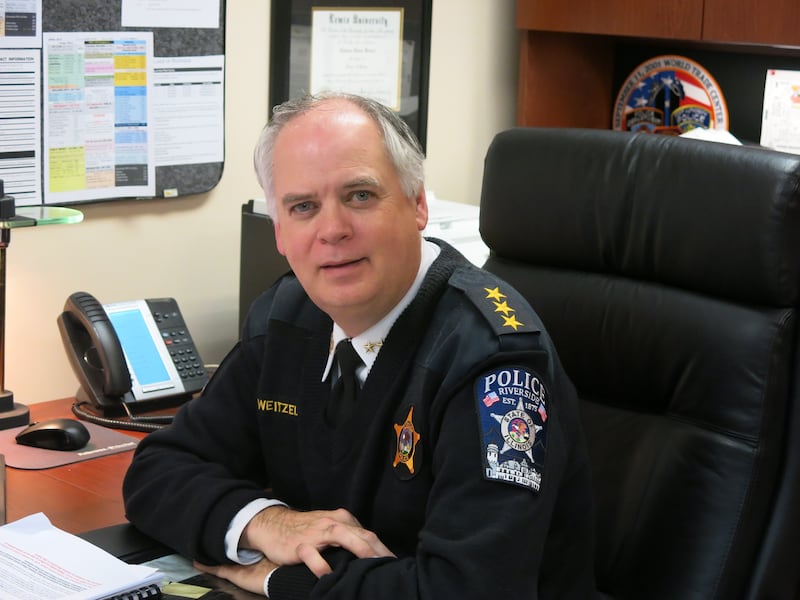
• Tom Weitzel is the former chief of the Riverside Police Department and spent 37 years in law enforcement. He can be reached at tqweitzel@outlook.com. Follow him on X at @chiefweitzel or TikTok at tiktok.com/@chiefweitzel.