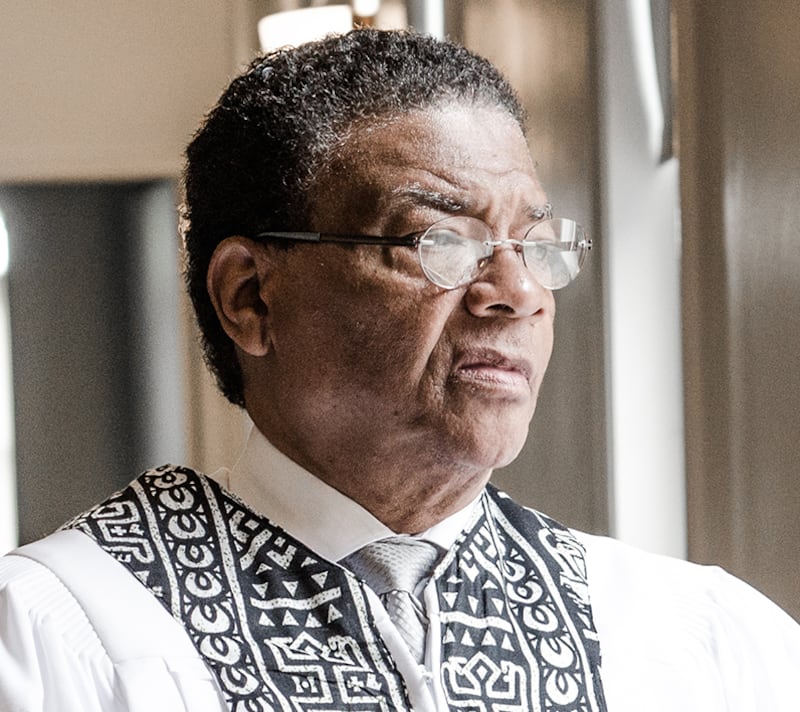
Just days after President Donald Trump shared a video depicting Barack and Michelle Obama as apes, a Glen Ellyn pastor stood at the pulpit of his church, where a portrait of Martin Luther King Jr., his childhood pastor, hangs on one side, and a portrait of Obama is displayed on the other.
“They looked at Barack Obama, and they looked at Michelle, both law school graduates, a two-term president, but they could only see them in the image of an ape,” the Rev. James Shannon, pastor of Peoples Community Church, said, recalling what he told his congregation. “That is racism at its peak.”
Shannon’s experiences with racism are rooted in his childhood growing up in Montgomery, Alabama.
Seeing the sitting president post a video depicting the country’s first Black president and first lady as apes was rock bottom, he said.
“I mean, how low can we go? I don’t think we can go any lower than that,” Shannon said.
Shannon, who has lived in Glen Ellyn for 40 years, attended the Dexter Avenue Baptist church in Montgomery, where King served as a pastor from 1954 to 1960.
“When Dr. King came to Dexter, I was seven years old, and I was 13 when he left,” Shannon said.
Coming of age during a time that Civil Rights leaders were assassinated and lived under death threats, Shannon said he hears the echoes of the same violence that led to the killing of two U.S citizens in Minnesota last month.
“When I think about the fear that Dr. King had to live under,” Shannon said. “The same fear that took their lives took the life of Renee Good, took the life of Alex Pretti. That’s the parallel that we have today.”
“I think the parallel is not just the parallel of the threats on Dr. King’s life, but now this thing has metastasized, and it’s on everybody’s life,” Shannon said. “I think our country has learned from that. But that’s the parallel that we have now. We can’t live under that kind of fear. No one can.”
The Civil Rights movement has made progress, stalled and sometimes moved backward throughout Shannon’s life.
Born in 1947, Shannon was baptized by King and lived through the Montgomery bus boycotts.
“Growing up in Montgomery and growing up in segregation, my life had been predetermined,” Shannon said. “Where I live, where I would go to school and what career I would have. All of that was predetermined by the color of my skin.”
When that many things in your life have been predetermined, you have no freedom, he said.
“So freedom for me was maybe freedom that’s different from somebody else, if you don’t understand segregation,” Shannon said. “When Dr. King said that his children will be judged by the content of their character and not the color of their skin, to our community, that was a very profound statement because everything that happened to us was by the color of our skin.”
Shannon was Glen Ellyn’s citizen of the year in 2024 and spoke at Elmhurst University Feb. 18, presenting “The Legacy of Martin Luther King Jr.” at the school’s Martin Luther King Jr. Intercultural Lecture.
Much has changed over the four decades that Shannon has lived and preached in Glen Ellyn.
“When I first moved out here, my neighbors wouldn’t speak to me,” he recalled. ”The first time I marched in a parade 40 years ago with the Democrats, they threw stuff at us. This year, I marched in a parade, and they applauded me. Now I’m a citizen of the year.”
Understanding the cry of freedom that came from places like Montgomery remains important, Shannon said.
“I think the people in Montgomery were just humiliated by racism,” he said. “Everywhere you go, it was just in your face.”
Shannon said in Montgomery, the push to end Jim Crow became a cry for freedom that had to be organized through churches because other public institutions like schools that were tied to state politics were not positioned to challenge segregation.
“God had to create someone that would come to Montgomery, that would be a vehicle, a person that could lead this movement,” Shannon said. “We didn’t have any guns. We didn’t have any money.”
King’s decision to come to Montgomery was irregular, Shannon said. As the son of a pastor, King was next in line to inherit a church with 2,500 members.
Instead, King chose to go to Montgomery to be a pastor at a church with 350 congregants.
King’s decision to go to Montgomery in addition to being a student of the teachings of Mahatma Gandhi and theologian Reinhold Neibuhr were critical to solidify the movement of oppressed people who didn’t have the power of money.
“The night after Rosa Parks was arrested, Dr. King said that our weapon is going to be a weapon of love,” Shannon said. The thing we have to do is withdraw ourselves from an evil system.”