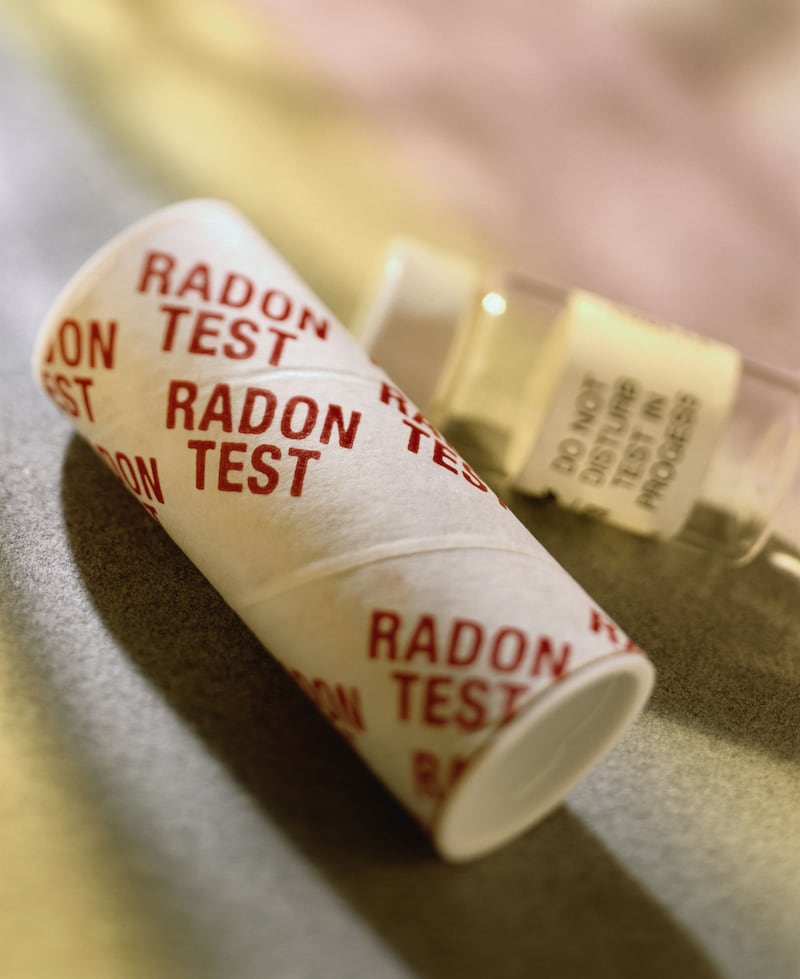
It’s tasteless, odorless and invisible, but related to the deaths of about 1,200 people in Illinois every year, according to the Illinois Emergency Management Agency.
January is Radon Action Month, and local county health departments are raising awareness about the dangers of the radioactive gas with a simple safety instruction: get your homes tested.
Often completely missed by homeowners, radon enters homes through cracks in floors, walls and foundations. Radon is a natural occurring gas caused by the decay of uranium in the soil.
As radon decays, radioactive particles are released into the air.
:quality(70)/cloudfront-us-east-1.images.arcpublishing.com/shawmedia/ZZCVIEQTVFBIVIK5DPGGBKLRCA.png)
Prolonged exposure to high levels of the deadly gas is the second leading cause of lung cancer in the nation, with about 21,000 deaths nationally each year, according to the U.S. Environmental Protection Agency.
This is because as radon decays in the lungs, it causes damage to the cells and tissues.
People who have a history of smoking or lung-related health issues are particularly at risk.
Local figures on the prevalence of the lethal gas give health officials concern. The geology of northern Illinois makes the region particularly vulnerable to high levels of exposure due to glacial deposits rich in uranium, according to the Illinois Department of Public Health.
Data collected from Kendall County indicates that one in five homes have radon levels above the EPA’s recommended action level of 4 pCi/L, according to a news release by the Kendall County Health Department.
:quality(70)/cloudfront-us-east-1.images.arcpublishing.com/shawmedia/XRX4IJQZ25D7VVLO4AJDH3R2XI.jpg)
According to an EPA map of Radon Zones, Kane County is in Zone 1, signifying the highest risk of radon. Kendall County is in Zone 1 as well. The average test result for homes in Kane County is more than 4 pCi/L, according to the Kane County Health Department.
“If a home, building or school tests at 4 pCi/L or higher, action needs to be taken to remove the radon,” the Kane County Health Department said on its website.
In Will County, 37% of homes tested higher than the action level, according to the Will County Health Department.
Officials at the Kendall County Health Department said the only way to ensure safety is to get your home or building tested.
“No two homes will have the same soil underneath them, and this can cause differences in radon concentration potential,” the Kendall County Health Department said in a release. “All homes are built differently, and this can also contribute to varying radon concentrations.”
Short-term radon test kits are available at each county’s health department or at many local hardware stores. They cost about $8-15 a kit.
According to the DuPage County Health Department, the best place to test is lower levels, such as basements and crawl spaces, because radon entering the house will have higher concentrations closer to the ground. This includes floor drains, sump pits, foundation cracks and gaps around pipes and wires.
According to the EPA, homeowners should test their homes every two years, especially after home renovations that could lead to increased exposure.
You also can contact a professional radon test specialist for long-term radon testing through the Illinois Emergency Management Agency, public.iema.state.il.us.
If radon is found in your home, there are ways to reduce the deadly gas through the services of a radon mitigation professional.
:quality(70)/s3.amazonaws.com/arc-authors/shawmedia/0cef0bf9-a04e-4bb4-aea0-03d8ced01c00.jpg)