For struggling families, seeking help can often feel like searching for a spotlight in the dark. Social service providers can help, but some experts say a more robust approach is needed.
With the launch of the Kane County Circle of Care, community leaders are striving to turn on all those lights at once, bringing services that address mental health, early prevention, housing, food instability and childcare together.
At the initiative’s launch at Club Arcada in St. Charles on Jan. 15, Jim Di Ciaula, executive director of CASA Kane County, said the collaborative effort between health care, education, social services and law enforcement officials is all about reaching the right families at the right time.
For him, success looks like reducing the number of children entering foster care through early intervention work. That number has doubled in Kane County over the past six years.
“We’re not only focusing on awareness of what’s out there, but then taking all the resources around a family’s well-being and finding a way to consolidate and find a tool to help them navigate,” Di Ciaula said.
The team is launching a website that will help direct those in need to countywide resources for housing, food instability, health and mental wellness, early childcare and learning support, academic planning, financial preparation, legal rights and documentation, recreational and mentoring programs.
The team is also piloting a resource search tool, designed for parents and caregivers, the public and caseworkers.
Di Ciaula said the project was born of recognizing the cracks in support at-risk youths often fall into. That includes those in underserved demographics, including youth 14 and older and those in their early 20s.
:quality(70)/cloudfront-us-east-1.images.arcpublishing.com/shawmedia/45SG6HHTGBCRLOSWQLRLEK2J5M.png)
Di Cialua said the coronavirus pandemic amplified stress on the family household like never before.
In 2019, CASA Kane County served a little more than 300 children. By 2025, that number rose to around 615, though it was down from 2024’s 650.
Di Ciaula said he hopes Kane’s community network successes can be replicated throughout the state.
‘Leading the way for the state’
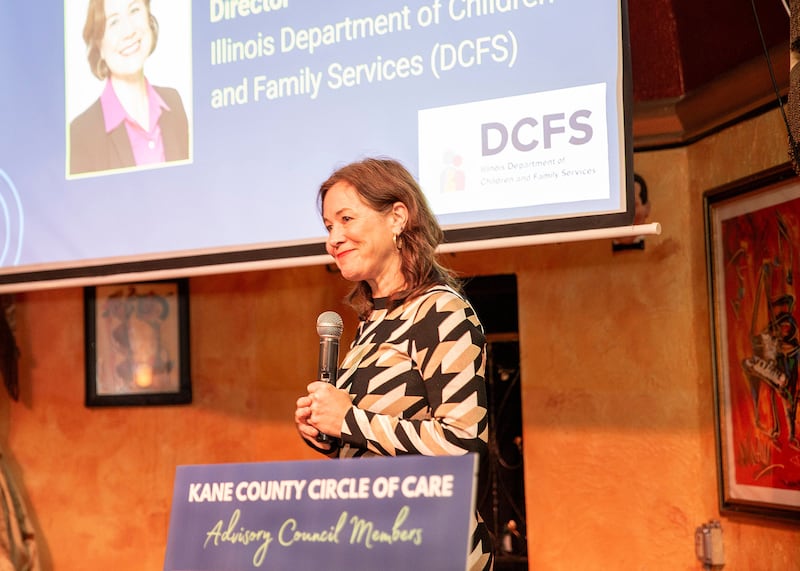
Heidi Mueller, director of the Illinois Department of Children and Family Services (DCFS), said deep collaboration between groups is being represented in statewide figures.
From 2019 through early 2024, hotline calls and child welfare investigations steadily increased at DCFS, she said. But statewide over the past 18 months, those numbers are trending down.
“Kane County is doing something incredibly innovative here and leading the way for our state,” Mueller said. “Families are often involved in several systems with complex needs, experiencing things all at once like financial difficulties, mental health issues, substance abuse and homelessness. When you have a coordinated care system like this, it’s about everyone coming to the table.”
Before, independent groups offering singular social services made it difficult for famileis to access the complex care often needed, Mueller said.
But Kane County’s Circle of Care model centers children and family, and then builds around it, she said.
Preventative care for challenges such as substance and domestic abuse or mental health care is cheaper in the long run, she said. It also reduces the likelihood a child will be removed from their home.
“We see in DCFS that kids have the best outcomes when they can be in families, especially if we can keep that family of origin safe and well,” Mueller said. “When you talk to kids in our system, what they want most is for their family to be healed.”
Melissa Ludington, deputy director of Illinois CASA, said expanding the community network model statewide is dependent on social services not being cut. That’s especially challenging these days.
“One of the challenges is funding and security, many of these programs are government funded, both state and federal,” Ludington said. “Recently the federal government cut funding for mental health and substance abuse services.”
She said while an affordable housing crisis is compounding pressures on families, through concentrated efforts, DuPage County has seen a significant reduction in kids entering foster care, with McHenry County staying level and figures increasing in Kendall County.
:quality(70)/cloudfront-us-east-1.images.arcpublishing.com/shawmedia/JVQCDRSYCZCANL4ZNWXHPIXWWQ.jpg)
But data shows that focusing on early prevention care is working: Fewer children are going into foster care in Illinois. And more families are staying whole.
For that to keep going, more people need to know about Kane County’s Circle of Care, she said.
Reaching families and kids at ‘key access points’
Jeff Aranowski, chief of executive services with the Kane County Regional Office of Education, said the Circle of Care also plays an important role in the classroom.
“We have traditional family fractures, and we’ve seen traditional trauma, but especially the increase of mental health concerns among families has a trickle down effect to children,” Aranowski said. “We’re seeing a spike in that area. That’s compounded by things like an affordable housing decline. It’s all linked together.”
Aranowski said it’s crucial for children to have full access to social- emotional learning, a counselor, and mental health supports. That’s especially true during at-risk ages, like the transition to fifth and sixth grades, where truancy and behavioral problems increase, or from eighth to ninth grade, where students switch schools.
Michael Isaacson, director of the Kane County Health Department, said collaboration among professionals is key. When someone goes to a library or doctor’s office, they can learn about the health department’s behavior health council, overdose prevention group, or early childhood services.
“There’s a lot of struggles families have and we need to be intentional about working together,” Isaacson said. “We have untreated mental illness, we have poverty with more hunger in households, we have violence in homes, we know if young people have these poor experiences, they’re more likely to have poor health outcomes, become court involved, and more likely to have issues with law enforcement.”
Circle of Care advisory council members include CASA Kane County, Illinois DCFS, the Kane County Health Department, Waubonsee Community College, the Kane County Regional Office of Education, Family Focus, Aurora University, RUSH, the Elgin Police Department, Prevent Child Abuse Illinois, the Aurora Police Department, Carpentersville, the Kane County Workforce Development Division, Fostering Success, Plum Tree Child and Adolescent Psychology and VNA Health Care.
For more information, visit casakanecounty.org, or email info@kanecircleofcare.org.
:quality(70)/s3.amazonaws.com/arc-authors/shawmedia/0cef0bf9-a04e-4bb4-aea0-03d8ced01c00.jpg)