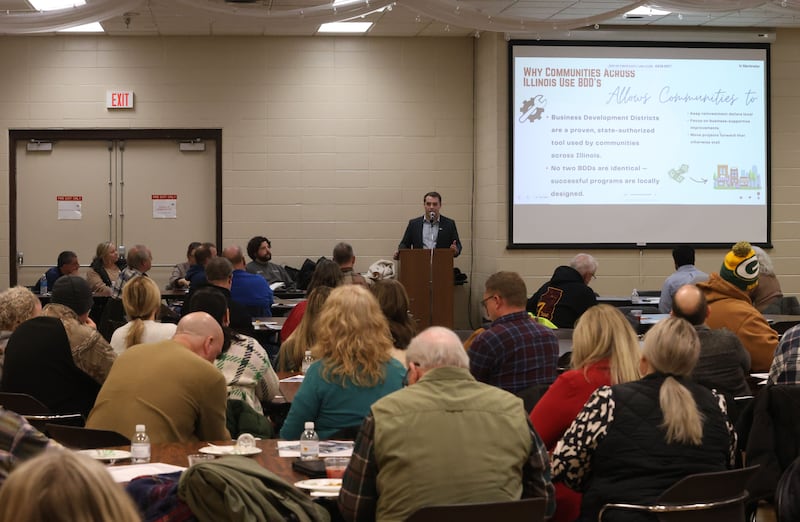
More than 60 Princeton residents and business owners attended a community meeting Tuesday night to learn more about a business development district being considered by the city.
The city meeting included a presentation from Hometown Consulting, a firm the city hired to help with economic development. Cole McDaniel, president of the firm, explained to everyone what a BDD does, how it could impact the city and answered questions from residents.
A BDD serves a similar role to a tax increment financing district by providing funding for business and redevelopment projects, although it relies on sales tax revenue instead of property taxes.
:quality(70)/cloudfront-us-east-1.images.arcpublishing.com/shawmedia/Q2GCAJGO2VDIXPGX5RQDHGJKCA.jpg)
If created, the district would be paid for through an additional sales tax on certain retail purchases made within the district.
Notably, the tax would only apply to items meant for “immediate consumption,” such as meals at a restaurant, snacks or drinks, but would not apply to groceries, prescription drugs or titled items such as vehicles.
The city would use the money to support projects inside the district, such as downtown improvements, building upgrades, infrastructure and new business development.
City officials estimate a 1% tax could generate about $800K annually, although the amount would depend on the final boundaries of the district.
McDaniel, along with city officials, treated the meeting as a way to not only explain to residents what a BDD is, but also to gather data and receive public feedback so that if the city goes through with it, they’ll have a better understanding of what residents and business owners want and need.
“All too often, I’ve been in communities to do these presentations where six people show up and the council moves forward soon after,” McDaniel said. “That’s not what’s happening here, and it’s important for how priorities are set if this happens.”
:quality(70)/cloudfront-us-east-1.images.arcpublishing.com/shawmedia/KIWNKAPV7FFGVJNQJ6WUAYFOQI.jpg)
McDaniel also included examples from other Illinois communities where BDDs helped revitalize downtowns.
He shared how the district in smaller towns supported projects such as building renovations, new businesses and infrastructure improvements, which increase foot traffic and sales tax revenue over time.
Attendees were able to ask questions and participate in a live survey at the end of the presentation. Residents had the opportunity to anonymously give feedback about their thoughts and concerns.
In the live survey, 19 participants said they or their organization would consider applying for BDD funding, 9 said no, and 20 said maybe.
Mayor Raymond Mabry said he thought the meeting was productive and would help guide the city going forward if they made any moves.
“It was very encouraging to see people show up,” Princeton Mayor Ray Mabry said. “The live survey was a neat tool to see some results in real time and how people are feeling. Every day, we’re trying to make Princeton a community we’d want to live in and share with visitors. But it starts with quality of life for our residents first and this could be a great thing for our city.”
Deadlines for establishing the district are Apr. 1 or Oct. 1, and it looks like the city is shooting for the April deadline.
Mabry said more discussions, including public input, will continue at future city council meetings before any official decisions are made.