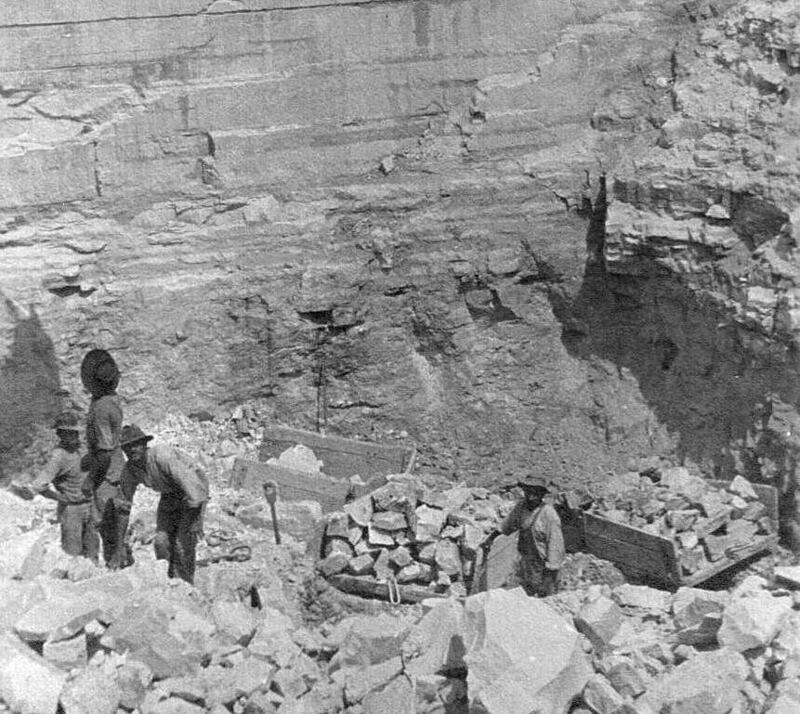
The idea for Lehigh Quarry, now a massive hole in the ground seven miles west of Kankakee, was born, more than a century ago, by two friends walking to work.
Michael J. Edgeworth and Wallis R. Sanborn regularly walked a mile from their homes on Oak Street to the offices of the Chicago, Indiana & Southern Railroad at Fifth Avenue. Edgeworth was the railroad’s auditor; Sanborn was an engineer in charge of maintaining the line’s 200 miles of trackage between South Bend, Ind., and Zearing, Ill..
“Mr. Edgeworth was brought up and worked for years in the Bedford-Bloomington, Indiana, stone area,” wrote Sanborn in his 1965 history of the Lehigh Stone Company, “and as a schoolboy, I had enjoyed many Saturdays exploring the many quarry holes in and around Rockford. So it was only natural that stone was a frequent topic of conversation as we walked the mile to and from the office.”
In early 1906, the railroad decided to move its general office from Kankakee to Cleveland, Ohio. “Mr. Edgeworth was not willing to move, and resigned his position, and I was more than willing to resign when I found a way of getting into the quarry business,” wrote Sanborn.
“Warren R. Hickox owned a useless little 13 acres of land at the station on the C. I. & S. then known as Carrow, named for the man who ran the [grain] elevator, and who had at one time operated a small quarry on his 160-acre farm north of the railroad.” The Hickox property was purchased, and on June 1, 1906, “Lehigh Stone Company was incorporated with a capital of $40,000, and we were on our way,” noted Sanford.
The reason for choosing the name “Lehigh” is not addressed by Sanford in his company history. Kankakee historian and geographer Michael Mahoney addressed the question in his 2018 book, “Place Names of Kankakee County.” Mahoney states that the “probable source of the name for Edgeworth and Sanborn’s company is the Lehigh Valley of eastern Pennsylvania. Underlain by massive beds of limestone, home to numerous stone quarries…and center of American portland cement manufacture from the 1870s to the 1920s, the valley was well-known to stone quarry operators of the time. It was this association of the name Lehigh with the American stone industry that likely explains Edgeworth and Sanborn’s choice of name.”
Work at Lehigh Quarry was soon under way, with a force of workers that commuted from Kankakee each day. Sanford noted, “When Lehigh was started, there were neither good roads nor autos to transport our employees to and from the quarry. So we arranged with the … railroad to haul our men back and forth in a caboose attached to the local trains that handled our empty or loaded cars. The C.I. & S. issued round-trip tickets at 16 cents each.”
An important product of the new quarry was “rubble stone,” irregularly sized, rough pieces of stone widely used at that time to construct building foundations (concrete block and poured concrete foundations were still in the future). The operation also produced crushed stone in four different sizes, from 3 inches down to ¼ inch. Sanford described the quarrying process, which began with the use of dynamite to blast the rock into large chunks:
“At our first plant, blasted stone was loaded by hand by pieceworkers into end-dump cars that held two tons. A mule and a teenage driver hauled the car from the quarry face to the foot of the incline, where the car was hoisted by a cable and dumped into the 15-inch crusher.”
Sanford contrasted that 1906 description with the quarrying operation in the year he wrote the company history. “In 1965, it is a diesel-powered shovel, four tons to the dipper load, that fills a 35-ton end-dump truck, that dumps its load directly into the 42-inch crusher.”
In October 1916, after 10 years at the original site, the company purchased a tract of land approximately two miles to the southeast, where a larger deposit of good-quality stone was available. The process of building its plant and transferring quarrying operations to the new site took more than a year; the first carload of crushed stone from the new quarry was shipped in March 1918.
Michael Edgeworth served as president of Lehigh Stone from its incorporation in 1906 until his death in 1933; he was succeeded in that office by Wallis Sanford, who died in 1967 at the age of 92. Today, the quarry is owned and operated by Vulcan Materials Company, based in Birmingham, Ala. Vulcan also operates a quarry located south of Manteno on Illinois Route 50.
The Lehigh Stone Company has become the latest in a group of local industries (including Radeke Brewery, J.R. Short Milling Co., Bear Brand Hosiery Co. and Schaefer Piano Co.) being honored by the Kankakee Model Railroad Club with a commemorative HO-scale model train car. For 2022, the club is offering for sale a triple hopper car bearing the name of Lehigh Stone.
Proceeds from sales of the cars are used to support the club’s Kankakee Railroad Museum in the former Illinois Central Railroad Station on East Avenue. The Lehigh Stone car is available at the Museum in kit form for $30, or fully assembled for $35. The Railroad Museum is open from 11 a.m. to 4 p.m. Fridays, Saturdays and Sundays.
The Lehigh Quarry made its movie screen debut in 1996, when spectacular action scenes were shot there for a film starring Keanu Reeves and Morgan Freeman. What was that film?
Answer: “Chain Reaction,” an action/adventure film in which “Two researchers in a green alternative energy project are put on the run when they are framed for murder and treason.” Several local law enforcement officers appeared in the film during a chase scene.