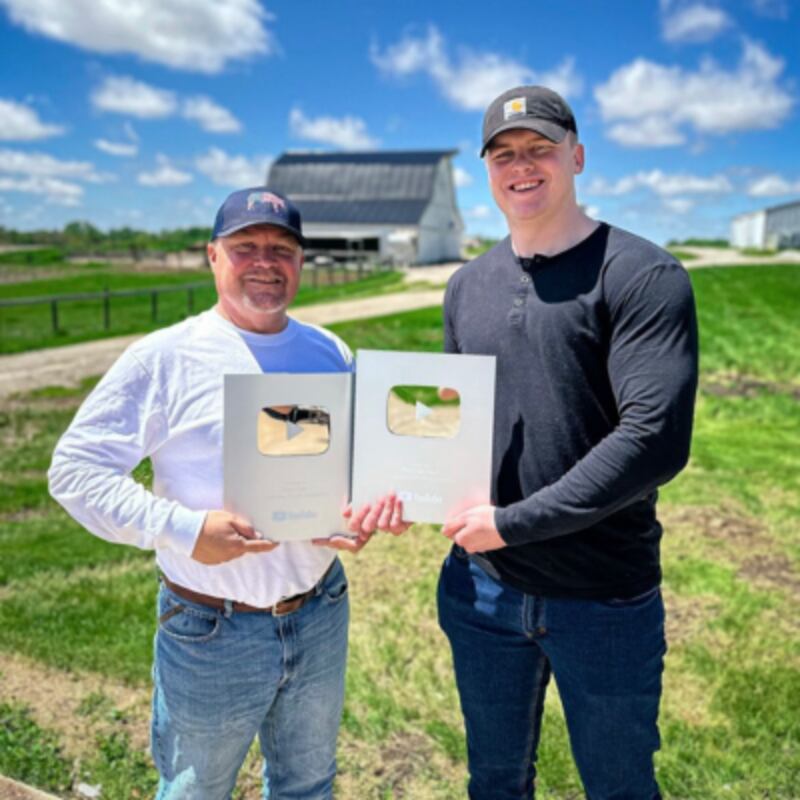
Developing a YouTube channel and the “Barn Talk” podcast has contributed to the viability of This’ll Do Farm in southeast Iowa.
“I always wanted to farm, and when I graduated from high school in 2018, entrepreneurship and social media really spoke to me,” said Sawyer Whisler, who farms with his dad, Tork Whisler.
“I decided to go right into the farming operation and started choring dad’s barns, but I wanted to bring my own value to the farm, and social media was that way,” Sawyer said during the GrainVantage 2025 webcast hosted by Compeer Financial.
The following year, Sawyer bought his first camera and started documenting what the farmers did every day on their hog operation.
“That was our niche with the ag creators, showing the modern-day hog farmer,” said Sawyer, a sixth-generation farmer.
Tork was raised on this family farm that included a 160-sow farrow-to-finish operation.
“I was my dad’s shadow, and I was the youngest of three boys,” he said. “I thought I would keep doing what my dad did because it seemed to work really well.”
After Tork graduated from high school, the family had the opportunity to purchase an operation close to them that had 120 sows.
“We put the two together, and my dad and I had a 400-sow farrow-to-finish operation,” he said. “In 1992, I thought I had the world by the tail.”
Then, Tork learned a really hard lesson in economics.
“By 1998, I realized I wasn’t going to be a hog farmer, and everything changed,” he said. “I exited the farm in 2000 and spent 20 years working in the construction business.”
Tork’s dad continued to grain farm.
“As the hole got closed in from my experience farrowing, I got to the point where I started thinking about if my kids were going to have a chance to farm,” Tork said.
“I credit one of my mentors for showing me what was possible as far as contract finishing,” he said. “At that time, building prices were low, interest rates were moving lower, and the cash flow worked, so I built my first finisher in 2010, and by 2016, I had three 2,400-head finishers.”
In 2020, Sawyer built his first 2,400-head finisher.
“In 2021, we started the podcast ‘Barn Talk’ to share our thoughts on agriculture,” he said. “It was one of the best decisions I made, because without doing that and thinking outside the box, I don’t know how viable we would be for the future.”
It is important for any farm family operation, Sawyer said, for the family to work together as a team.
“When Dad saw what I was trying to do with social media, I wouldn’t necessarily say he was on board from the get-go, but he did not shoot me down,” he said. “That was so important because I felt like I had a seat at the table, and he allowed me to get my ideas out.”
“There is something funny that when you reach a certain age, people start to look at you like you are supposed to have wisdom,” Tork said. “When Sawyer picked up that camera, I believed it would run its course. But then it bit, and he asked me to be a part of it.”
Income from their social media work, Tork said, has helped to diversify the farm’s income.
“But the people we have met and the things that we have learned because of it are more valuable than any monetary aspect,” Tork added.
“One of the problems that we have when we get older is that wisdom comes from failure as much as from success. You learn what works and what doesn’t work, and that shapes your world view of what ideas you are going to let in and explore.”
However, Tork said, when working with the next generation, their worldview has no frame.
“They have a larger view of what is possible, and part of that is because they haven’t failed very much,” he said.
Therefore, it’s important to be open and let young farmers explore so they can form their own worldview, Tork said.
“And you may end up having an opportunity you would never have found on your own,” he said.
“[With] the reality of where agriculture is, you get big or die, you create your own market, or you do a little bit of both,” Sawyer said. “We have conversations all the time about the family office, and working together to create a bigger pie for our family and not just being tied to commodity farming. We want to grow our farming operation but also create our own markets so we don’t have to rely on the commodity board for every dollar we make.”
“Probably the greatest strength of what we’ve learned from the podcast is that we can all learn more,” Tork said. “We have found that the more people we talk to and the more groups we get involved in, we’re all just trying to figure it out.”
It starts with having honest conversations, Tork said.
“You must have brutally honest finances within the family office,” he said. “If I could recommend one thing, it would be to get your financial numbers in order, and don’t let your banker do your balance sheet – be able to do your balance sheet yourself.”
In addition, Tork encouraged all farmers to be their own advocate and find their own truth about finances, inputs, soil fertility and so on.
“There are a lot of people that are really good within all these industries,” he said. “But to say they all have your best interest in mind, I think you are asking too much because at the end of the day, they are selling a service.”
“We are in an age where there is so much information available and so many ways to learn,” he added. “You don’t have to be an expert about any of these things, but you need to know enough that you can filter what is being told to you by people that are trying to sell you things.”
Tork recently returned from a trip to Nashville, Tennessee.
“It was great, but you can’t get anywhere very quickly, and there are lots of things to do, but a lot of people to do them with,” he said. “When I got back to the farm, I thanked the good Lord I have the opportunity to do what I do.”
“With all the doom and gloom about where the economy is, I think it is really important to know what game you are playing and what your field looks like,” Sawyer said.
“I think this is the greatest opportunity in our history – with the internet, social media and artificial intelligence – to learn,” he said. “For all that we do, I didn’t go to college for it. I learned it through self-teaching, YouTube, Google and trial-and-error.”
It has never been easier to start a business or go after an idea than right now, Sawyer said.
“There’s a lot of things that scare us about AI, but it also makes building a business easier and more automated,” he said. “It’s a blessing to be a farmer and to be in America. There’s so much opportunity; you just have to go and seize it.”
:quality(70)/s3.amazonaws.com/arc-authors/shawmedia/9ced883d-eedb-4ef5-9c5e-97d3e9903b5e.png)