A former suburban politician turned policy adviser, and a consultant’s analysis of the Bears’ stalled stadium search suggests economics and politics are to blame, and argues that politicians here should take the team’s threat to move to Northwest Indiana seriously.
Former Republican state Rep. Mark Batinick of Plainfield — also a commercial real estate broker and investor for the past 30 years — believes there is a realistic path for the Bears to remain in Illinois and that, under the right structure, such a project could be good for taxpayers, local governments, and the state as a whole.
But in his 15-page white paper, “A World-Class Stadium or 100% of Nothing,” released this week, he argues any deal is constrained by Cook County’s property tax system and the political math in Springfield, where so far key voting blocs haven’t had a compelling reason to say yes to the team’s ask for legislation giving them a break on those taxes.
“As somebody who grew up a little from the state line (in Lansing), who has seen my family and most of my friends move across the state line, and who has seen countless businesses move just across the state line, I don’t think it’s an idle threat. I mean, if we do nothing, they will go,” said Batinick, who represented the 97th District that includes parts of Plainfield, Oswego, and Shorewood from 2015 to 2023.
He estimated the Bears could be on the hook for an annual property tax bill of at least $200 million if their 326-acre site in Arlington Heights is taxed at an effective rate of 7%, and applied to a stadium and entertainment district valued at $3 billion.
By comparison, the tax bill is $8 million at SoFi Stadium in Inglewood, California, $6.1 million at the United Center in Chicago, and $2.7 million at Wrigley Field.
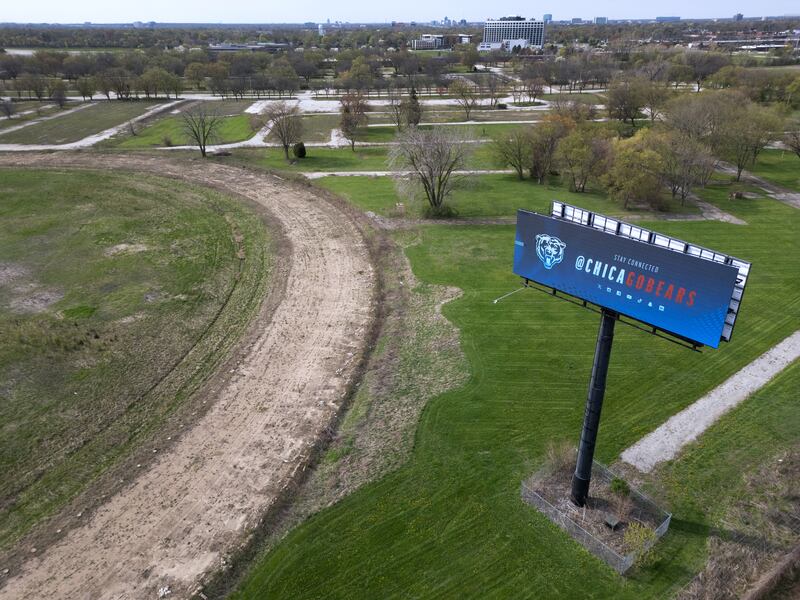
The Bears currently pay $3.6 million a year at the now-vacant racetrack property they purchased in 2023; Churchill Downs Inc. paid roughly $3 million when the horse racing venue was operating.
Absent a “reasonable” property tax cap, Batinick argues, the outcome is unavoidable.
“No stadium, no development and 100% of nothing,” he wrote in the report.
What would be an acceptable number? Somewhere around $10 million to $15 million, he suggests.
But he argues the Bears’ first major error wasn’t political — it was transactional. The NFL club closed on its $197.2 million purchase of the Arlington Park property before securing clarity on tax structure or government approvals, thereby surrendering leverage that developers typically preserve until approvals are in hand, Batinick writes.
“There may have been some other factors that I don’t know about. … Sometimes as a buyer or a developer, you have to go in a little bit blind and say, ‘Hey, I gotta take a leap of faith that I can get the government to come my way.’ And that happens. But normally the way it’s done is you get it buttoned up beforehand,” he said.
But he says politics, not economics, is the real obstacle to getting a deal done.
Approval of any bill has to get at least 60 votes in the House, 30 votes in the Senate, and a governor willing to sign it.
Certainly, it’s been a difficult sell for Chicago Democrats to support legislation that could move the Bears to the suburbs. But there hasn’t been much incentive for downstate Democrats, either, or any meaningful policy win for Republicans, Batinick says.
Any final decision rests with Democratic Gov. JB Pritzker, who is widely viewed as a potential presidential candidate.
“If you come in at the highest property tax bill for a stadium in the nation, I think that’s a political win for the governor,” Batinick said. “Because he can then talk about, you know, holding the feet to the fire of billionaires. … That’s some liberal street cred.”
Batinick suggested other financing tools that could be tapped, from earmarking a portion of new on-site sales tax revenue for infrastructure to using incremental income tax revenue generated by major events.
Batinick believes Arlington Heights makes the most sense for the Bears and other stakeholder groups.
From a pure balance-sheet perspective, Indiana is the cheapest option for the Bears, who could save on property taxes, construction costs, and prevailing wage rates, according to Batinick.
“At the same time, losing the Bears to Indiana would be an unmistakable embarrassment for Illinois leadership,” he said.
https://www.dailyherald.com/20260115/news/what-has-stalled-bears-stadium-deal-report-blames-taxes-and-politics/