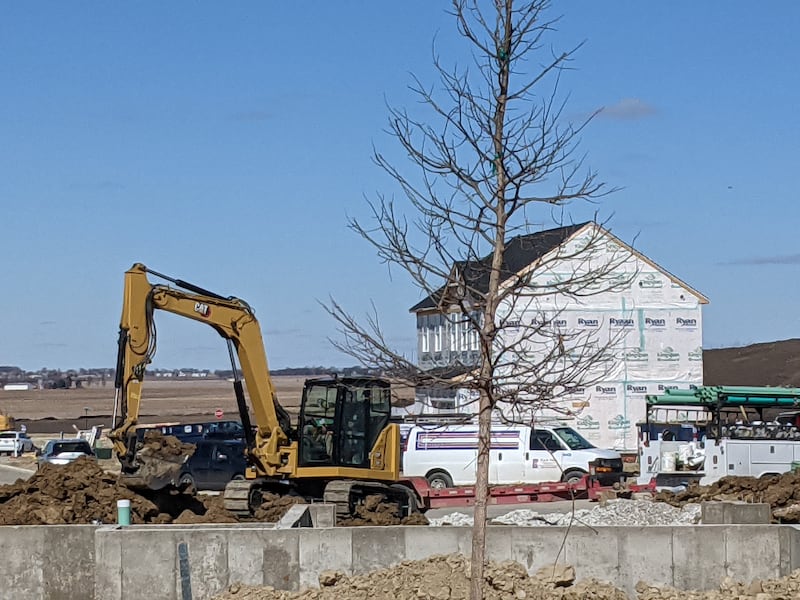
Lockport City Administrator Ben Benson did not mince words when asked about the governor’s proposal to impose state zoning rules on what kind of housing can be built in local neighborhoods.
“It’s crazy,” Benson said. “It’s trying to squeeze in a one-size-fits-all standard formula that doesn’t fit all communities.”
Benson said Gov. J.B. Pritzker’s proposal threatens local government, but it is just the latest mandate from Springfield imposed upon local cities and counties for larger political goals.
“These legislators are out of control,” Benson said. “They have no idea of the impacts that they are creating.”
Pritzker pitched what is called the Buiding Up IL Development, or BUILD, initiative in his State of the State address on Feb. 18.
On the surface, it’s a push for affordable housing by tearing down zoning restrictions that otherwise limit multi-family housing, especially in subdivisions designed for single-family homes.
:quality(70)/cloudfront-us-east-1.images.arcpublishing.com/shawmedia/2YDPIJU5VAPVCF76WQSGI7SORQ.jpg)
Multi-family housing is typically a flashpoint in local communities, where homeowners often see apartment living as an incursion into the lifestyle they want in the neighborhood.
The Pritzker proposal would pave the way for not only more multi-family construction but the conversion of single-family homes into apartments that would allow several families to move into houses first built for one-family occupancy.
It would eliminate certain restrictions, including mandated parking spaces typically set by local authorities.
“It’s basically state mandating development in your community,” Benson said. “It’s ridiculous.”
Oswego Village Administrator Dan Di Santo said he can appreciate the goals of the governor’s proposal. But he also is concerned about the proposal taking control away from municipalities.
“Bringing affordable housing to the state and bringing an increase in housing supply to the state I think are noble causes and goals,” Di Santo said. “I believe local governments are the best to determine zoning issues in their jurisdiction.”
:quality(70)/cloudfront-us-east-1.images.arcpublishing.com/shawmedia/6MJ7PT5JJVH2JANWEVKA3XAL2I.png)
He noted the village has been seeing a housing boom. The majority of Oswego is in Kendall County, which continues to be the fastest growing county in the state.
“We’re not having hard time with developers being able to build homes here,” Di Santo said. “They’re doing it as a bigger rate than anyone else in the state. And I believe that our planning and zoning commission and the village board do a great job in looking at every project on their own merits, not just in terms of the land use, but also, the neighboring properties and how they impact them.”
Di Santo noted the village’s Comprehensive Plan calls for diverse housing.
“We want Oswego to be open to everybody,” he said. “And so housing is a great way to make that a reality. Look at what we’ve approved over the past decade. We’ve approved multi-family housing. We’ve approved townhomes. We’ve approved two-family dwellings. We approved more single-family last year than we ever had. We have small-lot single-family. We have large-lot single-family. We have a very diverse housing stock in Oswego and it’s only getting more diverse. So I think a lot of the goals of this BUILD program, Oswego already meets.”
State mandates
The BUILD proposal is not the first state initiative taking away local authority for the sake of a cause set in Springfield.
Apartment builders now must install electric vehicle conduit to every parking space, a requirement that Benson said has slowed down multi-family housing in Lockport because of the additional costs.
The state also has taken away county government authority over zoning for solar farms, a mandate aimed at easing development of alternative energy project that have at times face opposition from people who live next to the facilities.
:quality(70)/cloudfront-us-east-1.images.arcpublishing.com/shawmedia/TZAVY7RD3RDUBBKN56IPUTKNBM.png)
Benson’s fears are well-represented with Sen. Sue Rezin, R-Morris, who said she agrees with the governor that housing affordability is a serious issue, but stripping control from local governments is not the solution.
“The state should partner with municipalities instead of dictating policy from the top down, like they did with the previously enacted bill that takes away local control for siting and zoning regarding wind and solar farms,” Rezin said. “Incentives and collaboration work better than mandates, and the governor’s proposal represents another example of government overreach by the state attempting to override local decision-making.”
What’s next?
Local cities and villages are just beginning to respond to the BUILD initiative.
The city of Joliet did not provide anyone for an interview on the BUILD plan.
Instead, Joliet provided comments through email attributed to Director of Community Development Dustin Anderson and not indicating any position regarding BUILD.
“The Governor’s BUILD plan is just one way to address the state’s housing shortages, and we look forward to further conversations with the governor on his plan,” one of the comments attributed to Anderson said.
The statements attributed to Anderson said it was ‘too early" to support or oppose the BUILD initiative.
Rezin said she’s anticipating hearing from officials in her district, which covers Bureau, Putnam, La Salle, Grundy and Kendall counties, asking her to oppose the bill after there’s language in the bill to analyze.
“If you give up the power and give it to Springfield, the question is, do they really care about what’s happening in your community or not?” Rezin said. “”I would say local officials know their communities better than anyone else. Zoning decisions should be made by locally elected leaders who answer directly to the residents"
Members of the Metropolitan Mayors Caucus also have expressed concerns about the proposal.
“We urge for the continuing role of local governments in land use planning,” said Neil James, executive director of the Metropolitan Mayors Caucus, in a statement. “Our member communities as well as those throughout the state vary widely in geography, population density, infrastructure capacity, and housing demand, and that is why it is crucial that we preserve local control, because our local leaders are best positioned to craft solutions tailored to their residents’ needs.”
Romeoville Mayor John Noak, chair of the Metropolitan Mayors Caucus, said the group appreciates the governor’s focus on housing and the importance of increasing supply across Illinois.
“As discussions move forward, we look forward to collaborating with the administration to ensure statewide policy goals are implemented in ways that respect the diversity of our communities while supporting locally driven planning decisions,” he said.
:quality(70)/s3.amazonaws.com/arc-authors/shawmedia/c957a8ff-14a0-492e-82d7-3c005b3cd732.png)
:quality(70)/author-service-images-prod-us-east-1.publishing.aws.arc.pub/shawmedia/4874e1d5-91ae-4f41-9dee-92d8e733e407.jpg)
:quality(70)/s3.amazonaws.com/arc-authors/shawmedia/744709d3-0d08-4f13-a8f2-47f3f8ea9de6.png)