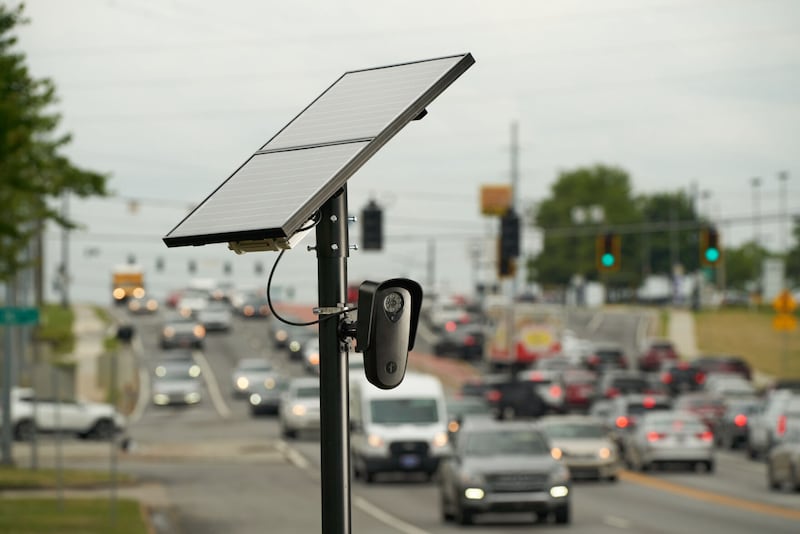
A Joliet resident has initiated an effort to eliminate the more than 80 Flock cameras in the city.
Flock cameras are used to collect license plates and other information that police use to track down people involved in crimes.
Sam Coffey, an unsuccessful candidate for the Joliet High School District 204 School Board in 2025, told the City Council earlier this month that the cameras should be removed.
“These cameras create a system that continuously collects data on anyone who drives past them,” Coffey told the council on Jan. 6. “Many people have concerns with what happens with that data.”
:quality(70)/cloudfront-us-east-1.images.arcpublishing.com/shawmedia/GIMOIZI5HFHKTP24P4VSKEDN54.jpeg)
Joliet police say the data is used for crime-fighting and has become an essential tool for the effort.
Police Chief William Evans, asked about Flock cameras after Coffey’s comments, said they have been “instrumental in getting an arrest and a conviction” in every major crime that the police solve.
Evans said he would oppose eliminating the cameras.
Use of Flock and other cameras to collect license plate information that can place people at specific locations has been used to link people to crimes and track down suspects on the run.
A pushback against their use questions the mass collection of data on people moving about public streets.
:quality(70)/cloudfront-us-east-1.images.arcpublishing.com/shawmedia/SLHCYLGES5EJZFHQ7I53TD6PBQ.JPG)
Coffey said a petition calling for the end of their use in Joliet has collected 125 signatures, which may not be enough to end a practice that has strong support from city police.
Council members gave no indication that they were concerned about Flock cameras.
Coffey said some people avoid downtown because of concerns about Flock cameras.
But they’re basically everywhere, said Chris Botzum, deputy chief for technical services with the Joliet Police Department.
“There are Flock cameras around the nation,” Botzum said. “No matter where you go, if you’re on the interstate, you’re going by Flock cameras without knowing it.”
:quality(70)/cloudfront-us-east-1.images.arcpublishing.com/shawmedia/ZC5X5DS5UFHRBFC2BPLQ7BCUYI.JPG)
Flock cameras have become “extremely” important in crime-fighting, Botzum said.
“It gives us leads on crimes we may never have had a lead on or may not have been able to solve,” he said.
Flock cameras were recently used to track down a shooting suspect.
They also were used in 2024 to locate Romeo Nance, who fled Joliet after fatally shooting seven family members and another man before being stopped in Texas by authorities. Nance fatally shot himself in the showdown with police in Texas.
The ability to track Nance also shows the widespread sharing of Flock data.
:quality(70)/cloudfront-us-east-1.images.arcpublishing.com/shawmedia/LQVKMW3C6ZGCZBMSC3O7TZ2QFM.jpg)
Joliet has agreements with hundreds of police agencies across the country, allowing access to Flock data that can be used for situations such as Nance’s attempt to flee.
But shared data does have limits, Botzum said.
“The data that’s collected through Flock is our data,” he said. “We have control of who we share it with and who we don’t share it with.”
The city has given no indication that it will shy away from the use of Flock cameras.
But Coffey’s call for its end was not the first local run-in with Flock.
State Sen. Rachel Ventura, D-Joliet, and others joined Illinois Secretary of State Alexi Giannoulias in June to condemn the use of Flock by the state of Texas to track a woman who traveled to Illinois to seek abortion services not allowed in Texas.
According to Giannoulias’s office, more than 83,000 cameras were used to track the woman.
The location of the woman with a Mount Prospect camera violated Illinois law, according to Giannoulias’s office.
:quality(70)/s3.amazonaws.com/arc-authors/shawmedia/c957a8ff-14a0-492e-82d7-3c005b3cd732.png)