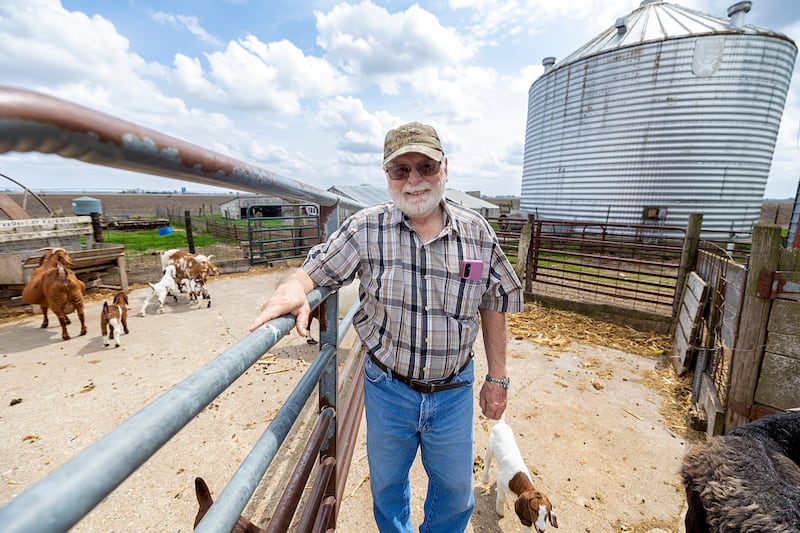
When Gordon Kelm was a 4-H member of the Hume Happy Hustlers 4-H Club, there was a 4-H club in nearly every township in Whiteside County and throughout Illinois.
Today, the Hume Happy Hustlers is one of only five 4-H clubs left in Whiteside County.
Kelm is now the adviser of the club, a post he’s held for more than 50 years. Kelm has continued to volunteer as club adviser because he wants to see the 4-H tradition – and the 92-year-old 4-H club – continue.
“I keep doing it because I am afraid nobody else will want to step up,” Kelm said.
4-H is the nation’s largest youth development organization. The 4-H program began more than 100 years ago as a rural education program through the Cooperative Extension Service.
4-H was designed to teach young people new agricultural practices as a way of passing on that education to their parents and other adults. The name of the organization symbolizes Head, Heart, Health and Hands. The 4-H approach is “Learn by Doing,” emphasizing the organization’s hands-on approach to education. Membership is open to children ages 5 to 19.
Gordon Kelm was one of those children.
“I was a 4-H club member. I stayed around here and went to Sauk. The people who were the club leaders then asked me if I wanted to be a leader also, so I went from being a member to being a leader of this club,” Kelm said.
Today, in addition to grain and livestock farming (he raises meat goats and beef cattle), Kelm puts in about 8 to 10 hours a month on club business, from getting ready for meetings to keeping up with paperwork, which is mostly online now.
“There’s a lot more paperwork and so much more is done online,” Kelm said.
While that cuts down on paperwork, it has also added a challenge in keeping up with the project status of club members.
“Now, the parents can go online and enroll their children and enter their projects for the show. Before, they would enroll with the leader. They would turn their projects into the club leader, and we had to double-check, and then we turned it into the office,” he said. “So technology has helped. But the flip side is that we don’t know as much about the projects. We can go online and find it, but it’s not as easy as when you had the paper right in front of you.”
Another challenge for 4-H clubs is outside distractions. Today, the Hume Happy Hustlers has about 26 members, a number that has held steady, hovering between 20 and 30 for about the last decade.
“I have 26 members in the club and five Cloverbuds in the Cloverbud Club. (Cloverbuds is the club for 4-H members younger than 8 years old). Years and years ago, when there were more 4-H members, Hume would have had around 30 to 40 members,” he said.
Keeping the club and the 4-H tradition alive is one of the reasons he continues to volunteer with 4-H. He said he enjoys seeing the difference that 4-H makes in the lives of the children who participate.
“It’s making a difference in the lives of children. I enjoy watching the kids learn and grow – and grow into leadership positions. It’s great to see them coming out of their cocoon, so to speak, to go from being this shy little 4-Her who doesn’t want to talk to anybody to being the president of the 4-H club and being involved in a lot of other activities,” he said.
4-H volunteers can make a difference in the lives of children who might otherwise not have a place to belong.
“You have to look to the future. 4-H involves all different kinds of people. We have some young people who might not have the best family life or home life, and you can help support them and give them some options for their future,” Kelm said.
In addition to being the club adviser, Kelm is the chairman of the Whiteside County 4-H Support Fund, a group that raises funds and awards three merit scholarships each year.
“We do a silent auction at the 4-H show to raise money for the scholarships,” Kelm said. He also sits on the Extension State Advisory Council. The ESAC is made up of representatives from around the state. It advises the University of Illinois Extension administration and leadership on local needs and offers input into program development.
“It’s a lot of work, but we have a lot of fun. The club just went rollerskating at White Pines, and in the winter, we went to Snowstar and went tubing,” he said.
Kelm hopes that more adults will continue to volunteer with 4-H, even after their children have moved out of the program.
“Typically, five to seven years is the length of service for 4-H volunteers. They volunteer while their kids are in the program. My fear is that the club will just fall apart, and I’ve been involved with it for so many years that I can’t stand to see that happen,” he said.
Originally a largely rural organization, 4-H clubs can be found throughout the country, including in larger urban areas.
In Illinois, about 200,000 children participate in about 1,600 4-H clubs throughout the state.
:quality(70)/s3.amazonaws.com/arc-authors/shawmedia/45a20eef-b8d1-4d42-b8b1-b5f9fb81a1b3.png)