There is a version of the Chicago Bears stadium saga that still exists in official statements, where “ongoing discussions” are meaningful, “productive conversations” are real, and all parties remain “committed to finding a solution.” That version is still being circulated. It just has fewer and fewer connections with the actual facts on the ground.
What is actually happening is closer to a coordinated breakdown of trust disguised as a negotiation between the Chicago Bears, Gov. JB Pritzker’s administration, the Illinois General Assembly, and, somewhere in the background, but increasingly as a prop, the City of Chicago under Mayor Brandon Johnson, whose role in “talks” with the team now feels less like governance and more like ceremonial participation in a process that has already moved elsewhere.
Start with the Bears, who have now advanced a “site TBD” in Hammond, Indiana. The phrasing matters. It is not a plan. It is not a commitment. It is not even a fully described proposal. It is a directional signal carefully calibrated to do two things at once: put a man in motion toward the exit, and preserve maximum flexibility to claim nothing is final.
The point is not to close a door. It is to make everyone else feel it swinging.
Illinois, for its part, has responded in the way Illinois too often responds to high-stakes structural decisions: slowly, then all at once, and then not at all before the deadline. The General Assembly adjourned its spring session without a stadium framework, despite months of forewarning that the issue would come to a head. That failure is not just legislative inertia. It is a familiar pattern in which big-ticket civic decisions are allowed to drift until they collide with procedural exhaustion, at which point “urgency” becomes the dominant policy framework.
Gov. JB Pritzker sits at the center of this with the familiar posture of a modern executive trying to be two things at once: a steward of public resources and a facilitator of marquee economic development. In theory, that balance is the job. In practice, it often produces a kind of calibrated hesitation, firm enough to signal fiscal seriousness, flexible enough to keep conversations alive, and ambiguous enough to be interpreted as reluctance by anyone trying to force a decision. And in a negotiation where one party is actively shopping for alternatives, ambiguity is not a position. It is an opening.
That opening is precisely what Indiana is exploiting. Hammond does not need to be fully baked as a project to matter. It only needs to exist as a credible alternative. Once that threshold is crossed, every stalled vote in Springfield, every incomplete framework, every “we’re still working on it” statement becomes part of a larger narrative of drift.
Meanwhile, the City of Chicago remains in a kind of procedural theater, where Mayor Brandon Johnson’s administration is still technically “engaged” with the Bears in discussions that increasingly resemble placeholder diplomacy. The idea that this is a three-sided negotiation implies symmetry that no longer really exists. The team is actively exploring exit leverage. The state is managing internal political constraints. The city is largely trying to preserve relevance in a process that is not waiting for it.
And through all of it, communication has become indistinguishable from strategy. The Bears do not need to issue a detailed plan; they only need to issue enough of one to be taken seriously. The state does not need to resolve the deal; it only needs to avoid being blamed for its collapse. The city does not need to secure a stadium; it only needs to remain in the sentence where the stadium is discussed.
This is what happens when nobody trusts anybody. The Bears issue carefully worded statements that reveal almost nothing while demanding to be taken seriously. Springfield drags its feet until the clock runs out and then acts shocked when pressure increases. Chicago keeps talking as if it’s a central player in negotiations that increasingly seem to be happening somewhere else.
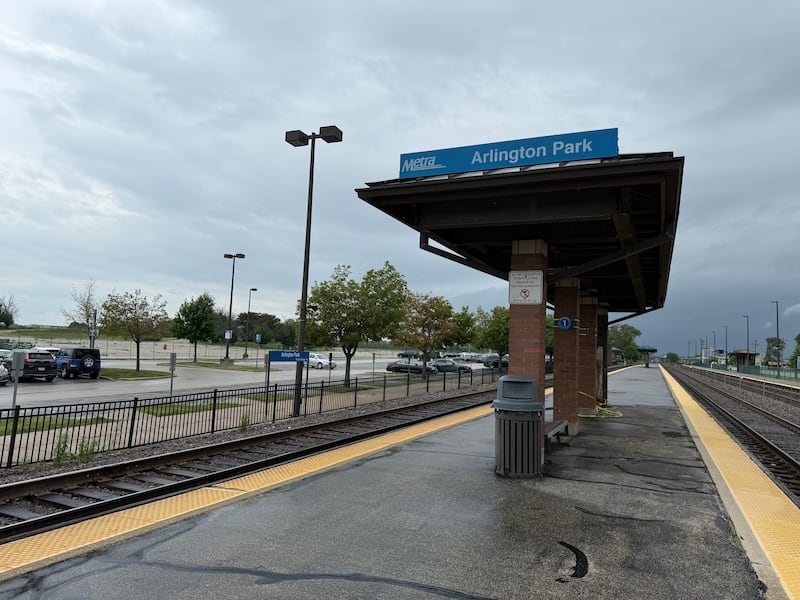
Eventually, someone will claim this stadium deal fell apart because of financing, politics or geography. For what it’s worth, we still think the Bears end up in Arlington Heights. But the bigger problem is credibility. The Bears have spent years changing directions, floating alternatives and keeping every option open. Lawmakers have spent years failing to provide certainty. At every turn, both sides have given the other reasons to doubt their intentions.
That’s why the Hammond announcement matters, even if there’s no actual stadium site to announce. It’s not a plan. It’s a warning shot. The Bears are telling Illinois lawmakers that the clock is running, whether Springfield likes it or not. The question is whether anyone in state government still believes them, and whether they should.