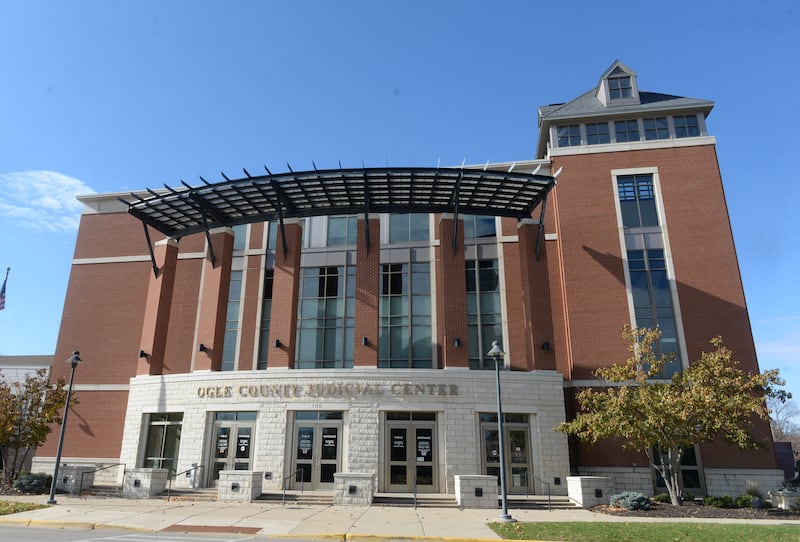
An Ogle County judge ruled Friday, Dec. 5, to suppress evidence seized during a 2024 search of a Woosung man’s home in part because police did not alert the court that the man had a medical cannabis card.
The decision prompted an immediate appeal by prosecutors.
Judge John “Ben” Roe announced his decision one month after hearing arguments from Joshua T. Anderson’s attorney, Mitchell Johnston of Sterling, that the search warrant issued in April 2024 was not proper.
Anderson, 40, was arrested April 10, 2024, after the Ogle County Sheriff’s Office Special Operations Unit executed a search warrant at his home in the 700 block of South Central Street in Woosung.
Police said they seized more than 46 pounds of cannabis with an estimated street value of more than $200,000 after what they described as a lengthy investigation.
Anderson is charged with unlawful possession with the intent to deliver more than 5,000 grams of cannabis, possession of 20 to 50 cannabis plants, and possession of less than 15 grams of a substance containing the painkiller tramadol. He has pleaded not guilty to all of the charges and has testified that he has a medical marijuana card and was growing the plants for his own use.
During a Nov. 5 Franks Hearing, Johnston argued that the warrant did not meet legal standards because the judge who issued it – Ogle County Judge Clayton Lindsay – was not told that Anderson was a medical cannabis-qualifying patient, which allows him to grow plants for his own personal use in his own residence.
A Franks Hearing is held to determine if a search warrant was issued based on sufficient evidence provided by officers who requested the warrant.
Johnston questioned whether the search warrant would have been issued if Lindsay had been aware of Anderson’s medical card that allows him to legally cultivate cannabis. Johnston argued that police had “improperly omitted information” when securing the warrant.
On Friday, Roe agreed, noting that other information given to Lindsay during the request for the search warrant was insufficient.
“I am granting the motion to suppress evidence obtained during the search,” Roe said.
On Nov. 5, Roe heard testimony from two Ogle County sheriff’s deputies and arguments from Johnston and Assistant State’s Attorney Matthew Leisten regarding the information given to Lindsay.
Deputy Joshua Lee and Lt. Michael Halfman – members of the Special Operations Unit – testified that the warrant was based, in part, on information from a confidential informant who said they smelled cannabis outside the home.
Halfman said that information – coupled with several weeks of surveillance by officers who observed a silver tent and bright light in the home, as well as fans in the windows and Facebook posts they said Anderson made regarding growing cannabis plants – prompted the request for the warrant.
Halfman testified that police learned that Anderson had a valid medical marijuana card during the investigation, but he was unsure when they learned that detail. Halfman said he would have put that detail in the affidavit if he had known about it before the search warrant was signed.
Under questioning by Leisten, Halfman said there was an “abundant smell of cannabis” coming from the home.
Johnston said Anderson could possess up to five plants and product from those plants, and he accused Halfman of “speculating” that Anderson was in violation of the Cannabis Control Act before the search warrant was issued.
Halfman said he believed it was “probable” that Anderson was growing more plants than allowed.
Johnston said the fact that Anderson had a medical marijuana card should have been provided to the judge before the warrant was approved and the omission of that information was done “recklessly or knowingly.”
Leisten argued that all the other information gathered by officers provided enough probable cause to justify the warrant. He said the omission of the medical marijuana card was not “reckless in regard to the truth.”
He argued that a medical marijuana card does not allow the defendant to grow an unlimited amount of plants and all the other information gathered by police showed a pattern of likely violations of the Cannabis Control Act. He said Anderson’s medical marijuana card only allows him to grow cannabis in his home for his own consumption.
Roe disagreed, ruling on Friday that other evidence presented to Lindsay – such as the Facebook posts – was not sufficient to issue the search warrant.
“That alone does not point to a crime,” Roe said. “It is obvious that knowledge of the medical card was essential.”
After Roe’s decision, Leisten immediately filed an appeal of the Franks Hearing and subsequent suppression of evidence arguing that Roe’s decision “substantially impairs the people’s ability to proceed at trial.”
Further hearings on the charges will not be held until an answer is provided by the appellate court.
Johnston then requested that some of Anderson’s additional pretrial conditions be reconsidered by the court.
“We have no objection to the general release conditions, but given that there is no future court date we are asking the court to reconsider the random drug testing and no alcohol conditions,” Johnston said.
Roe agreed and removed the random drug testing and no alcohol conditions from Anderson’s pretrial release conditions.
“The standard conditions will remain. I believe that is appropriate since the case is still pending on appeal,” Roe said. “There are no further court dates pending the appeal.”
Roe also agreed to appoint an appellate public defender for Anderson if the appellate court agrees to hear the case.
During Anderson’s April 24, 2024, preliminary hearing, Deputy John Shippert, a member of the Special Operations Unit for the Ogle County Sheriff’s Office, said 27 cannabis plants taller than 6 inches were seized during the search, as were vacuum bags, a bag sealer and scales. He said those items indicated to him that there was an intent to deliver the cannabis. He said ledgers also were found but not investigated.
Anderson testified at that hearing that he has had a medical marijuana card for at least eight years, and some of the plants were slated to be destroyed after the strongest ones were selected to complete their growing cycle.
Anderson said the ledgers kept track of his “cannabis consulting clients,” and all of the cannabis found was slated for his personal use.
:quality(70)/author-service-images-prod-us-east-1.publishing.aws.arc.pub/shawmedia/c70d24f0-1332-4244-8446-e91288029474.jpg)