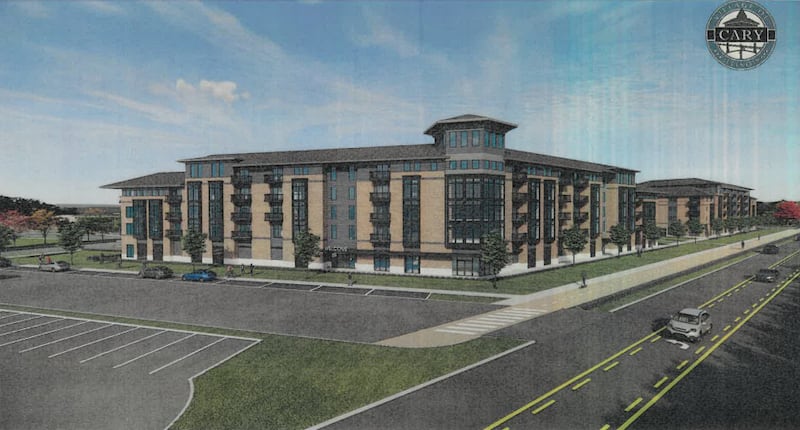
Developers looking to turn the former Maplewood School property in Cary into a multi- and single-family residential area will receive up to $12.35 million in tax increment financing funds as they formally enter a development agreement with the village.
The Village Board on Monday unanimously approved the redevelopment agreement that spells out exactly how much in TIF funds will go to the developers, who are looking to build more than 200 units of apartments and some owner-occupied homes along Krenz Avenue.
The total cost of the project is expected to be more than $94 million. In order to complete it in a “timely manner,” JM Developers said they need assistance from the Central Cary TIF District, according to village documents.
Developers asked the village for $12.35 million on a “pay-as-you-go basis solely from the incremental property taxes generated by the project,” according to village documents.
Throughout the life of the estimated 23-year TIF, which was established in 2023, the project is projected to provide total incremental property taxes of over $36.5 million.
The village is required by the state to set aside 42%, or about $15 million, of that income for potential impacts to school and library districts. The remaining amount would be divided equally between the village and developers – about $10.5 million each, according to development agreement.
:quality(70)/cloudfront-us-east-1.images.arcpublishing.com/shawmedia/BMIXFWCUUNC6FPCAY3AFJECBEM.png)
But it is expected that the project will generate fewer students than the required 42% for school and library districts to use the full amount, so additional dollars could be put toward developers and the village, Community Development Director Brian Simmons said.
Along with property taxes, the village will receive over $2.2 million in impact fees, a portion of which also will go to the school districts, park district and the Cary Fire Protection District, according to village documents.
The agreement, which Simmons said acts like a binding contract, spells out village costs for demolition work and storm sewer upgrades on School Street. Demolition of the long-shuttered school building is expected to happen this summer, Simmons said.
The village agreed to sell the property to developers for $1, according to village documents.
Developers will need to get zoning approval within 180 days, according to the agreement.
It has been a year since JM Developers first started negotiations with the village. Since then, open house meetings were held, and tweaks have been made to the plan following objections from some nearby residents, mainly over plans for multifamily residences. Plans were updated in June to include some owner-occupied single-family homes and a larger public park after many residents spoke out against the plans. However, residents’ concerns over density and building height remain.
The updated plan calls for 13 two-story, single-family homes; 15 two-story townhouses; eight duplex homes totaling 16 units; two five-story apartment buildings; and one four-story apartment building, totaling 236 apartment units.
:quality(70)/cloudfront-us-east-1.images.arcpublishing.com/shawmedia/XTQRQR2IXVF77BTRJ7G2Y5GC2E.jpg)
Apartments will range from studios to three bedrooms, according to village documents. Amenities include an outdoor pool, fitness center, indoor and outdoor working spaces, an entertainment kitchen, a dog park and a public park.
Residents at the Village Board meeting Monday continued to raise long-standing concerns about the impact that high-density rental units will have on the surrounding area. Some asked for the village to drop negotiations and find a developer who will build only owner-occupied homes.
“I can see why this is so appealing to the board,” resident Christy Wagner said. “There are millions and millions of dollars being tossed around here, and it’s a little overwhelming to hear all of this – to see what is projected for what has been a mainly residential area, [a] single-family home area.“
Wagner also raised concerns about whether enough funds will be distributed to the fire protection district and the police department with in influx of residents coming into the area.
The agreement that was approved by the board only lays out where TIF funds will go and other contractual obligations. Further details on exactly what will be built and what it will look like still will be up for approval by zoning commissioners and the Village Board.
“I want to stress that this is not final yet,” said Michael Poulakidas of Cordogan Clark & Associates and JM Developers.
Poulakidas said a “significant amount of professional analyses” were conducted for their proposal, including on the housing market, pricing and traffic.
“Taken together, these studies helped ensure this is not a speculative or rushed project on our part, but a well-informed and carefully considered development,” he said. “We recognize no project will ever please everyone, but we truly believe this plan reflects the best interest of Cary – the community as a whole – not just today but in the long term.”
In conjunction with the redevelopment of the school property, the planning stage of the adjacent Maplewood Road extension project continues. The new road would be an extension of Industrial Drive, running from Cary-Algonquin Road to High Road, parallel with Route 14 and south of the railroad tracks. Its aim is to improve mobility to downtown Cary.
The village is nearing the completion of the first of three phases of the road extension plan, with the next phase including land acquisition and plan preparation, which is expected to take about one year, according to the village website.
For next steps, developers will be heading to the Board of Zoning, Planning and Appeals this spring. If approved, construction could start this summer, while work on the new access road could start next year, with “substantial” project and road completion by Winter 2028, Simmons said.