Illinois vaccination rates among school children are holding steady, with most of the tracked immunizations showing slight increases from last year, according to new data released by the Illinois Department of Public Health and the Illinois State Board of Education for the 2025-26 school year.
IDPH notes that there are 11 required vaccinations that the state tracks records of year to year, including the Measles-Mumps-Rubella (MMR) vaccine, Polio, Chicken Pox, Hepatitis B, Meningitis and Pneumonia.
The data shared by IDPH in early May is based on reporting from 4,957 public and private Illinois schools covering grades K through 12. Data for each vaccine is split into three tiers of coverage per Illinois county: 95% or more students vaccinated, 90 to 94.9% vaccinated, and less than 90% vaccinated.
In order to achieve herd immunity for those who medically cannot receive a vaccine, at least 95% of the population should be vaccinated.
Overall, IDPH reported that “coverage rates for all school-required childhood immunizations are holding steady compared to last year, and all but one of those immunizations is above the state’s 95% coverage goal to optimize prevention of infectious disease spread.”
The meningococcal vaccine, which protects patients from meningitis – a potentially fatal brain and spinal cord infection – is the only tracked vaccine that is below 95%, with 94.4% of students statewide reported as vaccinated.
Unlike most vaccines on the list, the meningococcal vaccine has only been reported over the herd immunity threshold twice since 2014, in the 2018-19 and 2019-20 school years.
Across the board, vaccination rates for all 11 tracked immunizations have dipped since their pre-pandemic highs, though many have rebounded slightly in the past two years.
Since the compilation of the 2025-26 data, the State of Illinois has adopted the 2026 child and adolescent immunization schedule issued by the American Academy of Pediatrics for its school requirements, opposed to changes implemented at the federal level under the guidance of Health and Human Services Secretary Robert F. Kennedy Jr., who has repeatedly expressed vaccine-skeptical views.
“Across Illinois, families, schools, and public health partners are working together to keep children protected from preventable illnesses,” IDPH Director Dr. Sameer Vohra said. “The updated dashboard shows that school vaccination rates remain strong. Under Gov. JB Pritzker’s leadership and in partnership with the State Board of Education, IDPH is committed to ensuring that Illinois families have reliable, science-based information and easy access to vaccinations.”
Measles
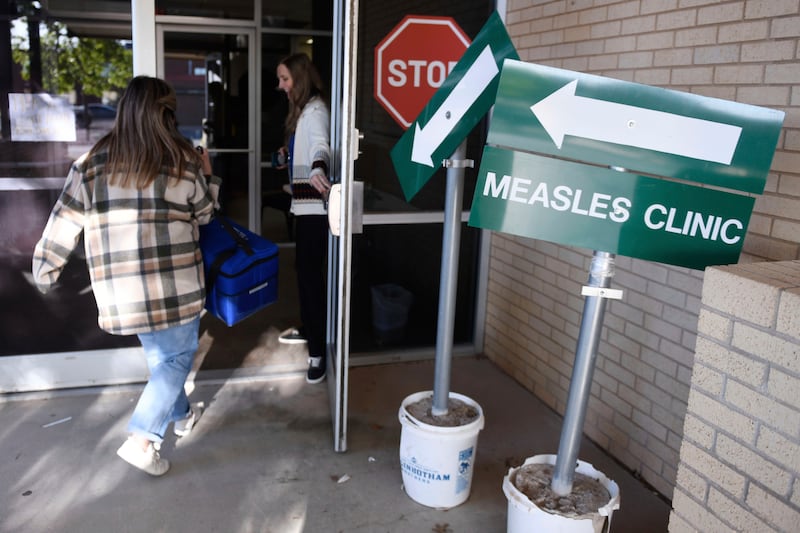
One of the most highly watched vaccination rates across the country is for measles, which, while tracked separately, is most commonly administered in a combination vaccine shot along with the vaccines for mumps and rubella.
The numbers for all three of these vaccines were identical across the state and were among the highest of any of the tracked vaccines, with 96.8% of students across 4,711 schools reportedly vaccinated. This is a slight increase from the last two year’s 96.5% vaccination rate, which was the low point of coverage since the 2014-15 school year.
Measles was declared eradicated in the U.S. in 2000, but cases have risen sharply in recent years amid declining vaccination rates and growing vaccine skepticism. 2025 saw the highest number of reported measles cases in the U.S. since 1991, with more than 2,200 infections. Three unvaccinated individuals in Texas also died from the illness. These deaths were the first measles fatalities in the U.S. since one occurred in 2015, and doubled the total number of American measles deaths since 2000.
Illinois pushed to increase measles vaccination rates in 2024 and 2025 following a non-fatal outbreak of 64 cases in the Chicago area in 2024.
In 2025-26, only nine counties fell below the 95% threshold. Four of those counties are in the rural southern tip of the state, including Pulaski County, the only county to fall below a 90% vaccination rate for MMR, with 87.7% of students reported as vaccinated.
While most of the state is over the herd immunity threshold, the numbers still are down from their pre-pandemic levels when MMR vaccination rates were consistently over 98%.
Other vaccines
Several other school-required vaccines in Illinois also remained above the 95% herd immunity threshold in 2025-26, although most continue to trail their pre-pandemic highs.
The Hepatitis B vaccine had the highest statewide coverage rate at 97.2%, while polio vaccinations reached 96.3% and chicken pox (varicella) vaccinations rose to 96.5%. All three rates increased or remained relatively stable from last year, according to IDPH data.
It is likely that the high rate of Hepatitis B vaccination stems from the shots being given to very young children, starting with newborns in the hospital.
Nine counties in Illinois and the City of Chicago did not meet the herd immunity level for polio vaccinations. Chicago is tracked separately from the northern and southern suburban portions of Cook County.
Chicago had a polio vaccination rate of 93.6%. Pulaski County was again the state’s only county below 90%.
Coverage for the DTaP vaccine, which protects against diphtheria, tetanus and whooping cough in younger children, reached 96.2%, while the Tdap booster for older students was slightly lower at 95.8%. Illinois officials reported a larger number of counties falling below the 95% threshold among older students receiving the Tdap booster.
Two vaccines aimed primarily at younger children, the Hib and pneumococcal vaccines, had far lower reporting rates because fewer schools administer or track them. Among schools that did report data, both vaccines exceeded the 95% threshold statewide for the first time since the pandemic-era declines.
Overall, 94.9% of schools reported at least some data to the ISBE by October 2025, which was included in the vaccination dashboard tool.
“Schools play a vital role in protecting the health and well-being of our students,” State Superintendent of Education Dr. Tony Sanders said in a statement. “The strong immunization rates reflected in this dashboard are the result of the dedication of school nurses, administrators, and families working together to maintain coverage that reduces disruptions to learning. The dashboard helps communities understand where we are succeeding and where we must continue to focus so every student can learn in a safe, healthy environment.”
The state passed a law in December 2025 to require state-regulated insurers in Illinois to cover vaccines recommended by IDPH under that plan, and to allow children to receive immunizations at pharmacies as adults can.