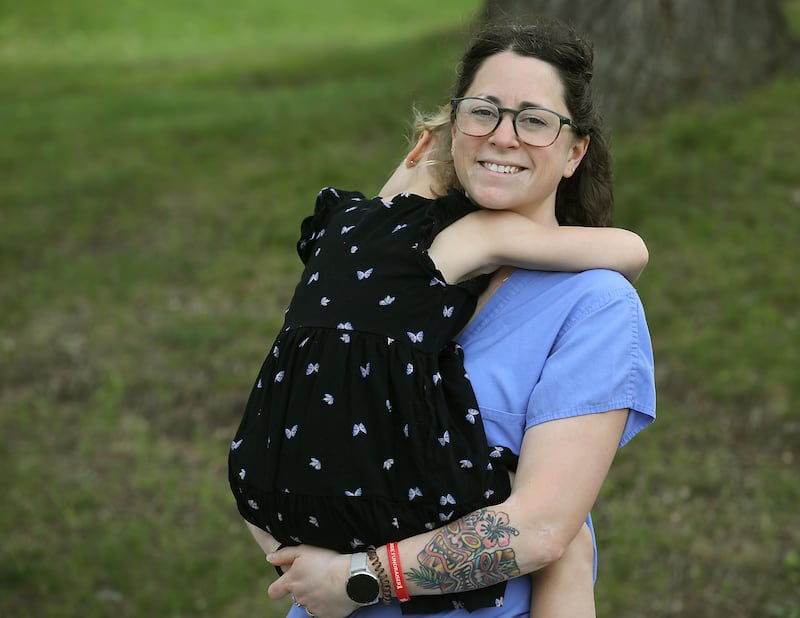
Kailee Schultz was seven months pregnant when a patient kicked her in the abdomen.
It was Feb. 17, 2021. Schultz was working the emergency room at Northwestern Medicine in McHenry when the patient, admitted for a mental health evaluation, struck her without warning. After being told that Schultz was pregnant, the patient kicked her again.
Schultz fell backward. “I was in shock, worried about my baby,” she testified later.
She told her colleagues she was fine. They disagreed, saying she was not fine.
Police were called. Schultz was sent to obstetrics for observation. Her baby was unharmed. But the incident cost her a shift’s pay and forced her husband to take time off work the next day.
For Schultz, the damage was deeper. It was not her first assault in six years of emergency room work. She had endured verbal threats, including a death threat. She had watched colleagues being attacked. And it had all gotten markedly worse since COVID-19.
“I come to this place to help people,” she recalled thinking.
Schultz’s experience is no longer an outlier. It is becoming routine.
According to a letter published in the American Hospitals Association in March 2022, urging the U.S. Department of Justice to protect healthcare workers from workplace violence “violence against hospital employees has markedly increased” since the pandemic began. “There is no sign it is receding.”
The data backs that up: 44% of nurses report experiencing physical violence, and 68% report experiencing verbal abuse during the pandemic, according to the letter.
Erin Price, vice president of nursing for OSF HealthCare Children’s Hospital of Illinois, said the surge has been unmistakable.
“We began to see a more noticeable surge during and after the COVID-19 pandemic,” Price said. “There was heightened stress, fear, and mistrust in healthcare, along with broader societal strain. Since then, we’ve continued to see higher acuity not just medically, but behaviorally and emotionally across all patient populations, including pediatrics.”
The International Council of Nurses has identified violence against healthcare workers as a key driver of what it calls “a significant increase in nurses’ migration or exodus from the profession altogether since 2021.”
These are among the key findings in a new report by the International Council of Nurses, warning of a deepening crisis in the global nursing workforce.
Schultz saw it firsthand. When she started nursing, she worked alongside nurses with 20 years of experience. There was camaraderie. “Sadly, this is no longer the case,” she said.
:quality(70)/cloudfront-us-east-1.images.arcpublishing.com/shawmedia/2YSGMQHDEVEMFMQK7UCUGFRYLI.jpg)
The hidden numbers
Violence against nurses is not new. What is new is the willingness to acknowledge it.
Price has more than 30 years of experience in nursing. She remembers being warned that being hit, verbally accosted, or threatened was simply part of the job.
That culture of silence meant assaults were underreported and normalized.
Schultz understands this firsthand. She said many assaults go unreported because the moment is chaotic, the job is demanding, and nurses feel “nothing will happen anyway.”
:quality(70)/cloudfront-us-east-1.images.arcpublishing.com/shawmedia/QHCY6GMFFJBBVKRRU2DGZJYDGI.jpg)
The official numbers reflect this gap. McHenry County Circuit Court Clerk Kathy Keefe reported that since 2023, just six cases with 10 charges of aggravated battery of a nurse have been filed in the county – a Class 3 felony.
But Price said hospitals have begun treating workplace violence as a patient and staff safety issue, not just an occupational hazard. They are now encouraging reporting and record-keeping.
“All of these efforts may make it seem like the numbers are increasing,” Price said. “But it may be more that the efforts in place are finally capturing the full picture.”
Hospitals are fighting back
Kristen Ramsey, Chief Nursing Officer at Northwestern Memorial Healthcare, which operates three hospitals in McHenry County, said keeping staff and patients safe is their “highest priority.” Ramsey acknowledges the increase nationwide, following COVID, of “incivility from people within hospitals.”
Price agreed that incivility and violence are problems in society at large, but hospitals have become ground zero.
“That doesn’t excuse the behavior,” she said, “but it helps explain why healthcare workers are increasingly on the front line of these societal challenges.”
Hospitals are adopting multiple strategies to prevent violence before it happens.
Risk assessments – long standard in psychiatric settings – now are spreading into emergency departments, medical and surgical units, clinics and home care. Hospital staff use these assessments to identify patients most likely to become violent and intervene early.
“The goal of risk screening and intervention programs are to be more proactive than reactive,” Price said.
Pediatric settings are increasingly incorporating behavioral risk assessments as well, recognizing that children may be dealing with developmental issues, trauma, or medical conditions that increase the risk of outbursts.
Northwestern Memorial Healthcare, which operates three hospitals in McHenry County, has implemented metal detectors, duress buttons, and reconfigured buildings to limit access. The system also has adopted a no-tolerance policy for disruptive patients and families. In some locations, Northwestern operates BEAT, a behavioral emergency response team that includes clinical and security staff.
Melinda Cooling, chief nursing and advanced practice provider executive for OSF HealthCare, said OSF has put in place policies to help patients, families, and visitors understand that staff safety is non-negotiable.
“OSF has put in place zero-tolerance policies to help patients, families and visitors understand that keeping our staff safe is important, as well,” Cooling said.
:quality(70)/s3.amazonaws.com/arc-authors/shawmedia/638ad18c-1176-4018-bcef-b5560cf36d58.png)